Familiar rivals. A division to climb. A title to defend
A league gives every match a place in a bigger story. You get to know your opponents, follow their results and compete for a position that takes more than one good evening to earn.
Organising one can be another matter. Conflicting diaries, postponed fixtures and players dropping out can turn a season into a scheduling exercise. More time goes into arranging matches than playing them.
In GamesGrid's single-player Career Mode, the virtual club members are ready when you are. You can concentrate on your next opponent and your place in the standings—not finding an evening when everybody is free.
Four leagues, five divisions of twelve. After every competition the top three go up and the bottom three go down.
Different leagues. Different match lengths
Each league has its own match length, giving you a different kind of challenge.
At the short end are single-point matches: one game, no doubling cube, and every decision counts towards an immediate result. At the longer end are matches with room to develop, where cube decisions and the changing match score give you more to consider—and more opportunities to recover from a difficult start.
Choose the format you enjoy, or compete across several leagues to test different sides of your game. Each has its own standings to climb, divisions to conquer and titles to pursue.
The rivals are the point
Over successive competitions, familiar names become rivals.
You learn who pushes the cube, who plays cautiously and whose style you find hardest to handle. You remember the member who beat you to promotion—and the one you narrowly kept behind you.
Some rivals climb alongside you. Others are waiting in the division above. A fixture against a familiar opponent starts to mean more than another result.
You are not just facing a rating. You are facing someone you have a record against.
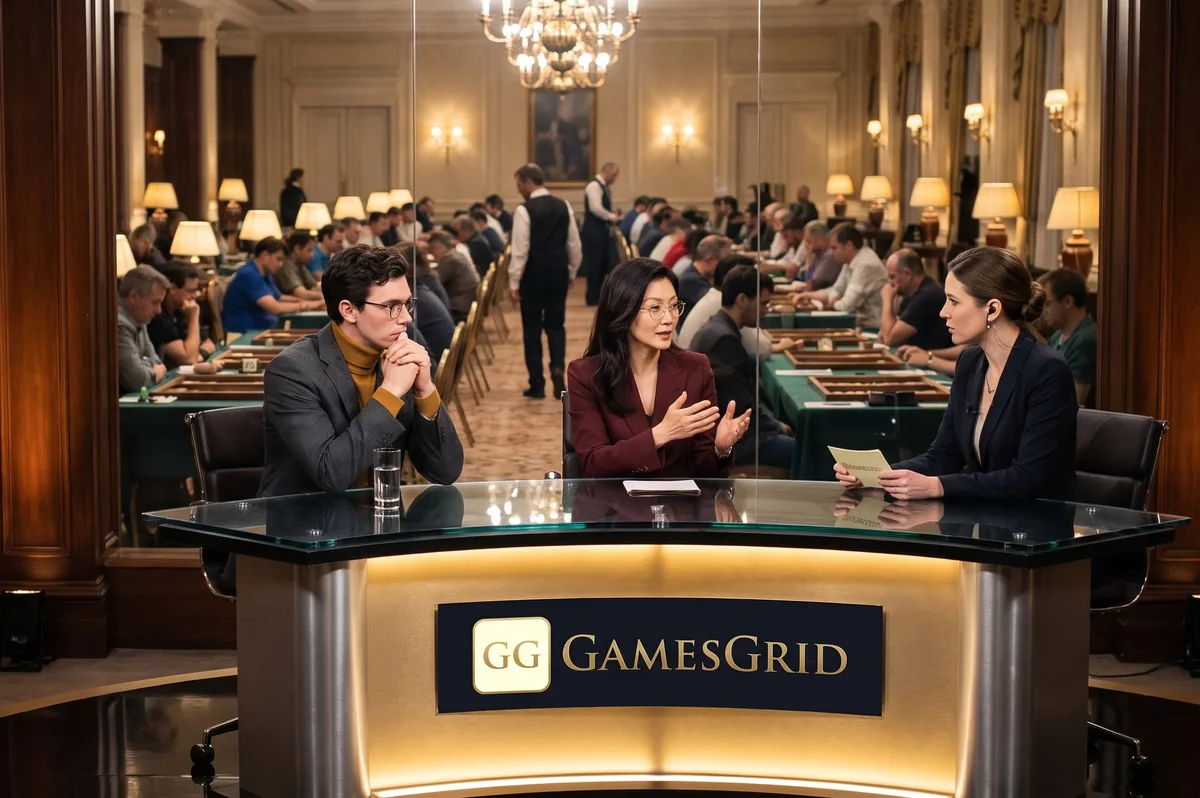
A league night. Familiar rivals, a full room, and a result that counts for the season.
Every match is really played
The other leagues and tournaments continue as you advance through your career, whether you enter them or not.
Members play their fixtures, standings change, champions are crowned and players move between divisions. Every result comes from a match played out by the game engine—not an outcome assigned from a table of odds.
You can follow the progress of members outside your own division and see who might become your next opponent.
The whole circuit moves forward with you. It does not move on while your game is closed.
Every league is divided into ranked divisions with a fixed number of players. Each competition is a round-robin: you play every other member of your division once, and every result counts towards the final standings, which decide the division champion and who moves up or down.
How do promotion and relegation work?
Whichever league you join, you start in its lowest division. Finish in the top three and you are promoted; reach the highest division and the league title becomes your target. Finish in the bottom three and you are relegated — unless you are already in the lowest division.
What happens if I skip a league fixture?
Advance past a competition you have entered without taking part and you lose your place: your seat goes to a waiting member and you start again in the lowest division. This only applies to choices within the career calendar — closing the game or taking a real-world break never costs you a fixture.
Why play a whole season instead of single matches?
A league asks you to build a record across a full competition. A defeat leaves work to do without ending your challenge; a difficult win can bring promotion back within reach. Winning a division gives you a title to defend, staying up is an achievement of its own, and going down gives you a reason to come back.
A new backgammon world is opening.
Imagine online backgammon as a living world, where you compete against over 500 unique personalities from 120 countries. Every member has their own character, life story, voice, playing strength and style. They compete in the same leagues and tournaments as you, build careers alongside yours and remember the matches, conversations and history you create together.
Learn who they are. Adapt to how they play. Earn their respect, make friends, create rivalries and become part of their story—because they will become part of yours.