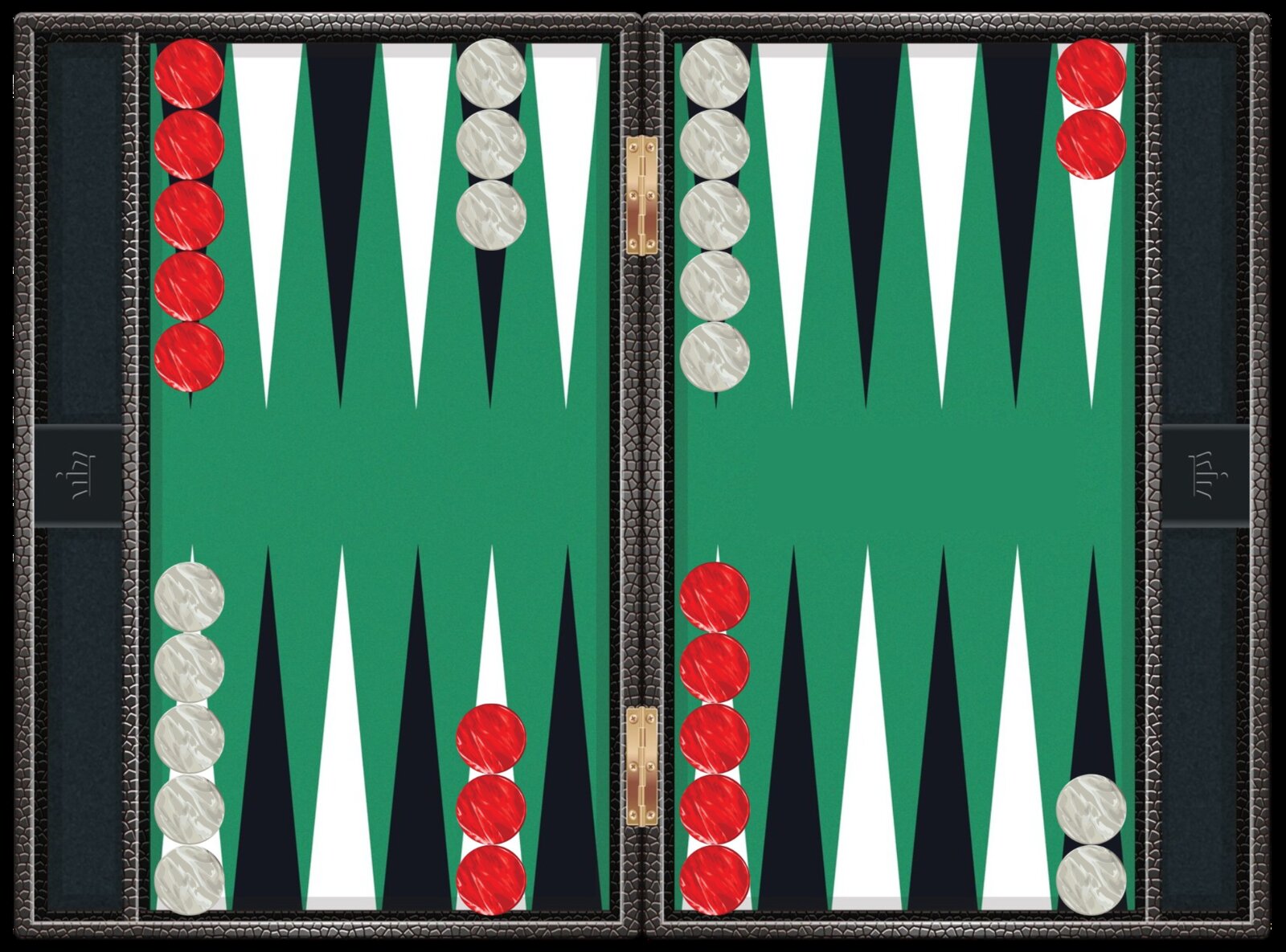
The standard backgammon setup has been mathematically stable for nearly three hundred years — codified by Edmond Hoyle in his 1743 Short Treatise on the Game of Back-Gammon and unchanged in international tournament play since. Each player begins with exactly 15 checkers distributed across four points on a 24-point board. The opening pip count is 167 for each side. The setup is symmetric: both players' starting positions are mirror images of each other.
This page is the step-by-step setup guide. For the complete game rules — movement, hitting, bearing off, the doubling cube — see the backgammon rules page. For regional variant setups (Tavla, Hypergammon, Nackgammon), see the linked sub-pages at the bottom.
The Board: What You're Looking At
A backgammon board is a long rectangular surface divided into four quadrants by a raised central bar. Each quadrant contains six narrow triangular points, giving a total of 24 points around the perimeter of the playing surface.
The four quadrants are:
Quadrant
Player's perspective
Contains points
Your home board
The quadrant nearest you, on one side
Points 1 through 6
Your outer board
The quadrant nearest you, across the bar from your home board
Points 7 through 12
Opponent's outer board
The far quadrant directly across from your outer board
Points 13 through 18
Opponent's home board
The far quadrant directly across from your home board
Points 19 through 24
The bar in the centre separates the home boards from the outer boards. Bearing-off trays sit on the edges of each player's home board.
Note on board orientation. Either side of the board can be designated as a player's home board — the convention is set at the start of play and is purely visual. Some boards have asymmetric inlays that suggest a fixed orientation; most do not. Either way, the setup itself is symmetric, so left-vs-right home board does not affect the position.
The Checker Placement: 15 Checkers in 4 Stacks
Each player places 15 checkers of their own colour on the board in the following arrangement. Reading the points from each player's own perspective, with point 1 in the corner closest to themselves and point 24 in the far corner across the board:
Point
Stack size
Where it sits
Strategic name
24-point
2 checkers
Far corner — opponent's home board
The back checkers
13-point
5 checkers
Middle of opponent's outer board
The midpoint
8-point
3 checkers
Player's outer board
Outfield point
6-point
5 checkers
Back of player's home board
Home-board point
Total: 2+5+3+5=15 checkers ✓
Standard backgammon starting position — 15 checkers per side, placed on the 24, 13, 8, and 6 points.
The opponent's setup is the exact mirror. If you look at the full board with both players' checkers placed, you'll see two stacks at each player's 24-point (the back checkers of each side), two stacks of five at each midpoint, two stacks of three at each 8-point, and two stacks of five at each 6-point.
Verifying the Setup: The Opening Pip Count
To confirm you've placed the checkers correctly, count your pip count — the total distance, in pips (board spaces), required to bring all 15 of your checkers around the board and bear them all off. From the standard starting position:
Opening pip count=(2×24)+(5×13)+(3×8)+(5×6)
=48+65+24+30=167
If your pip count comes out to anything other than 167, recheck your placement. The number is the same for both players from the symmetric starting position.
The Direction of Movement
Both players move their checkers around the board in opposite directions, from their own 24-point toward their own 1-point and off the board into their bear-off tray.
Player A (sometimes called the player on the bottom or "White") moves their checkers anti-clockwise around the board — from their 24-point through the 18-, 13-, 12-, 7-, 6-points and off.
Player B (the player on top or "Black") moves their checkers clockwise — from their 24-point through their own 18-, 13-, 12-, 7-, 6-points and off.
Each player numbers the points from their own perspective. Player A's 1-point is the same physical point as Player B's 24-point. This dual numbering is essential to remember when reading match notation — every move is written from the perspective of the player making it.
Standard 24-point board with central bar. Tournament boards are 18–22 inches wide.
Checkers
30 (15 per player)
Disc-shaped, distinct colours. Standard size: 1¼ – 1½ inch diameter.
Dice
4 (2 per player)
Two six-sided dice per player, used with a dice cup.
Dice cup
2 (1 per player)
Required for tournament play. Standard manufacture; no internal grooves that would manipulate dice landing.
Doubling cube
1
Six-sided die marked 2, 4, 8, 16, 32, 64. Placed in the centre of the bar at game start.
For casual play, the dice cup is sometimes omitted (dice are rolled by hand). For any rated, recorded, or money-play match, both players use cups.
Common Setup Mistakes
Five common errors made by new players or players relearning the game after a long absence:
Reversing the midpoint stack and the 8-point stack. The 13-point (midpoint) holds 5 checkers; the 8-point holds 3. New players sometimes flip this — it lowers the opening pip count from 167 to 157 and puts the wrong number of checkers on both points.
Placing 4 checkers instead of 5 on the 6-point. The 6-point is one of the two stacks of 5. Forgetting and placing only 4 creates a 14-checker position which becomes obvious within a few turns but is jarring.
Confusing the back checkers location. The 2 back checkers go on the 24-point (the far corner directly across the board from your 1-point, where you bear off), not on the 23- or 1-point.
Setting up on the wrong side of the board. When playing against a partner, both players need to agree which side is "Player A's" and which is "Player B's" before placing checkers. Both home boards must be on the same side of the board, facing each other; if one player sets up with the home board on the left and the other on the right, the position is wrong.
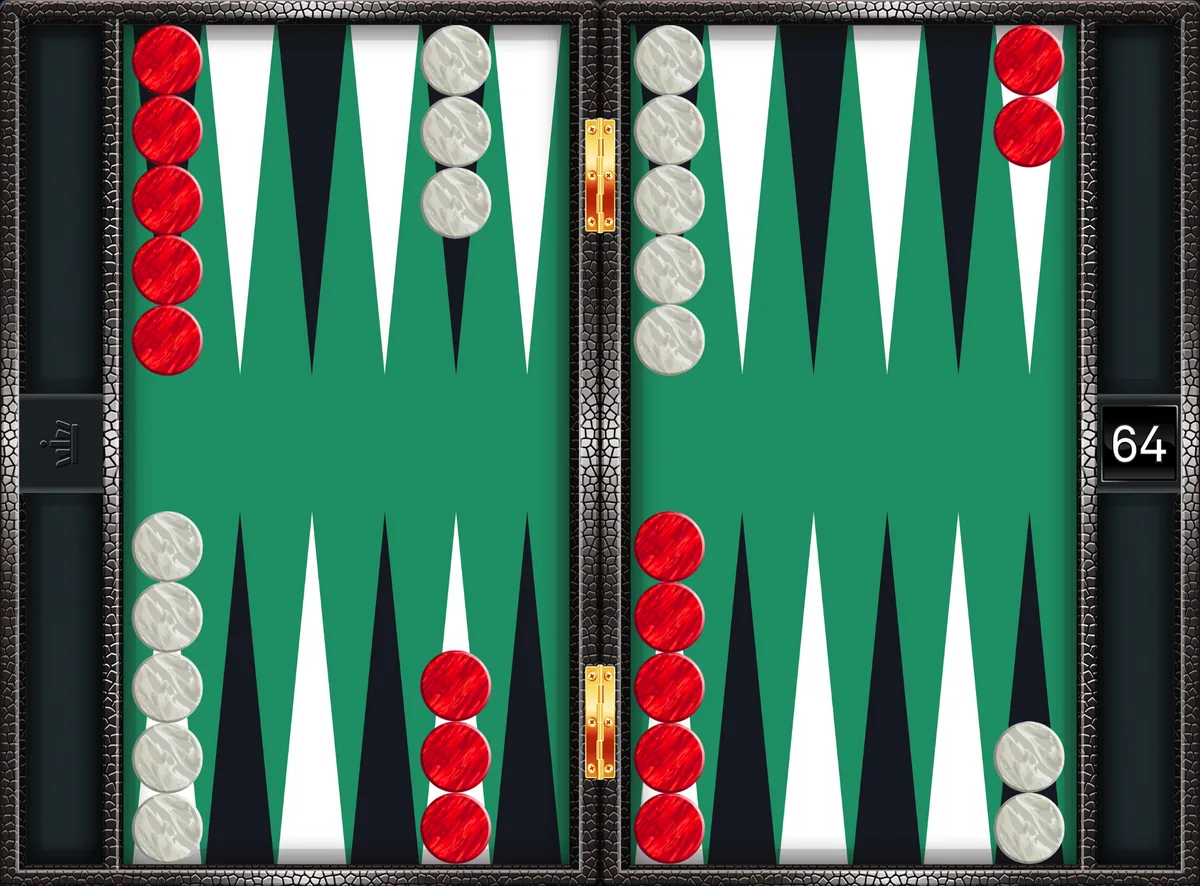
Forgetting the doubling cube. The doubling cube starts at the centre of the board, on top of the bar, showing the 64 face (representing the multiplier of 1 in the initial position). It is not placed in either player's tray.
Regional and Variant Setups
Several backgammon variants use different starting positions. Each is documented on its own setup page:
Tavla — Turkish backgammon. The everyday form (erkek tavlası) uses the same standard backgammon setup; uzun tavla and gül bara are no-hitting variants with different starting arrays.
Hypergammon — 3-checker speed variant. Each player starts with only 3 checkers on the 22-, 23-, and 24-points.
Nackgammon — Modern variant designed by Nack Ballard, with split back checkers on the 23- and 24-points to create more complex opening structures.
Takhteh — Persian backgammon (takhteh nard). The standard game uses the same setup as international backgammon; the page covers the Farsi vocabulary, Iranian rule conventions, and the Long Nardi variant.
For the Greek Tavli variants (Portes, Plakoto, Fevga), the Portes setup is identical to standard backgammon; Plakoto and Fevga have all-15-on-one-point setups documented in the backgammon rules page under "Regional Variants."
For the Russian Long Nardi setup (all 15 checkers on the 24-point, strict blocking, no hitting), see the backgammon rules page regional-variants section and the takhteh page for its Persian context.
After Setup: What Comes Next
With the board set up correctly, the first move is decided by each player rolling a single die. The higher number plays first, using the combination of both dice rolled as their opening move. If both dice show the same number, both players roll again.
For the complete movement rules, scoring (gammon, backgammon), doubling cube mechanics, and match-play conventions including the Crawford and Jacoby Rules, see the backgammon rules page. For the strategic priority of each opening roll, see opening moves. For backgammon's broader mathematical foundations including the 167 pip count, see the backgammon mathematics page.
Board Dimensions — every standard size, with the exact measurements and the proportion test.
A new backgammon world is opening.
Imagine online backgammon as a living world, where you compete against over 500 unique personalities from 120 countries. Every member has their own character, life story, voice, playing strength and style. They compete in the same leagues and tournaments as you, build careers alongside yours and remember the matches, conversations and history you create together.
Learn who they are. Adapt to how they play. Earn their respect, make friends, create rivalries and become part of their story—because they will become part of yours.