Every platform has an "about" page. This is not that. This is the documented thirty-year arc of GamesGrid Backgammon — one of the first dedicated online backgammon servers ever built, the home of the most famous bot family in the game's history, a cautionary tale about chasing the wrong boom, and, as of 2026, the game's most deliberate comeback. The deeper history of backgammon itself — the 5,000-year version — follows further down.
The Timeline
Dec 1996
GamesGrid Backgammon goes live — in the very first wave of internet board-game servers, four years after FIBS had proved real-time online backgammon possible.
1996–2004
The golden years: polished client, persistent ratings, structured tournaments and leagues — and the resident bot family (GG Forever, GG Raccoon, GG Beaver, GG Otter, GG Weasel, GG Chipmunk, GG Tutor and MrHyperBot) that became cultural figures. The bots play 2,000–4,000 matches a day.
1997–2008
Paul Magriel — world champion, author of the book on the game — operates his Xbot on the server as handle X22.
2000s
GamesGrid's resident bots run on GNU Backgammon, the free engine that first appeared in 1999.
2002
External measure of the era's strength: the GNU engine is publicly reported rated up to 2086 on GamesGrid — against the strongest online player pool of its day.
Apr 2005
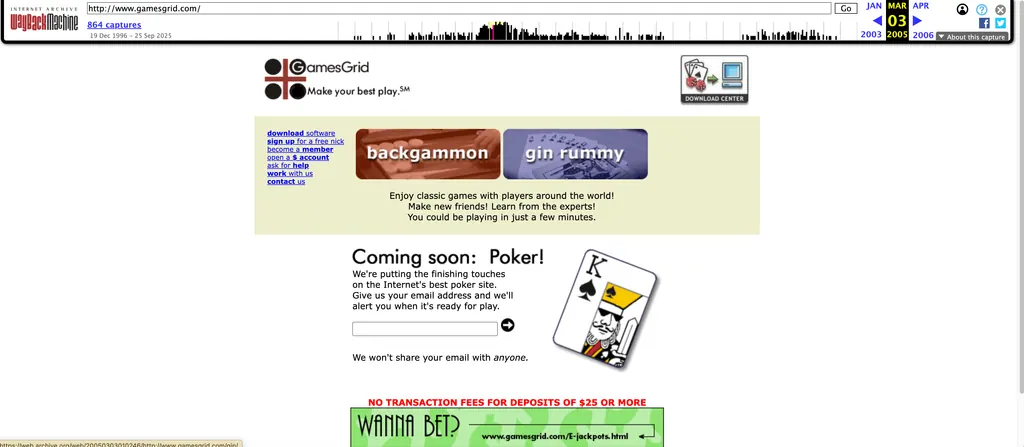
The poker detour: GamesGrid launches a poker product into the post-Moneymaker boom. The software can't compete with the giants; backgammon — the room that built the brand — is steadily neglected.
Mar 2008
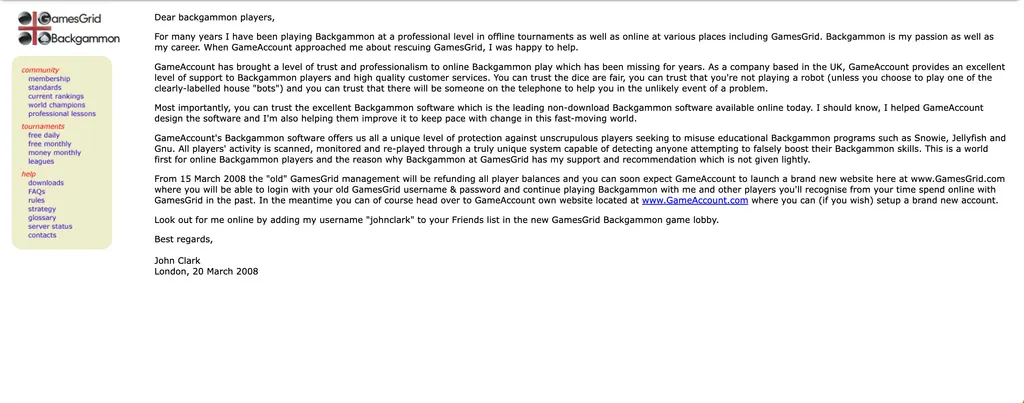
GamesGrid is acquired by GamesAccount. The new owners run the platform through 2008–2010.
~2010
The lights go out. For a decade, GamesGrid Backgammon exists only in archives, screenshots, and the memories of the community it made.
2020–2021
The domain comes up for sale and is acquired. The restoration begins: recovering the original site from archives, documenting the bots, rebuilding the record this page sits on.
2026
The Reopening. GamesGrid Backgammon returns — not a re-skin of the 2008 client, but a new platform built around competitive integrity: over 500 humanized AI players, full-strength analysis of every match you play, dice nobody sees in advance, and a club structure the original never had.
What Made the Original Matter
Plenty of servers carried backgammon in the late 1990s. What set GamesGrid Backgammon apart was a set of decisions that look ordinary now and were unusual then.
Match export was a first-class feature, not a favour. Every match could be taken off the server as a text file and fed into an analysis engine. That single design choice built a culture: a generation of players who reviewed every serious match against a neural net, argued about the results in public, and improved faster than any previous generation of backgammon players had. The shared vocabulary competitive backgammon still uses — error, blunder, equity lost — hardened on servers that worked this way.
The bots were characters, not difficulty settings. GG Weasel, GG Raccoon, GG Forever, GG Beaver, GG Otter, GG Chipmunk and MrHyperBot had names, reputations and known weaknesses. Beating GG Raccoon in a long session was a milestone you told people about. That is a fundamentally different product idea from a slider marked easy / medium / hard, and it is the idea the new platform scales up to over 500 players.
The player pool set the standard. A substantial share of the early-2000s competitive elite built their reputations on GamesGrid Backgammon, playing thousands of rated matches against each other and against the bots. When GammOnLine wanted an external measure of the GNU engine's strength in 2002, the number it reported was a rating earned on this server.
And the engineering is on the record in an unusual place. The bot family ran on the GNU Backgammon engine, and GNU's own official tutorial names one of them: GGRaccoon, running GNU 0.13 on a deliberately weaker setting so that it answered instantly, rated as high as 2165 against the strongest online pool of its era. GNU Backgammon also read GamesGrid's own save-game format — for years its importer was listed as “GamesGrid Save Game (.sgg)”. The full account is on the GNU Backgammon page.
The Lesson of 2005
In April 2005 GamesGrid launched a poker room into the post-Moneymaker boom. The reasoning was obvious at the time, and it was wrong. The poker client could not compete with PartyPoker or PokerStars on liquidity or features, and the attention it consumed came out of the room that had built the brand. Between 2005 and 2008 the backgammon product was starved of investment, the strongest players drifted away, and in March 2008 the company was sold. The lights went out around 2010.
2007: GamesGrid was a poker room. Backgammon had become one tab in the menu.
We tell that story on our own site because it is the reason the new platform is built the way it is: backgammon only, nothing else. No poker room, no casino portfolio, no adjacent vertical waiting for its own boom. A platform that neglected its core game once does not get to make that mistake twice.
The Record: 1996–2008, and 2021 Onward
The GamesGrid timeline, with the major inflection points:
Date
Event
December 1996
GamesGrid Backgammon launches. One of the first dedicated online backgammon servers in the world. Initial rooms also support Gin Rummy.
1997–2004
Backgammon room becomes the platform's flagship product. The resident bots — GG Forever, GG Raccoon, GG Beaver, GG Otter, GG Weasel, GG Chipmunk, GG Tutor and MrHyperBot — develop a player following. Tournaments and leagues run continuously across four categories (Daily Free, Monthly Free, Monthly Money, Leagues). GamesGrid becomes the largest closed-client backgammon server of its era.
April 2005
GamesGrid Poker launches, riding the post-Moneymaker poker boom. The poker client cannot compete with PartyPoker or PokerStars on liquidity or feature set. Internal product attention shifts away from backgammon.
2005–2008
The backgammon room is starved of investment. Long-time players begin to leave.
March 2008
GamesGrid is acquired by GamesAccount Network. The brand becomes a wrapped property.
2008–2010
GamesAccount operates the platform with diminishing engagement. The original community largely disperses across the surviving servers of that era. GamesGrid effectively ceases to function as a backgammon destination.
2010–2020
The domain lapses through a sequence of holders. The original codebase is lost.
2020
The gamesgrid.com domain comes up for sale.
2021
The domain is reacquired by its current owner. The original site is rebuilt from the Internet Archive's Wayback Machine snapshots as a historical reference.
2022–2025
New platform architecture, Career Mode design, and the bot roster are developed.
2026
GamesGrid Backgammon relaunches as a modern, integrity-first platform with zero coin-mechanic monetisation, dice nobody sees in advance, and an open analytical layer. A new Career Mode and an expanded bot cast are in development.
The GamesGrid arc, visually
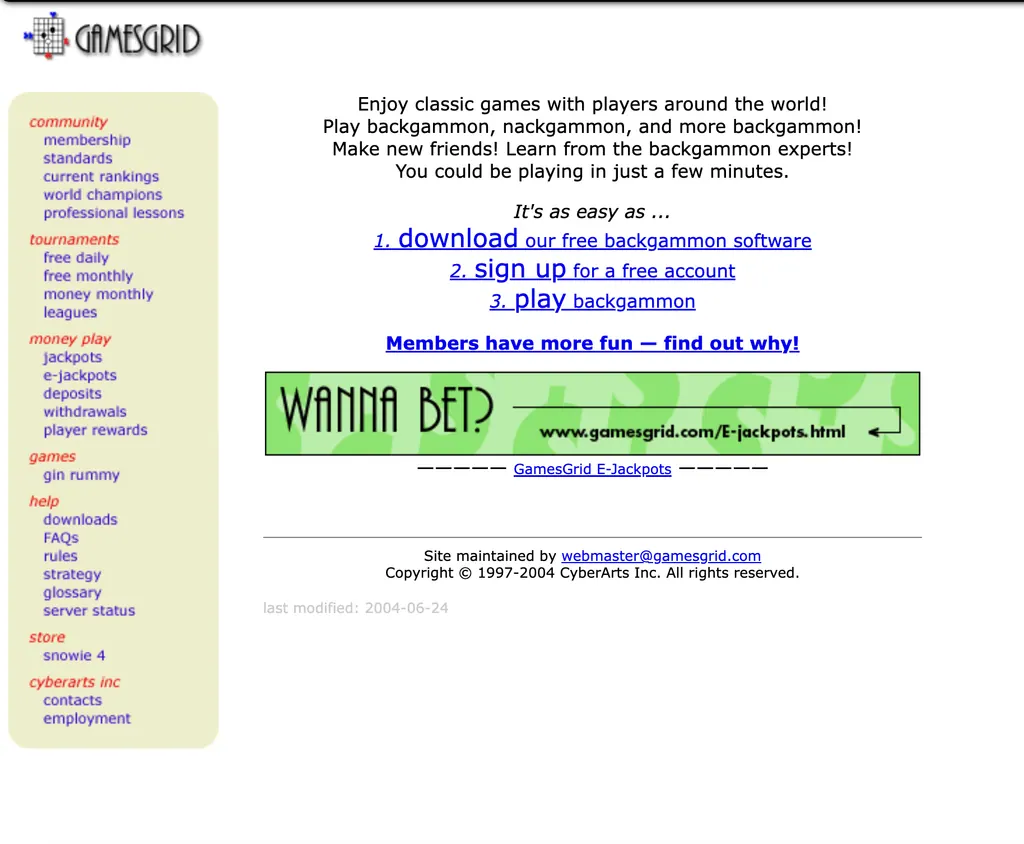
The website itself charts the platform's first decade. The 1996 site introduced GamesGrid Backgammon to its first generation of users; by the early 2000s the platform was the established home of online tournament backgammon; the 2005 poker launch marked the strategic pivot; by late 2008 the visible brand had narrowed; and the post-acquisition era brought a wind-down posture that closed the original chapter.
1996 — the GamesGrid Backgammon website at launch.Circa 2000 — the platform at the height of its backgammon era.April 2005 — the GamesGrid Poker launch announcement, the pivot that shifted platform attention away from the backgammon room.2008 — the site in its last GamesGrid-branded shape, around the March 2008 GamesAccount Network acquisition.2008–2010 — the post-takeover site, in wind-down operation. After this period the original GamesGrid effectively ceased as a backgammon destination.
Separately from the 2021 brand reacquisition, the original GamesGrid client software was continued by former community director Gabriella Barclay on a new server — GridGammon — which has operated as a small invitation-only platform since 2008–2009. The GridGammon project and the 2026 GamesGrid relaunch are unaffiliated.
The 2026 product is not a port. The original 1996–2008 client was a Java-and-Win32 application built against a server stack that is long gone. The new platform is a fresh implementation — modern client engineering, modern neural-net bot pipeline, modern integrity tooling — that inherits the original product philosophy and the original bot cast list rather than the original code.
What We Kept, What We Changed
We kept the idea of the bots, not the bots themselves. GG Forever, GG Raccoon, GG Beaver, GG Otter, GG Weasel, GG Chipmunk, GG Tutor and MrHyperBot belong to the 1996–2008 platform and stay there, documented on the GG family page. What their record made possible is calibration: the rating bands and strength tiers they left behind inform how the new cast — over 500 named members, each with a face, a country and a measured level of play — is tuned. The fuller picture of the members and Career Mode will be published closer to launch.
We kept the closed-client model — match data and ratings live on the server, not on the local machine, which means cross-device play and an auditable match history that no individual player can rewrite.
We kept the analytical transparency. Every match is recorded in the standard .mat format. Players can export to GNU Backgammon, XG, or any other tool that reads the standard format for independent post-game review. Player PR is the published rating, not a hidden internal score. The PR methodology is documented.
We changed the business model. The original GamesGrid drifted, after the 2005 poker pivot, into a friction-heavy tournament-entry economy. The new platform is being built on the opposite principle — no coin currency, no pay-to-win mechanics, no rake-disguised-as-membership. Membership and pricing details will be published closer to launch.
We changed the dice policy. The original server's roll generator was never publicly documented. The new platform states its policy in the open: nobody sees a roll in advance, every match is a record you can check, and when online play opens the server issues the dice. The contrast case is documented on Bots & AI — we name the servers that historically rigged their distributions.
GamesGrid Backgammon reopens as a club rather than a lobby. You join a living world of over 500 humanized AI players from 120 countries, each with a name, a face, a playing style and a career of their own. Every match you play is analysed the moment it ends by a full-strength engine that is never weakened for anyone, nobody sees a roll in advance and every match is a record you can replay, and nothing on the platform can be bought with a coin balance. What comes back from the original is the philosophy — named opponents with real character, open match export, integrity you can check yourself. What is new is the structure around it: leagues, seasons, and a club that keeps moving whether you are logged in or not.
The Game Itself: Five Thousand Years of Backgammon
Backgammon is the oldest board game in continuous play. The lineage runs unbroken from the Royal Game of Ur in Sumer, c. 2600 BCE, through Roman ludus duodecim scriptorum, medieval European tables, the Hoyle codification of 1743, the doubling-cube revolution of the 1920s, the Prince Obolensky world-championship era of the 1970s, and the online server boom that began in the early 1990s. What follows traces that arc through the three moments when the game's popularity exploded — the third of which is the one GamesGrid was founded in.
Origins: from Sumer to Hoyle
The archaeological record places the earliest direct ancestor of backgammon in the city of Ur, modern southern Iraq, where five game boards excavated by Sir Leonard Woolley between 1922 and 1934 date to approximately 2600–2400 BCE. The Royal Game of Ur is a race game played with four tetrahedral dice on a twenty-square board; the British Museum holds rule tablets in cuneiform from c. 177 BCE describing playable variants, written by the Babylonian scribe Itti-Marduk-balatu.
By the late Republic and early Empire, an evidently related family had spread across the Mediterranean. Tabula and the closely related ludus duodecim scriptorum (the "twelve-line game") used a thirty-piece board, two or three dice, and a hit-and-re-enter mechanic that survives substantially intact in modern backgammon. The Emperor Claudius (10 BCE – 54 CE) wrote a treatise on the game — now lost, but referenced by Suetonius — and travelled with a custom board built into his carriage.
The medieval European descendant was simply called tables. It is the tables of Chaucer and Caxton. The modern name "backgammon" first appears in English in the 17th century, attested in James Howell's Familiar Letters (1645) and in Francis Willughby's manuscript Volume of Plaies (c. 1672). The rules were codified by Edmond Hoyle in A Short Treatise on the Game of Back-Gammon (London, 1743), which remained the standard English-language reference for almost two centuries.
The parallel Eastern tradition is just as old. Nard is documented in Sasanian Persia by the 6th century CE — the Vizārišn ī Čatrang ud Nihišn ī Nēw-Ardaxšīr describes its invention as a counter to chess. The Persian game survives today as takhteh (takhteh nard), still one of Iran's most-played games. Tavla in Anatolia and Tavli in Greece descend from the same family. The Greek game is uniquely played as a match of three games in rotation: Portes (standard backgammon with an opening re-roll and no cube), Plakoto (in which a checker landing on a single opposing piece pins it rather than hits it), and Fevga (no hitting, no doubling, all entry on the same side). In Russia and the Persian-speaking world the game is Nardi: short nardi corresponds to modern backgammon, long nardi has a different starting setup and a no-hit rule.
This is the lineage GamesGrid is part of. Five thousand years. Continuous play.
The first hype: New York, 1920–1940
The single largest rule change in the modern era was not invented in antiquity but in a Manhattan club between 1925 and 1928. The doubling cube — a six-sided die marked 2, 4, 8, 16, 32, 64 that lets either player propose to double the stakes, with the opponent's option to accept or concede — was introduced anonymously, but the consensus attribution to "an unknown New York player, c. 1925" is supported by Oswald Jacoby and John Crawford in their The Backgammon Book (1970). The cube transformed backgammon from a folk race game into a piece of formal decision theory. Every modern equity calculation, from Janowski's cube-action formula to the rollout engines inside GNU Backgammon and eXtreme Gammon, exists because of that one cubic die.
The 1920s and 1930s were the game's first commercial boom. The major American newspapers ran weekly columns. Backgammon was the after-dinner game of the Vanderbilts, the Astors, and the Whitneys; English country houses and Côte d'Azur hotels stocked custom inlaid boards. The first American National Championship was organised in 1931.
The Depression and World War II flattened the social scene that supported it, and from the late 1940s through the mid-1960s backgammon survived primarily as a club game and a serious gambling pursuit in a small handful of cities — Paris, Monte Carlo, Beirut, New York.
The second hype: Las Vegas and Studio 54, 1970–1985
The second boom began with one man. Prince Alexis Obolensky — Russian émigré aristocrat, hotelier, and tournament organiser — staged the first major international backgammon invitational at the Lucayan Beach Hotel in Freeport, Bahamas, in March 1964. Three years later, the first event explicitly carrying the title "World Championship" was held at the Sands Hotel in Las Vegas in 1967, won by Tim Holland. From 1976 the World Championship moved to Paradise Island in the Bahamas, and in 1979 to Monte Carlo, where it has been held ever since. Obolensky's Backgammon: The Action Game (1969, with Ted James) became a bestseller.
The cultural moment was extraordinary. Backgammon was the in-game at Studio 54 in late-1970s New York. Hugh Hefner's Playboy Magazine published a dedicated backgammon column. Paul Magriel — a strong amateur chess player turned backgammon analyst — wrote a weekly column for the New York Times (1977–1980) and published Backgammon (1976), the single most influential strategy book ever written on the game and still the canonical reference for positional play. The 1975 World Championship in Las Vegas drew prize pools comparable to high-stakes poker.
This era also produced the formal mathematics that the modern competitive scene still uses. Émile Borel had laid the game-theoretic foundations in Théorie des jeux et les équations intégrales (1921). Edward Thorp — the same statistician who'd written Beat the Dealer — applied formal probability to the doubling cube in a 1978 paper on bearoff equities. William Robertie won the World Championship in 1983 and 1987 and authored the Modern Backgammon and Advanced Backgammon trilogy, which formalised the theory of efficient and inefficient doubles.
By the mid-1980s the casino-glamour wave had receded, but the analytical infrastructure was now in place: a working tournament circuit, a publishing canon, and a body of mathematics ready to feed the next, far larger wave.
The third hype: online, 1992–present
The internet era of backgammon began in July 1992, when Andreas Schneider launched the First Internet Backgammon Server (FIBS) on a university workstation in Germany. FIBS introduced an ELO-style rating system specifically adapted for backgammon's variance, supported live human-versus-human play in real time across continents, and — crucially — produced the first downloadable match-log format that could be fed into analytical engines.
The first of those engines, Jellyfish, was released by Fredrik Dahl in 1994. It was a neural network in the lineage of Tesauro's TD-Gammon (IBM Research, 1992) — the first program of any kind to demonstrate self-play reinforcement learning at superhuman level on any complex game. Jellyfish was followed by Snowie in 1998, GNU Backgammon in the early 2000s (the open-source standard), and eXtreme Gammon (XG) in 2009, which remains the world reference today. Modern PR ratings — the universal currency of competitive skill measurement — are calibrated against XG's evaluations. The full engine timeline is on the Bots & AI page.
Onto that infrastructure came the commercial servers.
Free community site for displaced portal players; still active.
2014+
Various mobile-first operators
Predominantly coin-mechanic models.
Alongside the live servers ran two quieter strands: Motif Backgammon put a playable board in the 1996 web browser, and DailyGammon still carries the correspondence tradition today. Each platform in the table has its own history page in this encyclopedia.
This is the era in which GamesGrid was founded, operated, was acquired, went dark, and is now being relaunched.
Frequently asked questions
Short, direct answers to the most-searched questions about backgammon's origins. The full archaeological and literary trail is in the sections above.
Where did backgammon originate?
Backgammon originated in ancient Mesopotamia, specifically the Sumerian city of Ur in modern southern Iraq. The earliest direct ancestor — the Royal Game of Ur — is dated to roughly 2600–2400 BCE on the basis of five game boards excavated by Sir Leonard Woolley between 1922 and 1934. The unbroken evolutionary line runs from the Royal Game of Ur through Roman ludus duodecim scriptorum, medieval European tables, and the 18th-century Hoyle codification, to the modern game.
How old is backgammon?
Backgammon is approximately 5,000 years old. Its direct ancestor, the Royal Game of Ur, dates to 2600–2400 BCE, which makes it the oldest board game still played continuously today. The modern English name backgammon first appears in writing in 1645 in James Howell's Familiar Letters, and the modern rules were codified by Edmond Hoyle in his Short Treatise on the Game of Back-Gammon in 1743.
When was backgammon invented?
The earliest known form of backgammon — the Royal Game of Ur — appeared in Mesopotamia around 2600–2400 BCE, so the game was effectively invented about 4,600 years ago. The modern rules with the doubling cube are a 20th-century evolution: the doubling cube itself was introduced anonymously in a Manhattan club between 1925 and 1928, with the consensus attribution to "an unknown New York player" recorded by Oswald Jacoby and John Crawford in The Backgammon Book (1970).
Who invented backgammon?
No single person invented backgammon. The game is the product of a continuous five-thousand-year evolution rather than a single act of creation. Sumerian players developed the Royal Game of Ur in the 26th century BCE; Roman players added the 24-point race-track-with-bar layout in tabula (alea), the successor of ludus duodecim scriptorum; Edmond Hoyle codified the modern English rules in 1743; and an unknown New York player introduced the doubling cube around 1925 — the single biggest rule innovation of the modern era and the change that turned backgammon from a folk race game into a piece of formal decision theory.
What country did backgammon originate in?
Backgammon originated in the country we now call Iraq — specifically the ancient Sumerian city of Ur, in southern Mesopotamia. From Sumer the game spread along two routes: westward through the Eastern Mediterranean into Roman tabula and medieval European tables, producing the line that ends in modern international backgammon; and eastward into Sasanian Persia, where it became Nard (and subsequently Tavla in Anatolia, Tavli in Greece, Nardi in Russia and the Persian-speaking world).
Where We Are in the Larger Story
A 5,000-year-old game is in its third online boom. The infrastructure that the FIBS-era and GamesGrid-era servers built — open match formats, neural-network analysis engines, public rating systems, world-class published theory — has matured to the point where every serious player can review every move against a world-class oracle for free. Backgammon is in a stronger position than it has been since the Studio 54 years.
GamesGrid is coming back. The thirty-year arc continues.
See Also
How to Play Backgammon — the beginner's guide: the rules in plain language, in fifteen minutes.
Board Setup — step-by-step placement of all thirty checkers, and the variant setups.
Sources
Royal Game of Ur excavations: Woolley, L. Ur Excavations: The Royal Cemetery (1934). The c. 177 BCE Itti-Marduk-balatu rule tablets are catalogued as British Museum 33333a/b.
Howell, J. Epistolae Ho-Elianae: Familiar Letters Domestic and Forren (1645). Willughby, F. Volume of Plaies, c. 1672, ed. Cram, Forgeng & Johnston (Ashgate, 2003).
Hoyle, E. A Short Treatise on the Game of Back-Gammon (London, 1743).
Jacoby, O., and Crawford, J. The Backgammon Book (Viking Press, 1970), Chapter 3 — origin of the doubling cube.
Magriel, P. Backgammon (Times Books, 1976). New York Times column 1977–1980.
Robertie, B. Advanced Backgammon (Gammon Press, 1991); Modern Backgammon (Gammon Press, 2001).
Thorp, E. Backgammon: The Cube in the Money Game. Gambling Times, 1978.
Tesauro, G. Temporal Difference Learning and TD-Gammon. Communications of the ACM, 38(3), 1995, pp. 58–68.
FIBS: Andreas Schneider, July 1992. The server's operational status as of 2026 is unclear; see the backgammon FIBS page.
GamesGrid Inc., December 1996 – March 2008 (independent); 2008–2010 (GamesAccount Network); domain reacquired 2021.
A new backgammon world is opening.
Imagine online backgammon as a living world, where you compete against over 500 unique personalities from 120 countries. Every member has their own character, life story, voice, playing strength and style. They compete in the same leagues and tournaments as you, build careers alongside yours and remember the matches, conversations and history you create together.
Learn who they are. Adapt to how they play. Earn their respect, make friends, create rivalries and become part of their story—because they will become part of yours.