The complete, formal rules of backgammon as played in international tournament competition. This page covers the standard international ruleset, the doubling cube, match-play conventions including the Crawford and Jacoby rules, and the principal regional variants — Greek Tavli (Portes, Plakoto, Fevga), Turkish Tavla, and Russian/Persian Nardi.
New to the game? Start with the backgammon beginner's guide — same content in plainer language, in about fifteen minutes. This page is the reference; the beginner's guide is the on-ramp.
Each player begins with fifteen checkers distributed across the board. The object is to move all fifteen of one's own checkers around the board into one's home board (the quadrant nearest oneself) and then bear them off — remove them from the board entirely — before the opponent does the same.
The two players move in opposite directions. White (sometimes called "the player on the bottom") moves anti-clockwise; Black (the player on top) moves clockwise. The board is read from each player's own perspective, with points numbered 1 to 24 starting from the player's own bear-off corner.
Equipment
Item
Quantity
Notes
Backgammon board
1
24 narrow triangular points, 12 per long side. A central bar divides the board into two halves of 12 points each, forming four quadrants of 6 points.
Checkers
30 (15 each)
Disc-shaped pieces. One colour per player. Standard tournament checkers are 1¼ to 1½ inches in diameter.
Dice
4
Two dice per player, used with a dice cup. Tournament rules require dice to land flat in the right-hand quadrant of the board to be valid.
Dice cup
2
Required for tournament play. Cups must be of standard manufacture to prevent dice manipulation.
Doubling cube
1
Six-sided die marked 2, 4, 8, 16, 32, 64. Tracks the multiplier on the game's stake.
Tournament boards are typically 18 to 22 inches wide on the playing surface. The standard checker count and the geometry of the four-quadrant board have been stable since the 17th century and codified in English by Edmond Hoyle in his 1743 treatise.
The Starting Position
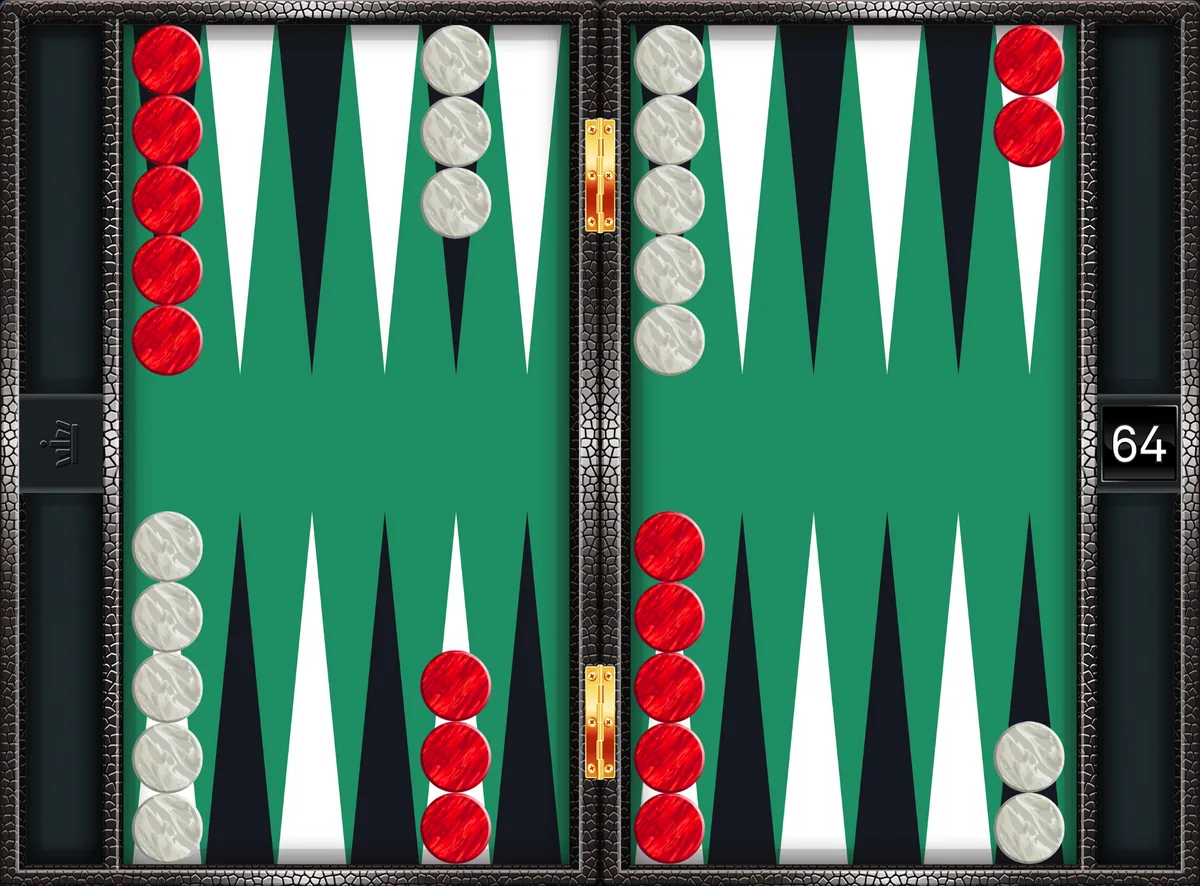
The fifteen checkers are placed in a fixed starting position. The summary table below gives the standard arrangement; for a step-by-step setup walkthrough with visual diagrams and common-mistakes notes, see the dedicated backgammon setup page.
Reading each player's board from their own perspective (with the 1-point in the right-hand corner nearest themselves, and the 24-point in the far right-hand corner, directly across the board from it, in the opponent's home board):
Standard backgammon starting position — 15 checkers per side, placed on the 24, 13, 8, and 6 points.
Point
Number of checkers
Quadrant
24-point (opponent's 1-point)
2
Opponent's home board
13-point (own midpoint)
5
Opponent's outer board
8-point
3
Own outer board
6-point
5
Own home board
Total: 2+5+3+5=15 checkers.
The position is mirrored exactly for the opponent. The opening pip count — the total pips required by each player to bring all checkers home and bear them off — is 167 for both sides at the start of the game.
The named points have specific strategic identities. The 6-point is the back wall of the home board; the 8-point is a critical structural point in the outer board; the 13-point is the midpoint; the 5-point is the Golden Point; the 7-point is the bar point; the 24-point holds the two back checkers.
The First Move and Subsequent Turns
To start the game, each player rolls one die. The higher number plays first, using the combination of both dice that were rolled. (If both dice show the same number, both players roll again.) Thereafter, players alternate, rolling both dice from a cup onto the right-hand quadrant of the board.
Movement rules:
The two numbers on the dice are played as two separate moves. A roll of 5-3 may be played as a single checker moving 8 pips, or as two checkers moving 5 and 3 pips respectively — but the 8-pip total must consist of a legal 5-step followed by a legal 3-step (or vice versa) with an intermediate stop on a legal point.
Doubles are played as four moves of that number. A roll of 4-4 = four moves of four pips.
A move is legal if it lands on:
An open point (a point with no checkers, or with the player's own checkers, or with exactly one opposing checker).
An occupied own point (already held by two or more of the player's checkers).
A point held by two or more opposing checkers is closed — the player cannot land there.
Landing on a point held by exactly one opposing checkerhits that checker, sending it to the bar.
All dice must be played if legally possible. If only one of the two dice can be played, the player must play that die. If neither can be played, the turn is forfeited. If the player can play either die alone but not both, the higher must be played.
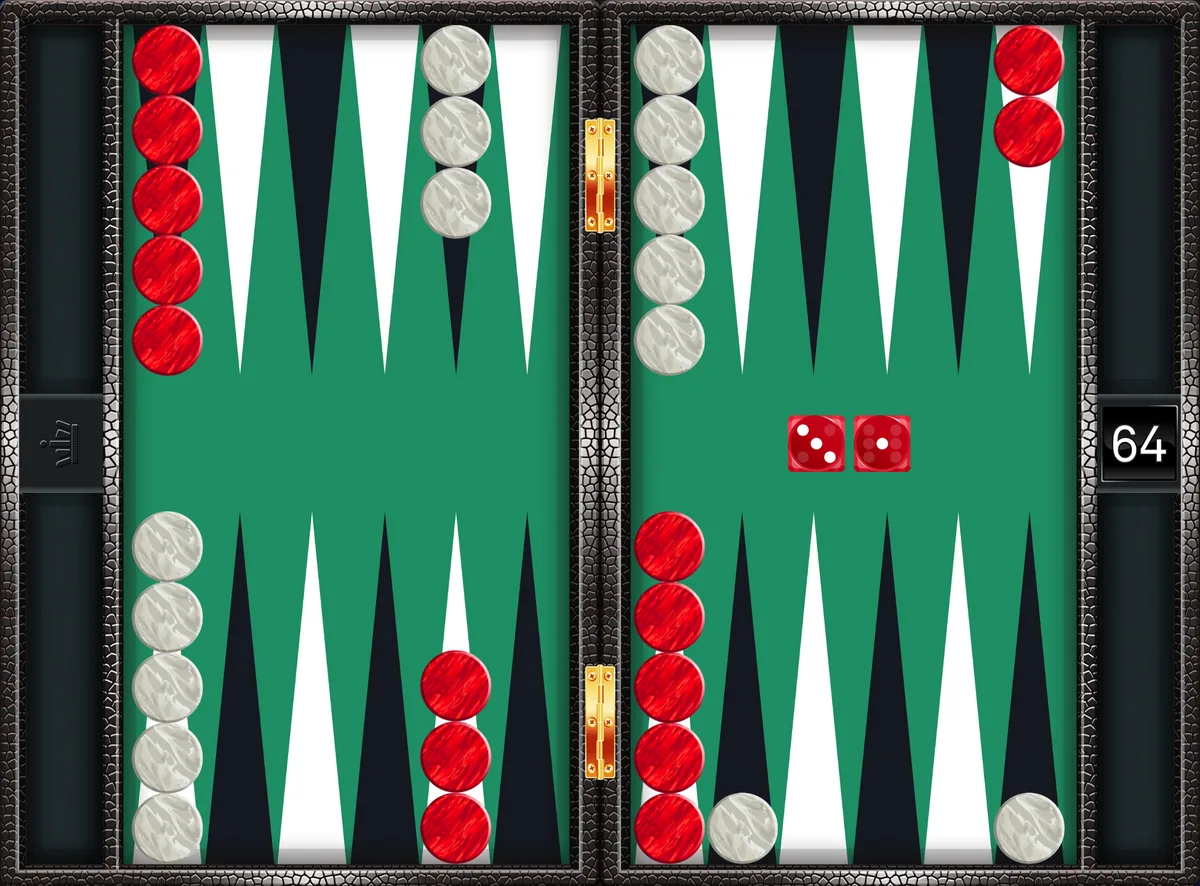
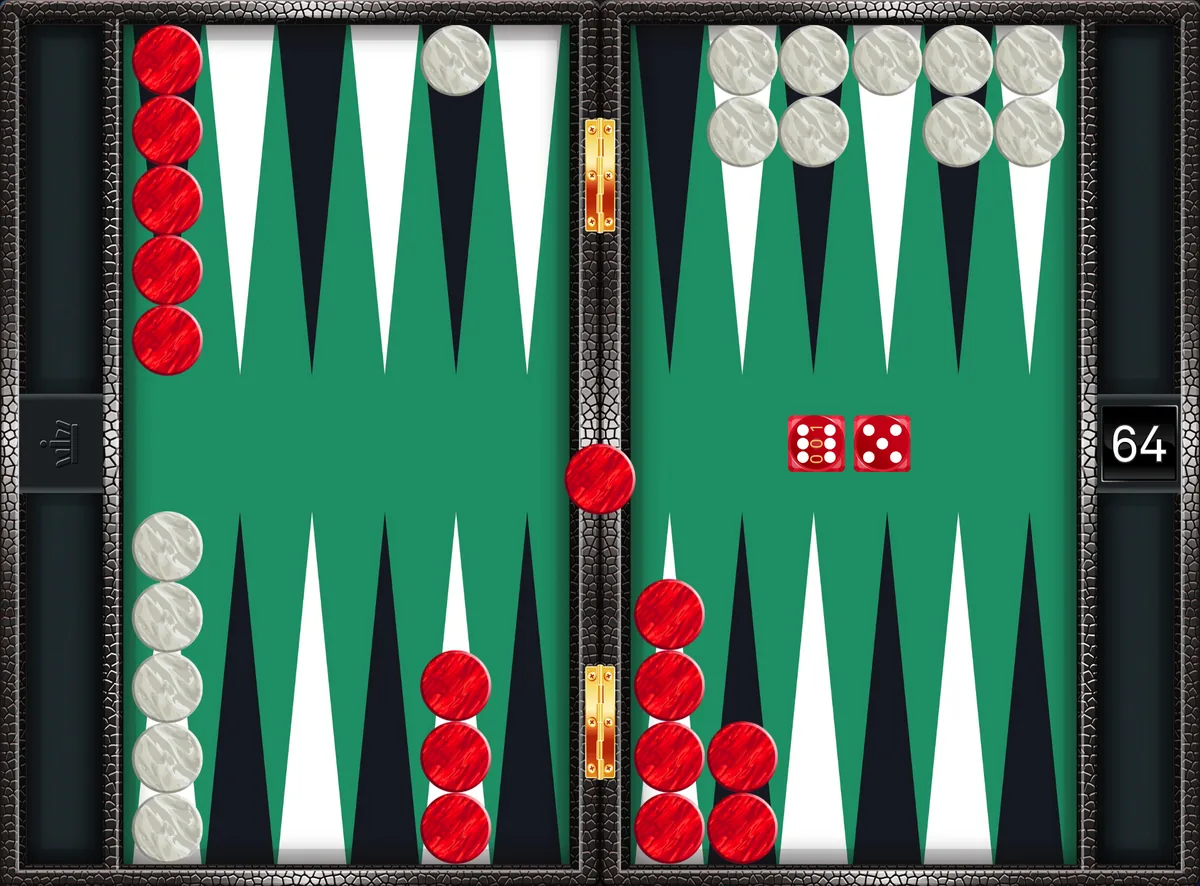
A blot under fire. White's lone checker sits on red's 5-point; red rolls 3-1 and can hit it while making the golden point (8/5, 6/5).
The Bar and Re-entry
A checker that has been hit is placed on the bar. While a player has any checker(s) on the bar, that player cannot move any other checker until every bar checker has re-entered the board.
Re-entry occurs through the opponent's home board (the player's own 19- through 24-points), corresponding to the dice rolled. A roll of 5-2 allows re-entry on the 5-point or the 2-point of the opponent's home board, depending on which is open.
If the opponent's home board has all six points closed (a closeout), the player cannot re-enter and forfeits the turn until a point opens.
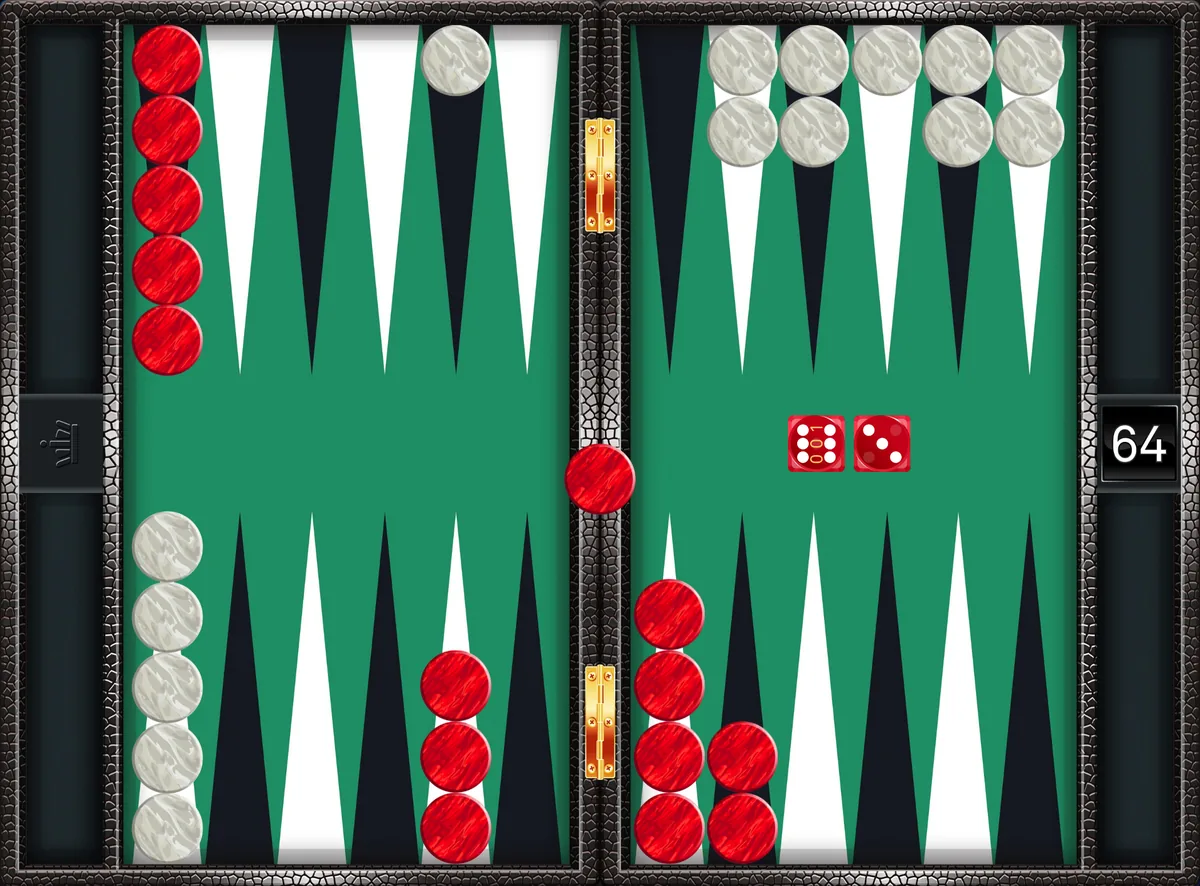
Re-entry from the bar. Red rolls 6-3: the 3 enters by hitting the blot on the 22-point; the 6 enters on the open 19-point.The closed board. Red owns every home point; the white checkers on the bar cannot enter until a point opens.
Bearing Off
Once a player has moved all fifteen checkers into their own home board (the 1- through 6-points), they may begin bearing off — removing checkers from the board entirely. Rules:
A die value of n bears off a checker from the n-point.
If no checker occupies the n-point but checkers exist on higher points, the die must be used to move a checker; it cannot bear off from a lower point unless no checker exists on any higher point.
If the die value is higher than the highest occupied point, the die bears off the checker from the highest occupied point.
A checker that has been hit during the bear-off must re-enter through the opponent's home board and travel all the way around again before bearing off can resume.
The first player to bear off all fifteen checkers wins the game.
GamesGrid is coming back and you can be part of it.
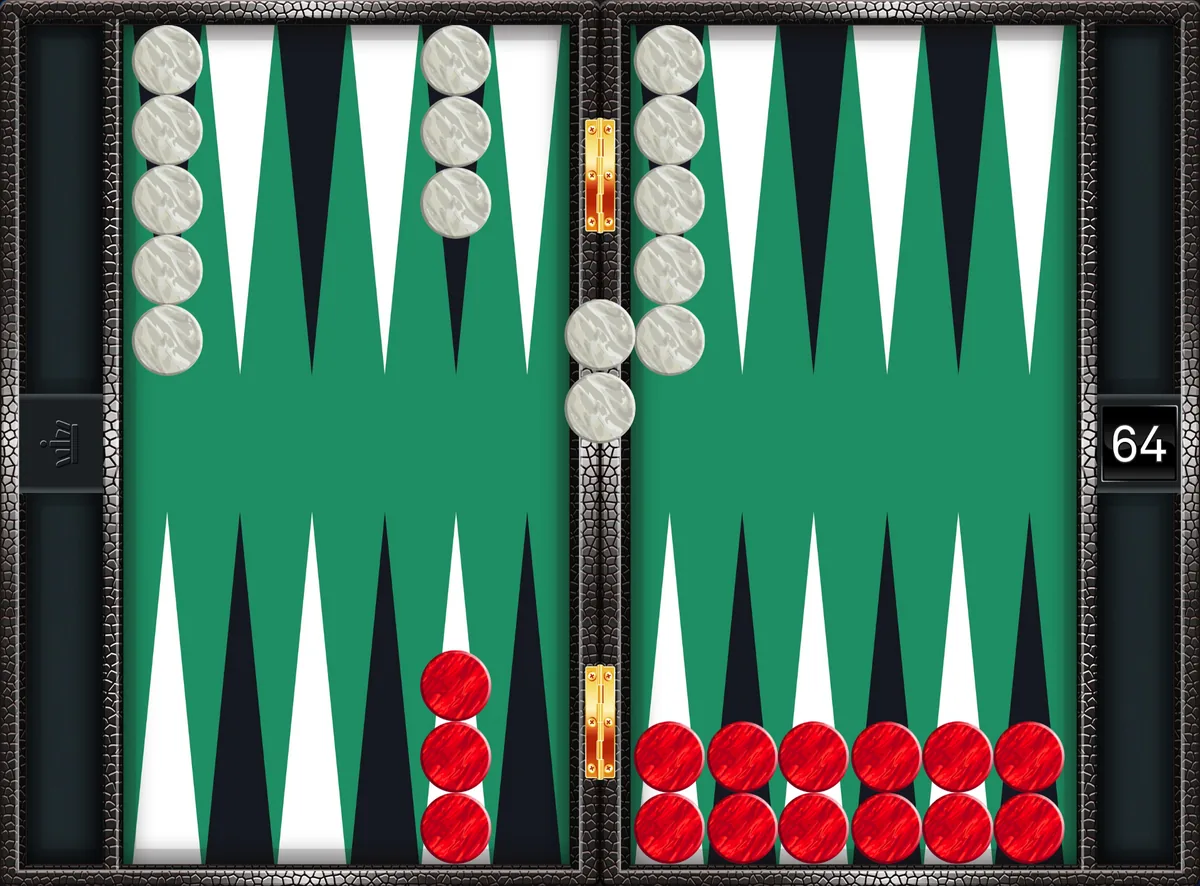
Bearing off. Red is all home with seven checkers already off; white has four off. The 6-5 bears off two more.
Scoring: Single, Gammon, Backgammon
The win value is multiplied by the doubling cube value (default 1 if the cube has not been turned) and then by the win type:
Win type
Multiplier
Condition
Single
×1
Winner bears off all 15; loser has borne off at least one checker.
Gammon
×2
Winner bears off all 15; loser has not yet borne off any checkers.
Backgammon
×3
Winner bears off all 15; loser has not borne off and has at least one checker on the bar or in the winner's home board.
Gammons and backgammons are critically important in match play and meaningfully shift cube strategy. They are conditional in money play under the Jacoby Rule.
The Doubling Cube
The doubling cube turns backgammon into a two-player no-limit equity decision and is the single most important difference between casual and competitive play.
Mechanics:
At the start of the game the cube is at value 1, placed in the middle of the board, available to either player.
Before rolling, either player may offer to double by turning the cube to 2 and pushing it toward the opponent. The opponent may take (accept the new stake and take ownership of the cube) or drop (forfeit the game at the current cube value).
Once owned, only the owner may turn the cube again, by offering a redouble to 4, 8, 16, etc.
Each escalation is offered before the owner rolls, and the opponent may again take or drop.
The mathematics of cube action is the subject of the match equity page. The single most cited result is the dead-cube take point of 25%: in the absence of recube vigorish, a player should accept any double at which their winning probability is at least 25%.
The cube transformed backgammon from a folk race game into a piece of decision theory. The full origins are covered on the history page.
Match Play and the Crawford Rule
Match play is the standard tournament format. Players play games until one reaches a target score (typically 5, 7, 9, 11, 13, 15, 17, 19, 21, or 25 points). Cube values, gammons, and backgammons all count toward the score.
The Crawford Rule, introduced by John R. Crawford, governs the cube in the game played immediately after one player first reaches a score of (match length) − 1. In that single game — the Crawford game — the doubling cube is removed from play.
In all subsequent games of the match (the post-Crawford games), the cube returns and is in play normally. The trailing player should, in nearly all positions, double at the first legal opportunity post-Crawford, since the cube value at the end of a game in which they will already need to win regardless is essentially free.
The Crawford Rule has substantial implications for cube strategy as the score nears the match length. The full treatment, including the formal equity argument and the free-drop windows, is on the Crawford Rule page.
Money Play and the Jacoby Rule
Money play is the older format, in which each game is settled at its final cube value times the agreed stake and there is no match target. Money play uses the Jacoby Rule: gammons and backgammons count only if the doubling cube has been turned at least once during the game.
Without the Jacoby Rule, a player with a strong gammon position has incentive to delay doubling in order to capture the unboosted gammon multiplier. The Jacoby Rule eliminates that incentive and encourages efficient cube action.
Money play also commonly allows beavers (instant immediate re-doubles on a take) and raccoons (an analogous escalation by the original doubler). Beavers and raccoons are not part of standard tournament match play.
Regional Variants
Backgammon is the international name for a family of related games. The regional variants share the 24-point board and the 15-checker count but differ in starting setup, hitting rules, and match structure.
Greek Tavli
Tavli is played in Greece and Cyprus as a match of three games taken in rotation, to 3, 5 or 7 points:
Portes — The same movement rules as international backgammon, but the winner of the opening roll re-rolls, there is no doubling cube and no triple win. The standard variant.
Plakoto — Landing a single checker on an opposing blot pins rather than hits it. The pinned checker cannot move until the pinning checker leaves. No bar. Both players start with all fifteen checkers on a single point.
Fevga — No hitting and no pinning. A point held by even a single opposing checker is blocked — no landing on it at all. Each player begins with all fifteen checkers stacked on opposite diagonal corners of the board, and both players move counter-clockwise along parallel tracks (not on opposing tracks). The strategic core of the game is racing the prime forward while denying the opponent landing points; there is no contact in the hit-and-bar sense.
A Tavli match is played to 3, 5 or 7 points, the three games in rotation; a win scores 1, a double (gammon) 2. The doubling cube is generally not used in Tavli outside competitive tournament settings.
Turkish Tavla
Tavla is Turkey's national board game. The principal forms are:
Tavla (erkek tavlası when distinguished from kız tavlası) — The everyday Turkish game: international backgammon's setup and movement, but the opening roll is re-rolled, there is no doubling cube, and a gammon scores 2 with no triple win; hit-and-run in the home board is commonly forbidden as a café house rule.
Uzun Tavla ("long tavla") — The long game: all fifteen checkers start in one corner, both players move the same direction, no hitting.
Gül Bara — A scoring variant rewarding specific configurations.
Russian / Persian Nardi
Nardi (Nardy, Nard) is played throughout Russia, Iran, and the Caucasus. In Iran the game is known as takhteh (takhteh nard); see the dedicated takhteh page for the Persian setup, vocabulary, and rule conventions.
Short Nardi — Corresponds to standard backgammon.
Long Nardi — All fifteen checkers start on the 24-point. No hitting and no pinning — Long Nardi uses pure blocking mechanics. Landing on a point occupied by even one opposing checker is prohibited; the game is won by getting all fifteen checkers around the board and borne off while denying the opponent landing points. (Pinning is the defining feature of Plakoto, not Long Nardi — the two should not be conflated.)
French Jacquet and Trictrac
Jacquet is a French tables game with same-direction movement and the postillon lead-checker rule. Trictrac is the older French game with substantially different scoring — players accumulate points for positions and feats reached during play, not for bearing off. Both are documented on the backgammon trictrac page.
Tournament Conduct
Standard international tournament conduct generally requires:
All rolls to be made from a cup, with both dice landing flat in the right-hand quadrant.
Visible cube changes (the cube is physically turned and placed in the recipient's half of the board).
A "completed move" announcement convention, after which a play cannot be retracted.
Optional use of clocks with delay and reserve time for serious tournament play.
The GamesGrid platform enforces equivalent conduct standards through automated game flow — all rolls are server-generated, all cube actions logged, and all completed moves committed irrevocably to the match record.
The Rules We Play By
The rules on this page are not just how backgammon is generally played — they are the rules GamesGrid Backgammon enforces in every match, verified line by line against the sport's governing bodies: the World Backgammon Federation's Tournament Rules (Edition 2.1, August 2023 — the ruleset the UK federation also adopts) and the published rules of the U.S. Backgammon Federation.1 Where match play and money play differ — the Crawford rule, the dead cube, automatic doubles, beavers, the Jacoby rule — the platform enforces exactly the official split: match rules in matches, money-play rules only in the casino, with simulated chips. What you learn here is what you play there.
See Also
Backgammon Setup — step-by-step board setup with visual diagrams.
Crawford Rule — full equity treatment of the rule and post-Crawford strategy.
Live Play and Etiquette — cocked dice, illegal moves, cube handling, and how tournament directors rule.
Chouette — the multiplayer form: box, captain, rotation and the cube systems.
Footnotes
World Backgammon Federation, Tournament Rules, Edition 2.1, August 2023 — including 4.4(iv) on the Crawford game, 4.4(vii) on the dead cube, and 4.4(viii) on the match/money split for automatic doubles, beavers and the Jacoby rule. United States Backgammon Federation, published tournament rules. ↩
A new backgammon world is opening.
Imagine online backgammon as a living world, where you compete against over 500 unique personalities from 120 countries. Every member has their own character, life story, voice, playing strength and style. They compete in the same leagues and tournaments as you, build careers alongside yours and remember the matches, conversations and history you create together.
Learn who they are. Adapt to how they play. Earn their respect, make friends, create rivalries and become part of their story—because they will become part of yours.