All you need to know about Backgammon's golden point
The single highest-priority structural decision in the first six turns of a backgammon game is making the 5-point. It is the most-cited point in modern strategic literature. Tournament players call it the Golden Point. Its rollout-confirmed primacy is the reason the opening roll 3-1 — played 8/5, 6/5 — is the strongest non-double opening in the game.
This page explains why the 5-point holds its position at the top of the point-priority hierarchy, traces the strategic recognition from the 1970s "pure style" era through modern neural-network rollouts, and works through the canonical opening plays that target the 5-point: the 3-1 Golden Point opening, the 6-1 bar-point opening (which is "5-point-adjacent"), and the 1-1 super-roll that makes both the 5-point and the bar-point in a single move.
For the parent strategic framework, see the strategy hub. For the comprehensive opening-roll catalogue, see opening rolls.
The 5-Point's Five Strategic Functions
The 5-point is simultaneously a home-board attack point, an outfield builder anchor, a 6-prime keystone, an opposing-escape blocker, and a midpoint-link — five structural functions in a single point. No other point in the 24-point board carries five such functions.
Function 1: Home-Board Attack Point
The 5-point is in the player's home board (the 1- through 6-points). Any opposing checker hit during contact must re-enter through the player's home board, and a closed 5-point reduces the opponent's available re-entry points from six to five. Combined with other home-board points, the 5-point contributes directly to closeout pressure.
Function 2: Outfield Builder Anchor
The 5-point sits at the boundary between the player's home board and outer board. Builders coming from the 6-, 8-, and 13-points pass directly over (or land on) the 5-point. A made 5-point captures builder flow that otherwise leaks past — every outfield checker that could have been a 5-point builder must now be redirected.
Function 3: 6-Prime Keystone
The strongest blocking structure in backgammon is the full 6-prime — six consecutive made points that no single die can escape. The most-built 6-prime structures span 5-through-10, 4-through-9, or 3-through-8. The 5-point is a member of every 6-prime that extends into the home board, and is therefore the point that determines whether the prime "reaches in" to the home board or fails to.
Function 4: Opposing-Escape Blocker
The player's 5-point is the opponent's 20-point. The opponent's back checkers, starting on the player's 1-point (the opponent's 24-point), must escape over the 20-point to reach the opponent's outfield. A made 5-point — held by 2+ of the player's own checkers — denies the opponent that critical 20-point landing square. Rolls that land on the 20-point from the 24-point — any roll containing a 4, plus 3-1, 2-2 and 1-1 — are 15 of 36, about 42% of the opponent's rolls, and every one of them is denied whenever the opponent tries to escape via that route.
Function 5: Midpoint Link
The 5-point sits 8 pips from the 13-point (the midpoint). Builders on the 13-point can reach the 5-point with a single checker on rolls that total 8: 6-2 and 5-3 (two ways each), 4-4 and 2-2 — 6 of 36. This makes the 5-point the most-connected unmade point at the start of the game.
The combination of all five functions — and the simultaneous expression of them — is why the 5-point is the Golden Point.
Historical Recognition: The Pure Style
Recognition that the 5-point was the highest-leverage point in the game emerged over the 1960s and was consolidated in the 1970s. Prince Alexis Obolensky's tournament era — the Bahamas Championships from 1967 onward, the Las Vegas World Series of 1975, Studio 54 — coincided with the publication of Paul Magriel's Backgammon (1976), which made the 5-point's central role explicit and supplied the strategic vocabulary still in use.
Magriel's school of play was called the pure style: an emphasis on early aggressive structural commitment, particularly targeting the 5-point even at the cost of accepting hit risk. The 4-1 slot play (13/9, 6/5) — placing a blot on the 5-point in the hope of covering it on the next roll — is the canonical pure-style move. In Magriel's era this was a slight equity favourite over the splitting alternative (13/9, 24/23) but the analysis was based on hand-tabulated rollouts and was disputed by the more conservative European school.
Modern neural-net rollouts (XG2, GNU Backgammon, Wildbg) confirmed the pure-style preference in the late 1990s and refined it. The 4-1 slot vs split equity gap is small — modern rollouts favour the split by a slim margin — but the structural conclusion — take the 5-point as early as possible — is unambiguous across every reference engine.
GamesGrid is coming back and you can be part of it.
The 3-1 opening is played 8/5, 6/5. One checker from the 8-point moves three pips to the 5-point; one checker from the 6-point moves one pip to the 5-point. Together they make the 5-point — two checkers, exactly the minimum to "make" a point.
The rollout edge over the principal alternative is dramatic. Modern XG2 rollouts:
Play
Equity
Description
8/5, 6/5 (Golden Point)
+0.150
Makes the 5-point.
13/10, 6/5
+0.070
Slots the bar-builder; less than half the equity.
13/10, 13/12
+0.030
Pure builder play; no point made.
The 3-1 Golden Point opening is the single biggest first-turn equity differential in backgammon. The +0.080 edge over the next-best play is roughly what a two-pip lead is worth in a medium-length race — a substantial structural commitment to start the game.
Why Not Slot?
A reasonable question: if the 5-point is so valuable, why not slot it more often when no point-making roll is available? The answer is hit probability. A slotted 5-point is hit from the opponent's back checkers on the 24-point — 15/36 of all opposing rolls hit a 5-point slot (any roll containing a 4, plus 3-1, 2-2 and 1-1). A 42% chance of being hit and sent to the bar is a substantial cost; the slot is only correct when the structural value of covering the slot next turn outweighs the average expected loss from the hit.
The 4-1 slot stays close to the split because the split is also a modest play; modern rollouts nonetheless favour the split (see the openings page). The 3-1 make-the-point is dramatically better than slot-style alternatives because it eliminates the hit risk entirely — the point is made, not vulnerable.
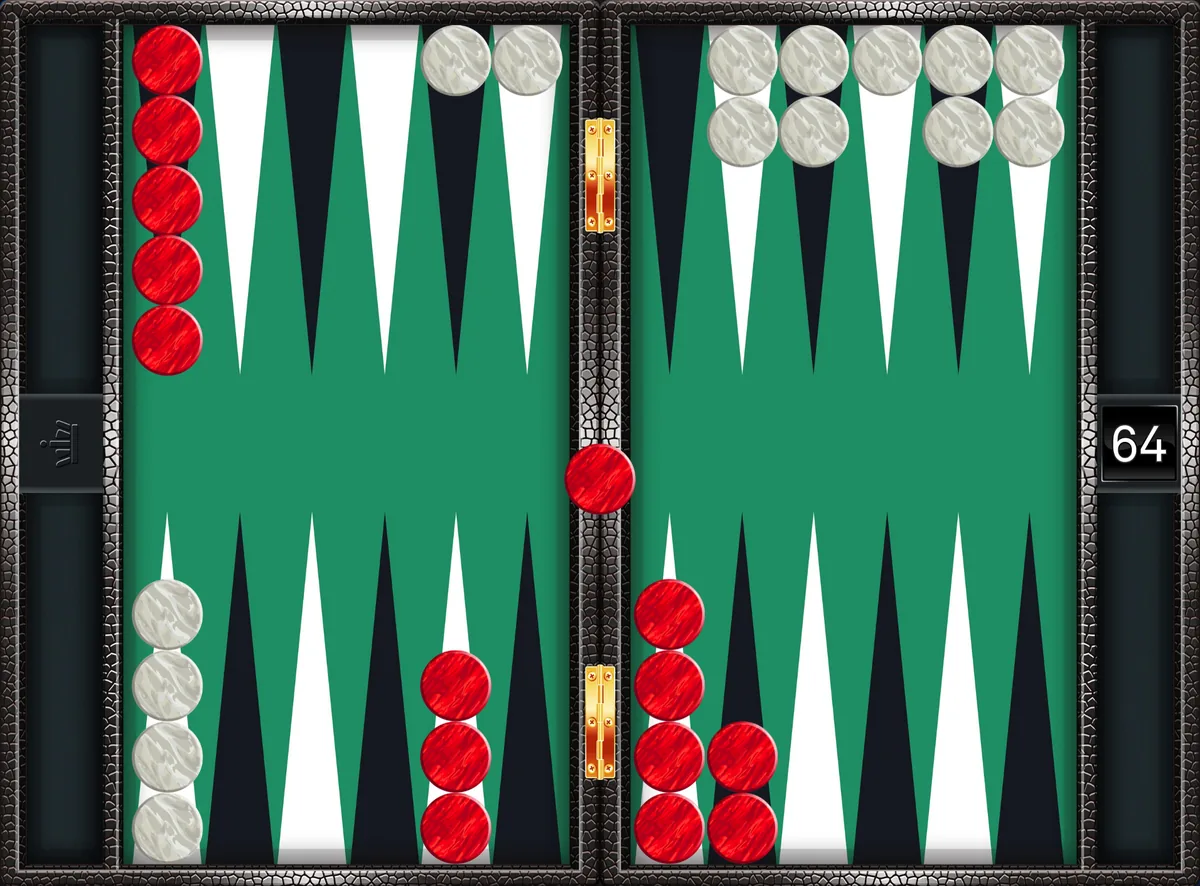
After the 3-1 opening 8/5, 6/5: red owns the golden point — the 5-point.
Other Rolls That Make the 5-Point
Beyond the 3-1, several other opening rolls (or first-turn position-types) make the 5-point in a single play:
Roll
Play
Notes
3-1
8/5, 6/5
Canonical.
1-1
8/7, 8/7, 6/5, 6/5
Doubles. Makes 5-point and bar-point.
3-3
8/5, 8/5, 6/3, 6/3
Doubles. Makes 5-point and 3-point.
Because a tied opening throw is re-rolled, the opening roll is never a double: 3-1 is 2 of the 30 possible opening throws, 2/30≈6.7% — about one game in fifteen starts with a Golden Point. 1-1 and 3-3 can make the 5-point only as a reply or on a later turn.
The Golden Anchor
The 5-point is most valuable when made — held by two or more of the player's checkers. But the corresponding point in the opponent's board — the player's 20-point, the opponent's 5-point — is equally valuable when held as a defensive anchor. This is the Golden Anchor.
A 20-point anchor:
Provides return-shot opportunities throughout the opponent's bear-in.
Maintains contact (preventing the game from collapsing into a pure race).
Sits in the highest part of the opponent's home board, with the strongest tactical leverage for late-game hit-and-cover sequences.
Strong play in the early-middle game often forces a structural choice between making one's own 5-point (offensive structural commitment) or anchoring the opponent's 5-point (defensive structural commitment). The choice depends on the position type emerging — primes vs holding games — and is one of the principal middle-game strategic decisions.
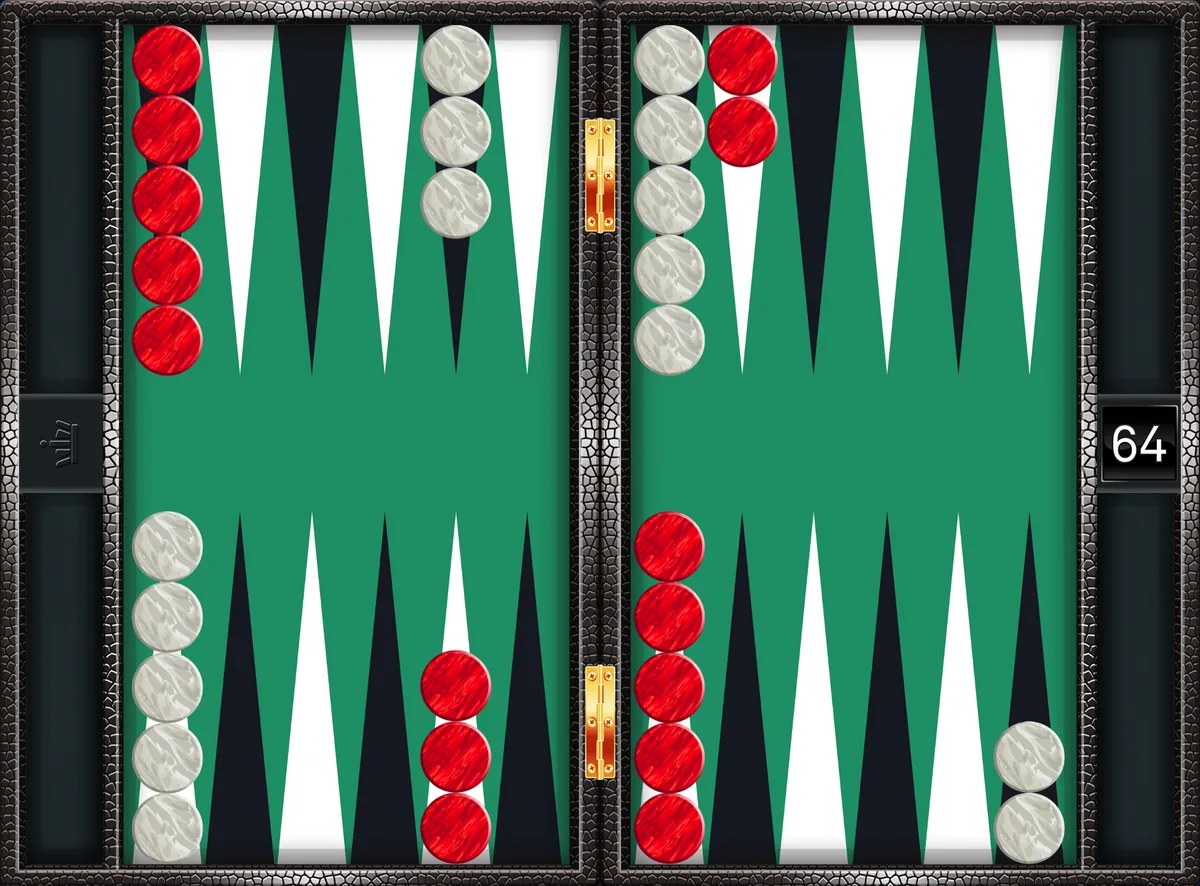
The golden anchor. Red's back checkers hold the opponent's 5-point — the best defensive anchor on the board.
Sequences That Build the 5-Point
A player who does not roll 3-1, 1-1, or 3-3 on the opening still aims to make the 5-point in the first few turns. The canonical multi-turn sequences:
Turn 1 builder on the 9- or 10-point (e.g., 4-1 → 13/9, 24/23 or 4-1 → 13/9, 6/5), turn 2 makes the 5 with a covering 4 or 3 from the 9 or 10.
Turn 1 split with the back checkers, turn 2 builders consolidate on the 9-point, turn 3 makes the 5.
Turn 1 makes the bar-point (6-1), turn 2 builders move toward the 5, turn 3 makes the 5.
These sequences are why the principle is target the 5-point early and not make the 5-point on turn 1 only. The early game is essentially a contest to make the 5-point first — and the player who succeeds at this typically holds a +0.10 to +0.20 positional edge through the middle game.
When the 5-Point Is Not the Priority
Two scenarios in which the 5-point ceases to be the priority:
Opponent has already made their 5-point
If the opponent has made their 5-point first, the player's own 5-point declines somewhat in marginal value (the prime-building race is already lost) and the priority shifts to either:
Making the bar-point (7-point) to begin a competing prime structure, or
Anchoring the opponent's 5-point (the Golden Anchor) before the opponent can fully close their home board.
Position has drifted to a race
If contact has been broken and both sides are out-of-contact, the 5-point's structural value disappears entirely. The game has collapsed to a pure race, and pip count is the only metric that matters.
See Also
Opening Rolls — all 15 first-turn dice combinations and their canonical plays.
Prime Building — the 6-prime structures the 5-point anchors.
Glossary — formal definitions for Golden Point, Golden Anchor, pure style, slotting.
A new backgammon world is opening.
Imagine online backgammon as a living world, where you compete against over 500 unique personalities from 120 countries. Every member has their own character, life story, voice, playing strength and style. They compete in the same leagues and tournaments as you, build careers alongside yours and remember the matches, conversations and history you create together.
Learn who they are. Adapt to how they play. Earn their respect, make friends, create rivalries and become part of their story—because they will become part of yours.