A prime in backgammon is a contiguous wall of made points. It is the most powerful structural feature in the game: a fully-built 6-prime is mathematically impassable to any single checker, because no single die roll can produce a jump of 7 or more pips. A trapped checker behind a 6-prime stays there until the prime breaks.
This page covers the mathematics of the 6-prime's impassability, the construction sequence (how primes are built incrementally from individual points), the strategic concept of rolling the prime forward, and the relationship between primes and the other principal mid-game position types (blitzes, back games, holding games).
For the strategic context — when prime-building is the right strategy and when it is not — see the strategy hub. For the structural priority of the points that anchor primes, see the Golden Point page.
The Mathematics of the 6-Prime
A standard die shows the values 1 through 6. The largest single-die jump is therefore 6 pips. A backgammon 6-prime is six consecutive points, each occupied by 2+ of the prime-owner's checkers. A checker trapped behind the 6-prime — i.e., on the opposite side of the prime from the bear-off — must traverse the prime to escape.
The minimum traversal of a 6-prime requires a jump of 7 pips in a single die. No standard die can produce a 7. Therefore:
P(escape via single die from behind a 6-prime)=0
The trapped checker can only move when:
A specific point in the prime is broken (reduced to 0 or 1 of the prime-owner's checkers), or
The prime is rolled forward by the prime-owner — which often eventually breaks the trailing edge.
This is the most extreme positional asymmetry in backgammon. The cube equity of a 6-prime with a single contained checker behind it routinely exceeds +1.4 (i.e., approaching the maximum for a backgammon-deserving position) when the contained checker is on the 24-point and the prime-owner's race is fast.
Comparing the 5-prime
A 5-prime is five consecutive made points. The minimum escape jump is 6 pips — which is rollable as a single die (one of 11/36≈30.6% rolls contains a 6). A contained checker escapes a 5-prime in expectation in 3.3 rolls (the inverse of the per-roll escape probability).
The gap from 5-prime to 6-prime is dramatic. The expected escape time goes from 3.3 rolls to infinite. This is why the construction of the 6th point of an emerging prime is one of the most consequential single-move decisions in the middle game.
The broken prime
A broken prime is a prime structure with one or more interior points held only by a single checker (a blot). For example:
8-point, 7-point, 6-point, 5-point, 4-point, 3-point with one checker = "broken 6-prime"
The single-checker point is hit-vulnerable. If the opponent hits, the prime collapses and the trapped checker escapes. Broken primes are dramatically weaker than full primes — depending on hit probability, the cube equity of a broken 6-prime can be 30–60% of the cube equity of a full 6-prime.
The Five Canonical Prime Structures
A 6-prime can be built across various sets of consecutive points. The five most-built structures, in approximate frequency order in tournament play:
Structure
Points
Notes
The Mid Prime
3, 4, 5, 6, 7, 8
The classic prime — the "blocker prime." The trapped opposing checker sits on the 24-, 23-, or 22-point. Most-built structure in primer-vs-primer games.
The Inner Prime
2, 3, 4, 5, 6, 7
Deeper prime — strong for blitz-to-prime transitions where the home board is already largely formed.
The Forward Prime
4, 5, 6, 7, 8, 9
Extension into the outfield. Used when the opponent has anchored on the 24-point and timing favours forward extension.
The Wide Prime
5, 6, 7, 8, 9, 10
The most outfield-extended structure. Strong against a back game but vulnerable to a fast race.
The Inside Prime
1, 2, 3, 4, 5, 6
A "closed board" — all six home-board points made. This is no longer a prime but a closeout when the trapped checker is on the bar; cube equity is typically near-maximal.
The transition between these structures is one of the principal dynamic features of mid-game play. A prime built across 3–8 may be rolled forward to 4–9, then 5–10, as the prime-owner's own checkers progress around the board toward bear-off.
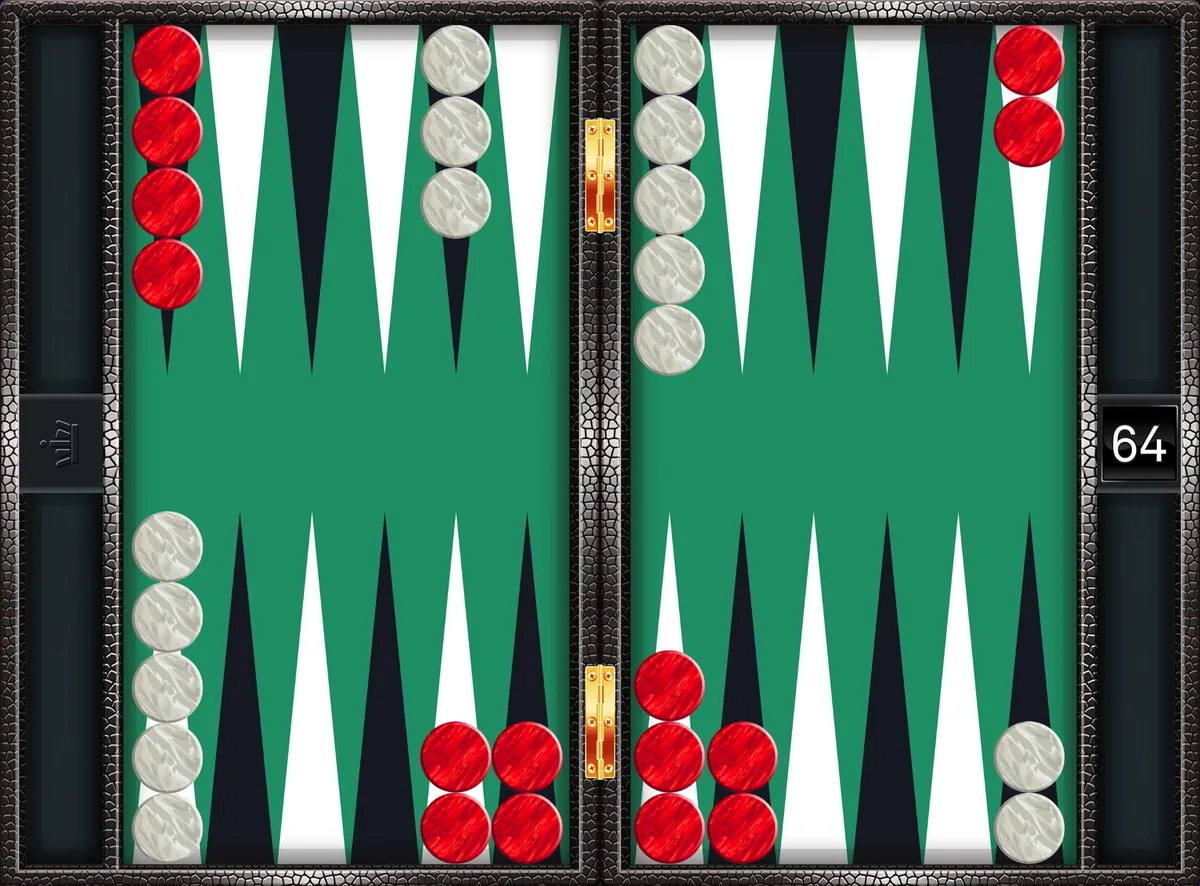
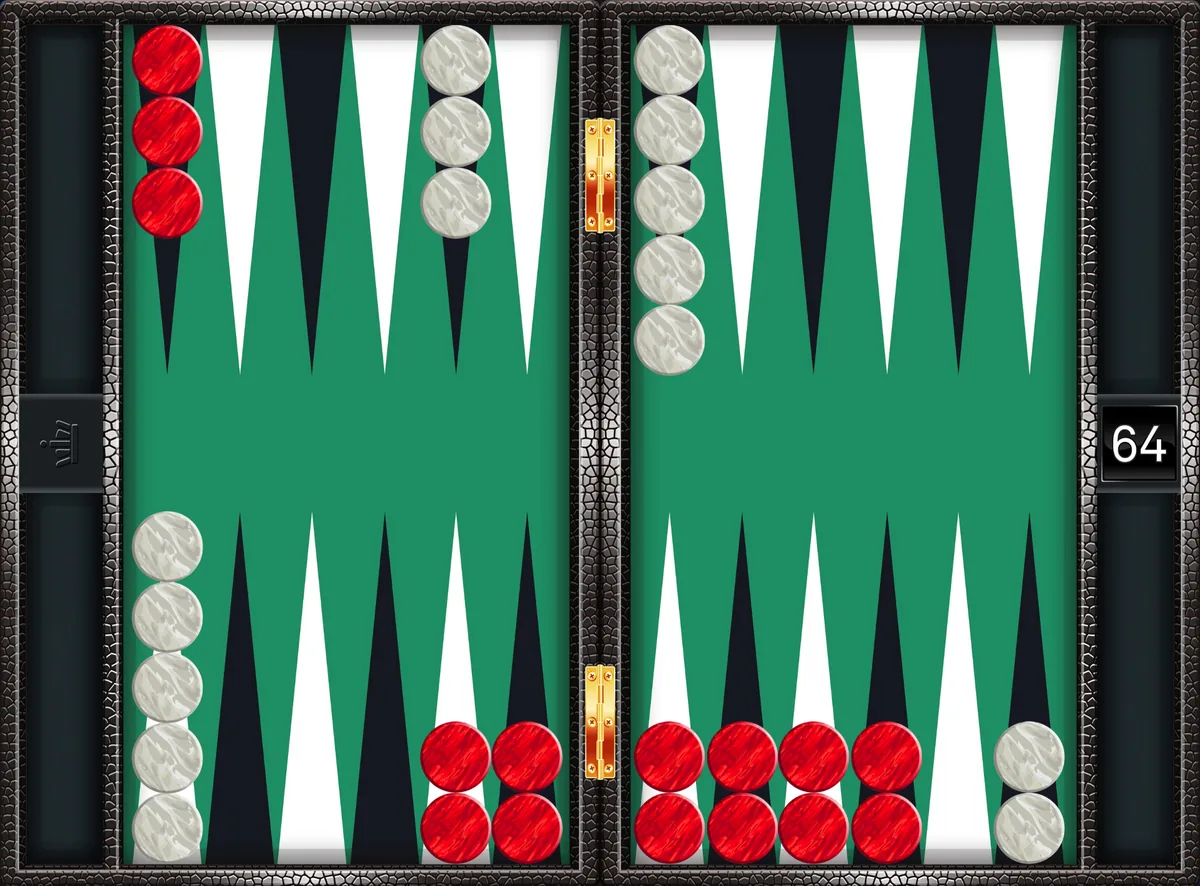
A four-prime across the 8-7-6-5. Rolls of 5 and 6 still escape — the wall wants extension, not admiration.The full six-prime, 3 through 8. No number escapes: the two white checkers behind it are spectators until the wall breaks.
Building a Prime: The Construction Sequence
A 6-prime is rarely built in fewer than 6 turns. The typical construction sequence:
Turn 1: Make a key point. The 5-point (3-1 opening), 4-point (4-2), or bar-point (6-1) are the strongest starting points.
Turn 2–3: Extend with builders into the outfield (9-, 10-points) and consolidate a second key point.
Turn 4–6: Complete the prime structure. The hardest single point to make is typically the trailing edge (the deepest point of the prime), because it is furthest from the player's flow of checkers from the midpoint.
The construction priority order, based on Magriel's Backgammon (1976) and confirmed by modern rollout analysis: make the 5-point first; the 4-point or bar-point second; the 3-point or 9-point third. The remaining prime points come together in the natural flow of builders.
The 3-Prime Threshold
A 3-prime (three consecutive made points) is the structural starting position from which a full prime can be projected. From the starting points, only 6-7-8 forms a true 3-prime; 5-6-8 or 4-6-8 are not yet a prime: 5-6-8 needs the 7-point, 4-6-8 the 5- and 7-points. A 3-prime constrains the opponent's checkers and creates pressure to extend. From a 3-prime to a 5-prime is the most-studied construction sequence in the strategic literature.
Rolling the Prime Forward
A prime is not static. Once built, the prime-owner's structural problem is what to do as they race toward bear-off — eventually their own checkers must move forward, and the prime points themselves must give way as the player bears off.
The technique is to roll the prime forward: as a back point of the prime breaks (because the prime-owner's own checkers move forward, leaving the back point under-occupied), the prime-owner simultaneously makes a new front point, maintaining a contiguous six-point structure that has migrated one column forward.
Worked example: a prime built across the 3-8 has been completed. The opponent is contained behind it on the 24-point. The prime-owner now rolls forward:
Turn n: break the 3-point (move both checkers off the 3 to better positions), but in the same move, make the 9-point.
Result: prime is now 4-9.
Turn n+1: break the 4-point, make the 10-point.
Result: prime is 5-10.
The prime can be rolled forward as far as 5-10 before the structure inevitably collapses on the player's own bear-in. Each forward roll consumes one turn of the prime-owner's pip count but preserves the structural advantage. The number of times a prime can be rolled is determined by the timing differential between the two sides — the difference in pip counts.
Timing
The prime-owner's pressure to maintain the prime can fail in two ways:
Crushing the back: the prime-owner runs out of room behind the trailing edge of the prime; their own checkers must occupy the back points of the prime structure, eventually breaking the formation.
Outpaced timing: the prime-owner cannot roll forward fast enough to keep the prime intact; the opponent's eventual escape (when the prime breaks) is too late to matter.
The classic balance is the back game vs prime match-up. A trailing player holding a deep back-game (anchors on the 1- and 3-points) gains timing because they don't want to advance their back checkers; they want to keep contact and shoot at a late blot. If the prime-owner cannot roll the prime forward fast enough, the back-game eventually catches a shot and the position swings dramatically.
Prime vs Blitz: The Mid-Game Choice
A player whose opponent has back checkers contained and a weak home-board structure faces a classic mid-game choice:
Prime: build a 5- or 6-prime; contain the opposing back checkers; roll the prime forward.
Blitz: aggressively attack any opposing blots; force checkers to the bar; close the home board for a closeout.
Both strategies can succeed; both can fail. The choice depends on:
Hitting opportunities: if the opponent has multiple blots within direct-shot range, the blitz is faster and higher-volatility.
Builder distribution: if the player has many builders deep (on the 6-, 7-, 8-points), the prime is the natural extension.
Race position: if the player is significantly behind in the race, the prime-build is necessary; the blitz alone won't recover the pip deficit.
Score: at gammon-rich match scores (e.g., trailer at 4-away), the blitz is strongly preferred for its higher gammon equity.
Strong players choose based on the structural details. Modern engine rollouts can resolve any specific position, but the strategic intuition for which type of game to head for is one of the principal competitive distinctions between expert and intermediate play.
The Mathematical Limit
A theoretical aside: a full 6-prime with a closed home board — i.e., a 6-prime extending into the home board with all home-board points already made — is the most-blocking position in the game. The trapped opposing checker cannot escape the prime and cannot re-enter once hit. This is a closeout condition where the opponent is contained and cannot move at all from the bar. Gammons are common from these positions; backgammons remain rare.
The relationship between primes and closeouts is structural: a 6-prime across the inner home board (1-6 points) is, by definition, a closed home board. A 6-prime across 3-8 is two points short of a closed board (the 1- and 2-points are open). Closing the remaining home-board points while preserving the prime is the most-decisive mid-game structural move.
Glossary — formal definitions of prime, broken prime, closeout, blitz, back game.
A new backgammon world is opening.
Imagine online backgammon as a living world, where you compete against over 500 unique personalities from 120 countries. Every member has their own character, life story, voice, playing strength and style. They compete in the same leagues and tournaments as you, build careers alongside yours and remember the matches, conversations and history you create together.
Learn who they are. Adapt to how they play. Earn their respect, make friends, create rivalries and become part of their story—because they will become part of yours.