LongGammon: The Long Version of Standard Backgammon
Everything you need to know about LongGammon
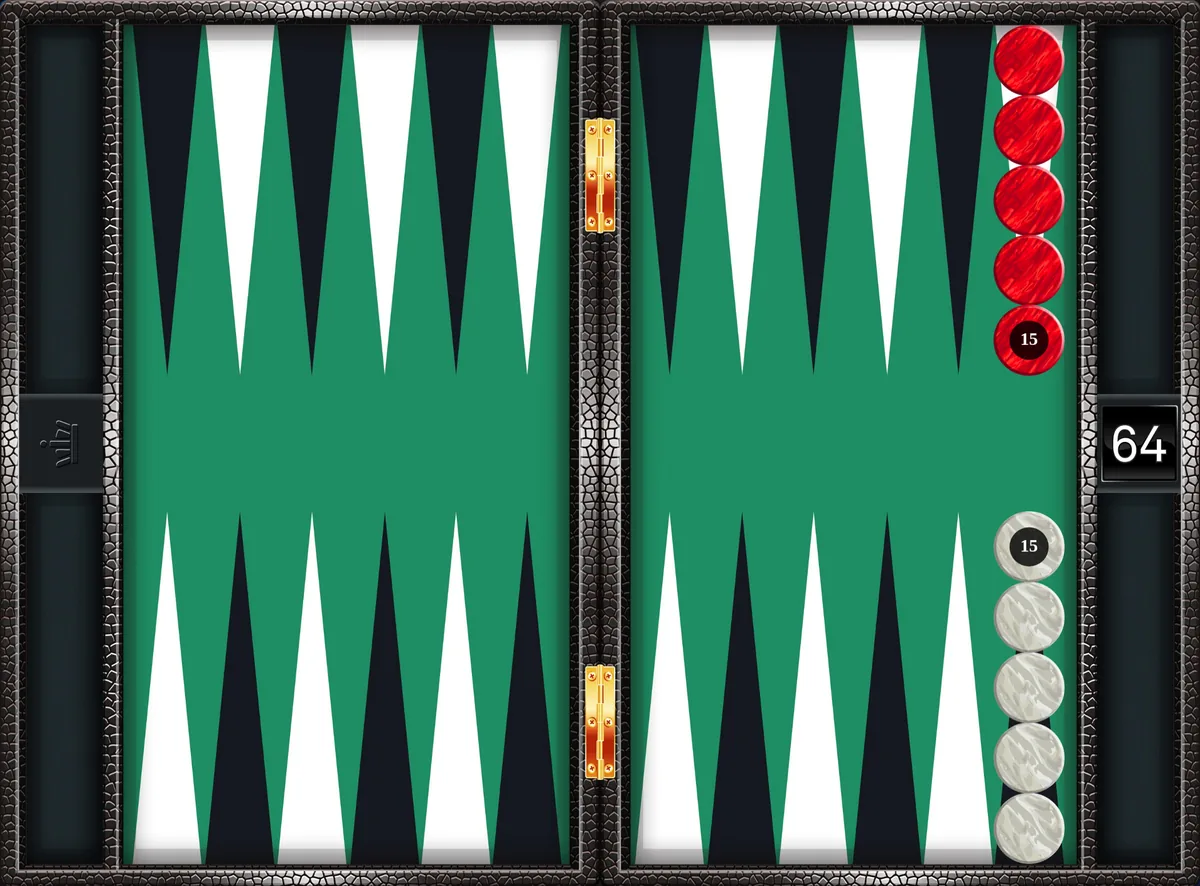
LongGammon is standard backgammon stretched to its geometric limit: all 15 of your checkers start on the opponent's one-point — your 24-point — the farthest legal square from home. Every other rule of the standard game applies unchanged. The variant was described by Michael Strato and posted to the rec.games.backgammon newsgroup, and is documented at Backgammon Galore.1 It is a niche, newsgroup-era creation rather than an established tournament game, and this page frames it honestly as such — but as a thought experiment in how far a starting position can be pushed while keeping the rules intact, it is instructive.
Each player stacks all 15 checkers on their 24-point (the opponent's one-point). The two armies therefore begin as mirror-image towers in each other's home boards — the deepest possible mutual anchor, and the longest possible race.
Feature
Standard backgammon
LongGammon
Checkers per player
15
15
Starting points
24, 13, 8, 6
24 only
Starting pip count
167
360
All other rules
—
identical
The LongGammon start: all fifteen checkers on the opponent's ace point — a 360-pip race from the first roll.
Rules: Identical to Standard Backgammon
LongGammon changes the starting position and nothing else. Hitting, the bar, bearing off, the doubling cube, and gammon (×2) and backgammon (×3) multipliers all apply exactly as in the standard game.1 There is no special roll, no entry phase, no scoring quirk. Whatever you know from the backgammon rules page transfers without amendment — the strategic character alone changes, because both sides must extract a fifteen-checker stack past a fifteen-checker enemy stack sitting in their own home board.
The Pip Count: A 360-Pip Race
The arithmetic defines the variant. Fifteen checkers, each 24 pips from home:
15×24=360
pips per player — the maximum starting count any 15-checker, opposite-direction tables setup can produce. Compared with its relatives:
At more than double the standard count, LongGammon games are long, contact-heavy in the early going (every checker must run the full gauntlet), and rich in blitz-versus-anchor dynamics before they ever become races.
Two distinctions matter, because the name invites confusion:
LongGammon is not Long Nardy. Long Nardy belongs to the nardi family, a different branch of tables games in which there is no hitting and both players move in the same direction. LongGammon keeps backgammon's hitting, bar and opposed movement in full.
LongGammon is not nackgammon writ large — it is nackgammon's extreme.Nackgammon makes a mild change to the back-checker arrangement and adds 27 pips; LongGammon commits every checker to the rear and adds 193. Nackgammon is an established variant with competitive pedigree; LongGammon is a deliberately maximal design exercise.
Origins and Status
LongGammon emerged from the Usenet era of backgammon culture: Michael Strato described it and posted it to rec.games.backgammon, and Backgammon Galore preserves it in its variants archive.1 Beyond that page, corroborating literature is scarce — there is no known tournament tradition, master-level theory or independent rules lineage. GamesGrid records it as what it is: a clean, well-defined curiosity from the newsgroup years, worth knowing chiefly for the light its 360-pip start sheds on how the standard 167-pip position balances race against contact. Background on the game's broader lineage is on the history page, and terms used here are defined in the glossary.
LongGammon and GamesGrid
GamesGrid documents LongGammon as part of its encyclopedia of backgammon variants, alongside hypergammon, nackgammon and acey-deucey. The GamesGrid play platform centres on standard backgammon.
Frequently asked questions about LongGammon
How do you set up LongGammon?
All 15 checkers per player go on the opponent's one-point — your 24-point. There is no other change from the standard game.
What is the LongGammon starting pip count?
15×24=360 pips per player, against 167 in standard backgammon and 194 in nackgammon. It is the longest possible race from a 15-checker opposed-movement setup.
Are the rules different from standard backgammon?
No. Hitting, the bar, bearing off, the doubling cube, and gammons (×2) and backgammons (×3) all work exactly as on the backgammon rules page. Only the starting position differs.
Is LongGammon the same as Long Nardy?
No. Long Nardy is part of the nardi family, in which there is no hitting and both players move in the same direction. LongGammon retains backgammon's hitting and opposed movement.
Where does LongGammon come from?
It was described by Michael Strato and posted to the rec.games.backgammon newsgroup, and is documented at Backgammon Galore. It is a niche newsgroup-era variant with little literature beyond that.
Backgammon Galore, "LongGammon" — bkgm.com/variants/LongGammon.html (variant described by Michael Strato, posted to rec.games.backgammon). ↩↩2↩3
A new backgammon world is opening.
Imagine online backgammon as a living world, where you compete against over 500 unique personalities from 120 countries. Every member has their own character, life story, voice, playing strength and style. They compete in the same leagues and tournaments as you, build careers alongside yours and remember the matches, conversations and history you create together.
Learn who they are. Adapt to how they play. Earn their respect, make friends, create rivalries and become part of their story—because they will become part of yours.