Acey Deucey: The Backgammon of the American Sea Services
Acey-deucey is the backgammon variant of the American sea services — a favourite of the U.S. Navy, Marine Corps and Merchant Marine from World War I onward.1 Two features define it: every checker begins off the board and must be entered into play, and the roll of 1-2 — the "acey-deucey" that gives the game its name — grants the roller a free double of their choice and another roll. The result is a faster, swingier, more sociable game than standard backgammon, historically played in mess decks and ready rooms rather than tournament halls.
GamesGrid offers modern backgammon only.
Acey-deucey is not one fixed ruleset. American, European and Greek branches of the game exist, and within the American tradition doubles-handling and scoring were always subject to service and house rules.1 This page describes the common core, then sets out where the branches diverge. For the standard game it modifies, see the backgammon rules page and the setup page.
What Is Acey-Deucey?
Acey-deucey belongs to the same tables family as backgammon, tavla and shesh-besh: two players, fifteen checkers each, movement governed by two dice, victory by bearing off. Its probable origin is Mediterranean or Middle Eastern, and it reached its greatest popularity aboard American warships and merchant vessels in the twentieth century.1 The name comes from the special roll: ace (one) and deuce (two).
The three recognised branches differ mainly in how doubles are played and how games are scored:
Branch
Distinguishing traits
American
Checkers may move before all 15 are entered; no doubling cube; per-checker loss scoring2
European
Entering takes priority, so play is slower to start; doubles trigger a complement play; flat scoring3
Greek
A related branch of the same family, documented alongside the other two1
Setup and Entering Play
All 15 checkers per player start off the board. Each checker enters on the opponent's home board exactly as if entering from the bar in standard backgammon — see the backgammon rules page for the bar-entry mechanics. Because a checker awaiting entry stands the same distance from home as a checker on the bar, the effective starting pip count is
15×25=375
per player — compared with 167 in the standard game and 360 in LongGammon.
The branches split immediately on one point of law. In the American game, checkers already entered may move before all 15 are in — you may run, make points and hit while teammates are still queuing to enter. In the European versions, play is slower to start because entering takes priority.23 This difference makes the American opening more tactical.
Hitting, the bar and bearing off otherwise follow standard rules: a hit checker returns to the bar and re-enters in the opponent's home board.
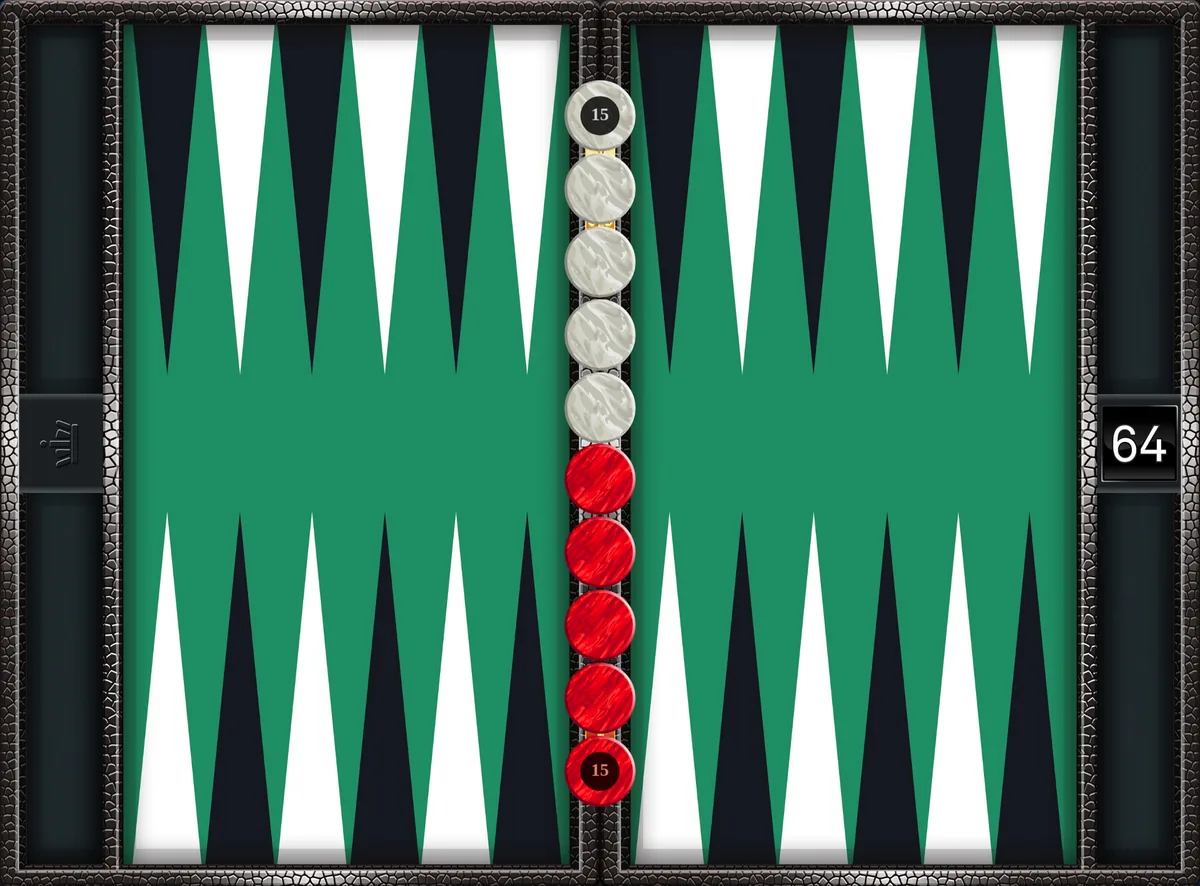
The acey-deucey start: an empty board — all thirty checkers enter from the bar as the game begins.
The Acey-Deucey Roll
The roll of 1-2 is the engine of the game. When you roll it, you receive, in order:
Play the 1 and the 2 as a normal roll.
Name any double you wish — from 1-1 to 6-6 — and play it (four moves of the named number).
Roll again and play that roll too.
If the new roll is another 1-2, the entire sequence repeats.
A string of acey-deuceys can therefore transform a game in a single turn, which is precisely the high-variance charm that endeared the game to sailors between watches.
Doubles: Service and House Rules Vary
How ordinary doubles (other than the named double after a 1-2) are handled is the most contested point in acey-deucey, and published sources genuinely disagree. GamesGrid presents the conflict rather than papering over it:
Play the double, then also play its complement — 7 minus the number, four times — then roll again3
Under the European complement rule, a roll of 5-5 means four 5s followed by four 2s (since 7−5=2), then a fresh roll; 6-6 yields four 6s and four 1s (7−6=1). Before playing, agree which rule is in force — aboard ship, the "house" rule of the mess prevailed, and no single version can claim to be the official one.
American: there is no doubling cube and there are no gammons. The loser pays 1 point for every checker still on the board or not yet entered. A crushing loss with, say, 9 checkers still in play costs 9 points; a near-run thing costs 1.2
European: games are scored at a flat 1 point. Some circles play that each acey-deucey rolled doubles the stake, reintroducing volatility by another route.3
The per-checker American scoring rewards playing on for the rout, much as gammons do in standard play — but measured checker by checker rather than in fixed multiples.
History and Origins
Acey-deucey's documented heyday begins with the First World War: from WWI onward it was the shipboard game of the U.S. Navy, Marine Corps and Merchant Marine, spreading wherever American crews sailed.14 Its deeper ancestry is less certain; a Mediterranean or Middle Eastern origin is probable, consistent with the broader tables family described on the history page. The parallel existence of American, European and Greek branches reflects that mixed inheritance — a folk game carried by sea, adapted port by port, and never centrally codified. Terms used on this page are defined in the glossary.
Acey-Deucey and GamesGrid
GamesGrid documents acey-deucey as part of its reference coverage of the tables family, alongside tavla, tavli, nardi and the modern variants hypergammon and nackgammon. The GamesGrid play platform centres on standard backgammon.
Frequently asked questions about acey-deucey
How does an acey-deucey game start?
All 15 checkers per player begin off the board and enter on the opponent's home board exactly as if coming in from the bar. In the American version, entered checkers may move before all 15 are in; in the European versions entering takes priority, so play is slower to start.
What happens when you roll 1-2?
You play the 1 and the 2, then name any double you like and play it, then roll again. If the new roll is another 1-2, the whole sequence repeats.
Do doubles give an extra roll in acey-deucey?
It depends on whose rules you follow. The American version documented at bkgm.com grants no extra roll; Wikipedia's account grants an extra turn; the European version adds the complement of the double (7 minus the number, played four times) and then a re-roll. Agree the rule before play.
How is acey-deucey scored?
American: no cube, no gammons — the loser pays 1 point per checker still on the board or not yet entered. European: a flat 1 point, though some players double the stake for each acey-deucey rolled.
Is acey-deucey a World War II invention?
No. It was already a favourite of the U.S. Navy, Marine Corps and Merchant Marine from World War I onward, and its roots probably lie further back in Mediterranean or Middle Eastern tables games.
Imagine online backgammon as a living world, where you compete against over 500 unique personalities from 120 countries. Every member has their own character, life story, voice, playing strength and style. They compete in the same leagues and tournaments as you, build careers alongside yours and remember the matches, conversations and history you create together.
Learn who they are. Adapt to how they play. Earn their respect, make friends, create rivalries and become part of their story—because they will become part of yours.