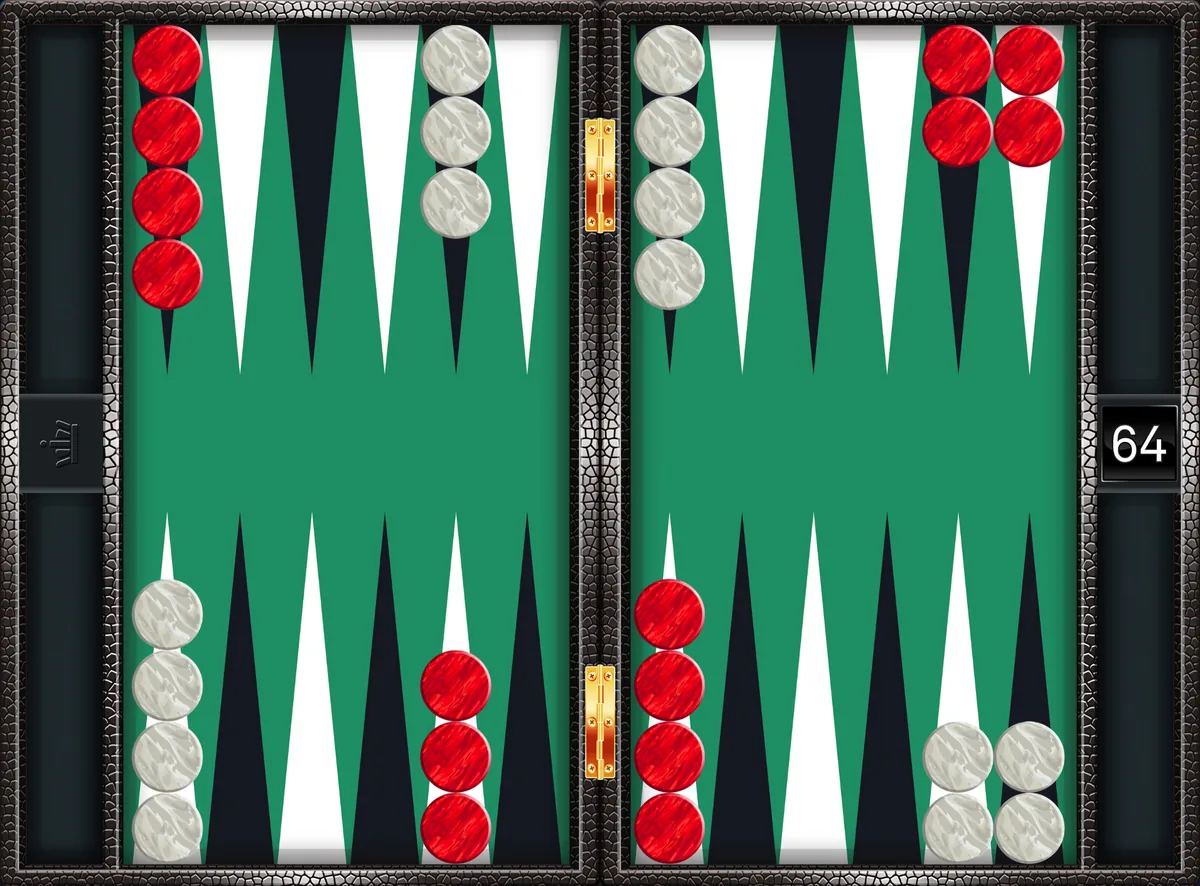
Nackgammon is a modern backgammon variant designed by Nack Ballard, one of the strongest American competitive players of the 1980s and 1990s. Each side starts with four back checkers instead of two — two on the 24-point and two on the 23-point — and one checker fewer on both the midpoint (four instead of five) and the 6-point (four instead of five); the three on the 8-point stay. This change produces dramatically different opening dynamics and a richer middle game, with more emphasis on priming and back games and less on attacking and blitzing.
GamesGrid offers modern backgammon only.
Nackgammon was supported by the original GamesGrid platform (1996–2008) as an alternative match format alongside standard backgammon.
For the standard backgammon setup that nackgammon modifies, see the main setup page. For full play rules (movement, hitting, bearing off, doubling cube), see the backgammon rules page.
The Nackgammon Starting Position
Each player begins with 15 checkers — the same count as standard backgammon — distributed across five points:
Point
Stack size
Compared to standard backgammon
24-point
2 checkers
Was 2; same.
23-point
2 checkers
Was 0; new in Nackgammon.
13-point
4 checkers
Was 5; one fewer.
8-point
3 checkers
Was 3; same.
6-point
4 checkers
Was 5; one fewer.
Total: 2+2+4+3+4=15 ✓
The opponent's setup is the mirror image.
The standard backgammon starting position is "rebalanced" — two checkers move from the 13-point and 6-point stacks to the 23-point, splitting the back checkers. The 8-point and the 24-point remain unchanged.
— substantially higher than standard backgammon's 167, reflecting the deeper back checker on the 23-point that needs to travel further.
The Nackgammon start: four back checkers — two on the 24-point, two on the 23-point.
Why Split the Back Checkers? The Strategic Idea
The standard backgammon starting position has both back checkers stacked safely on the 24-point. From this position, the player has a clear binary choice on each opening turn: split the back checkers (move one of them forward) or escape (run them out). Modern engine analysis has substantially narrowed the strategic space — there are correct plays for every opening roll, and the back-checker decisions are largely settled.
Nackgammon starts with the back checkers already split. This forces the player into a richer set of structural decisions from move one:
Four back checkers instead of two, on two points, mean more contact from the first roll: every opening play has to weigh escaping, anchoring and building at once. The position has built-in action.
With the rear split across the 23- and 24-points, the back checkers cannot be brought out as a single unit; they are released one point at a time.
Priming battles are more active because there is more contact from the first roll.
Back games and priming battles are more common than in standard backgammon, because four back checkers are already in place; blitzes are rarer.
The position has been likened to "standard backgammon five turns in" — the early-game tedium of point-making and back-checker decisions is bypassed, and the players are immediately in the meaty middle-game contest of primes, attacks, and contact.
Nackgammon Rules: What's the Same
Every other rule of standard backgammon applies to Nackgammon without modification:
Movement: dice are rolled, played as separate moves; doubles play four times.
Hitting: a single checker on a point is hit by a landing opposing checker; goes to the bar.
Bar and re-entry: bar checkers must re-enter through the opponent's home board.
Bearing off: all 15 checkers must be in the home board first; then the standard bearing-off rules apply.
Scoring: gammons (×2) and backgammons (×3) score normally.
Doubling cube: the cube starts at 1 in the middle, with all the standard cube actions (offer, take, drop, redouble, beaver, raccoon in money play).
Crawford and Jacoby: apply in match and money play respectively, exactly as in standard backgammon.
The only difference is the starting position. Everything else is identical.
GamesGrid is coming back and you can be part of it.
A few high-level strategic notes for players coming from standard backgammon:
Openings are different
The 15 opening rolls have different canonical plays in Nackgammon because the position is different. The principles are similar (make the 5-point, the bar-point, the 4-point; split the remaining back checker), but the specific plays vary. Most opening rolls in Nackgammon involve some combination of point-making and freeing the rear checkers; the opponent's second anchor on your 2-point blocks a home-board point you would normally own, which changes the value of several opening plays.
Priming is easier
Because the position starts with more built-in contact and the back checkers are pre-split, prime construction begins earlier. Strong players reach 5-prime structures by move 4 or 5 of a Nackgammon game with regularity; the equivalent timing in standard backgammon is several turns later.
The doubling cube is active earlier
Cube actions occur on average 2–3 turns earlier in Nackgammon than in standard backgammon because positions clarify faster. The "early double" window opens sooner; the "too good to double" window is reached more quickly.
Back games are more common
With four back checkers from the start, two-point back games and long priming battles arise far more often than in standard backgammon, and blitzes far less; timing — when to run and when to hold — matters more than in the standard game.
Nackgammon in GamesGrid History
The original GamesGrid platform (1996–2008) supported Nackgammon as a recognised match format. The GG bot family — GG Forever, GG Raccoon, GG Otter, GG Weasel, GG Chipmunk — accepted Nackgammon invitations alongside standard backgammon, up to 9-point matches. The variant attracted a small but dedicated following of players who appreciated the deeper opening complexity.
The new GamesGrid plays standard backgammon; nackgammon is documented here as reference, not offered as a playable mode. How the club's members are built is documented on the Bots & AI page.
Nack Ballard
A brief note on the creator: Nack Ballard was a top American competitive backgammon player in the 1980s and 1990s, winning the 1982 World Professional Championship in Las Vegas and voted the world's number-one player at the 1984 U.S. Invitational. He designed Nackgammon as a variant that preserved the strategic depth of standard backgammon while eliminating what he considered the "settled" early game. The variant has been widely adopted in serious tournament backgammon circles and is recognised as one of the few substantive variant innovations of the post-Magriel era.
Frequently asked questions about nackgammon
How does the nackgammon setup differ from standard backgammon?
Each side has four back checkers — two on the 24-point and two on the 23-point — four on the midpoint, three on the 8-point and four on the 6-point. Standard backgammon has two back checkers and five each on the midpoint and the 6-point.
What is the nackgammon starting pip count?
Nackgammon opens at 194 pips per player, against 167 in the standard game — 194−167=27 additional pips, reflecting the deeper starting arrangement of the rear checkers.
Who is Nack Ballard?
Nack Ballard is the variant's designer and one of the strongest American competitive backgammon players of the 1980s and 1990s.
Why does nackgammon produce a richer middle game?
The single change to the back checkers produces dramatically different opening dynamics, with more priming and back-game play and less blitzing than the standard starting position, so games develop more complex middle-game structures before resolving into races.
See Also
Backgammon Setup — the standard 15-checker setup that Nackgammon modifies.
Rules of Backgammon — full rules, which Nackgammon inherits without modification.
Opening Rolls — standard backgammon opening theory; the Nackgammon equivalents are positionally different but the principles are similar.
How to Play Backgammon — the beginner's guide: the rules in plain language, in fifteen minutes.
A new backgammon world is opening.
Imagine online backgammon as a living world, where you compete against over 500 unique personalities from 120 countries. Every member has their own character, life story, voice, playing strength and style. They compete in the same leagues and tournaments as you, build careers alongside yours and remember the matches, conversations and history you create together.
Learn who they are. Adapt to how they play. Earn their respect, make friends, create rivalries and become part of their story—because they will become part of yours.