Most places you play backgammon, the match ends and that is that. You won or you lost, you feel lucky or unlucky, and you have no idea which of your own moves actually decided it.
On GamesGrid the match ends and the review is already waiting. Every checker play, every cube decision and every resignation has been looked at by the engine at full strength, and one button on the post-match screen puts the whole thing in front of you. Not a summary: the match itself, taken apart one decision at a time.
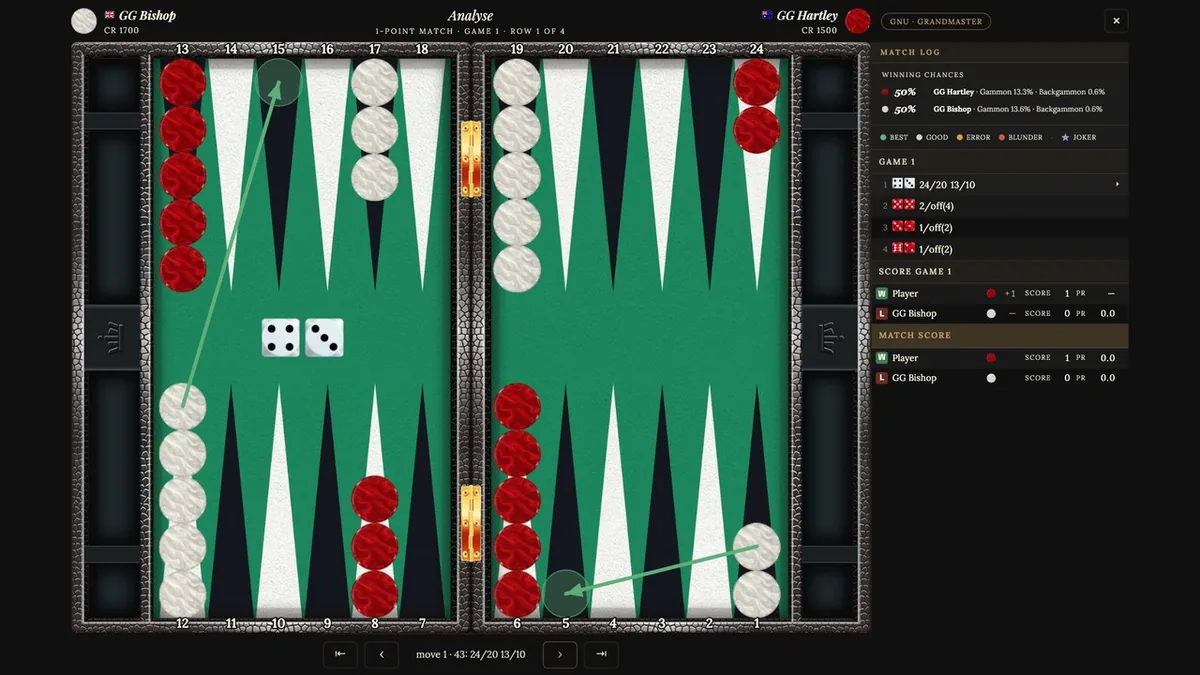
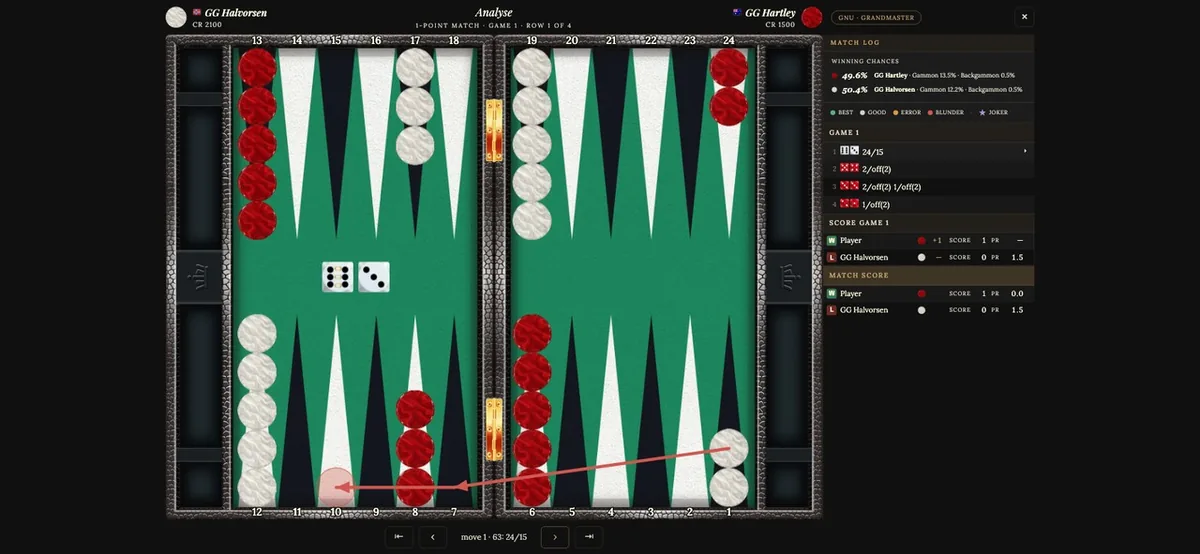
The GamesGrid analysis screen: the match log with every decision graded, winning chances for both players, and the board replaying the selected position.The same review on a phone. Analysing your matches works on every device.
Every decision, graded
The review opens on the match log: one row per decision, and a grade on each: best, good, error or blunder. The grade is not an opinion about style. It is the gap between what you played and what the engine would have played, measured in equity: what the position was worth before your move, and what it was worth after.
That distinction is the whole point. A move can look ugly and cost nothing. A quiet, natural-looking play can be the most expensive decision of the match. The list tells you which is which, and it does so for the moves you did not think twice about, which for most players is where the real losses hide.
Cube decisions sit in the same list on the same scale: doubling when you should have waited, waiting when you should have doubled, taking one you should have passed. In backgammon the cube errors are usually the expensive ones, and putting them next to the checker play is the only honest way to show it.
Click any row and the position comes back
Select a decision and the board redraws that exact position, with the move you played drawn on it. Not a diagram: the same board you were just playing on, in the set you chose, as it stood when you had to decide.
Beside it, the Winning Chances panel gives both sides at that moment: the chance of winning, of winning a gammon, of winning a backgammon. Step through a game and you can watch the match swing, roll by roll, and find the exact turn where it got away from you. Revisit a difficult cube, inspect an unexpected error, or return to a move you were certain was right, the position is in front of you, not just your memory of it.
It works on a phone too, in landscape, on the same board.
Your PR: how well you actually played
Every match gives you a Performance Rating. PR is the number competitive backgammon uses to say how well somebody played, and the arithmetic is public: add up all the equity you gave away, divide by the number of decisions you made, multiply by 500. Lower is better. Zero means no errors according to the analysis engine.
The point of PR is that it does not care whether you won. Dice decide matches; PR measures the part you were responsible for. You can win a match playing badly and lose one playing the best backgammon of your life, and PR is the only number on the screen that will tell you so.
One match is a data point, not a verdict. Ten easy decisions and anybody scores well; a match full of close ones punishes everybody. A PR you can trust needs a run of matches behind it, which is exactly why a career of them is worth more than an evening of them.
What the scale means, what a good PR is, what the world's best actually score, is on the performance ratings page.
Luck, measured separately
Next to your PR the post-match screen shows Luck: for every roll, the difference between what you got and what an average roll in that position would have been worth, added up over the match.
It is there for one reason. Once luck is a number on the screen, it stops being an argument. You can see that you were handed a run of jokers and still played poorly, or that you were rolled over and played well. Both happen. Neither has anything to do with the other, and keeping them apart is where getting better starts.
Resigning is a decision too
Give up a game you could still have fought for, and the review scores it like any other error, with the cost attached. Concede a truly hopeless one and it costs you nothing, as it should.
It cuts the other way as well. The club's players can offer to resign a game or a match, and when you accept for less than you would have won by playing on, that is a graded decision with your name on it. Very few places in backgammon score those. They are real mistakes, and they belong in the record.
The same judge, for everyone
The analyst is completely separate from whoever you played. Beat a Beginner or lose to the strongest player in the club, and the review runs at exactly the same setting for both matches: two-ply evaluation, no noise, the same move filter, every time. It is never weakened to spare you, never sharpened to flatter you, and it is the same judge that grades the club's own players when we calibrate them.
That is the difference between a game that scores you and a game that marks its own homework, and it is why the number means something when it moves.
Take the match with you
Every match can be exported as a .mat file, the match format the rest of the backgammon world already reads. Save a match you want to study, keep a memorable result, or load it into GNU Backgammon, into eXtreme Gammon, into whatever you already use, and run your own analysis at whatever depth you like.
We would rather you did. If our numbers are right, a second opinion confirms them. If they are ever wrong, we want to know. An analysis you cannot check is an analysis you have to take on trust, and this platform is not asking for that.
What this is for
None of this exists to hand out a grade. It exists because backgammon is one of the few games where you can be told, precisely and without ego, what you did wrong, and then go and fix it. An unexpected blunder becomes a position to study. A difficult cube becomes a question you can return to. A disappointing result becomes something you can learn from, rather than just another loss.
The players who improve are the ones who look. On GamesGrid, looking takes one click, after every match, against every one of the 500-plus members of the club. A Tutor mode, for help while you are still playing, is on the roadmap.
Imagine online backgammon as a living world, where you compete against over 500 unique personalities from 120 countries. Every member has their own character, life story, voice, playing strength and style. They compete in the same leagues and tournaments as you, build careers alongside yours and remember the matches, conversations and history you create together.
Learn who they are. Adapt to how they play. Earn their respect, make friends, create rivalries and become part of their story—because they will become part of yours.