Shesh besh is a rhyming bilingual compound: shesh is "six" in Persian (by coincidence, the Hebrew word for six is also shesh), and besh is "five" in Turkish. The name is literally the call for a 6-5 dice roll — the throw that in standard backgammon powers the "lover's leap", running a back checker from the 24-point straight to safety on the 13-point: 24−6−5=13.
GamesGrid offers modern backgammon only.
Across the Middle East, dice rolls are traditionally announced in mixed Persian and Turkish number words, the same bilingual habit that produced the doubles names used in Turkish tavla (düşeş, dübeş and the rest), built on Persian numerals, described on the tavla page. Shesh besh is simply the roll-call that became the name of the whole game.
What Game Is Shesh Besh?
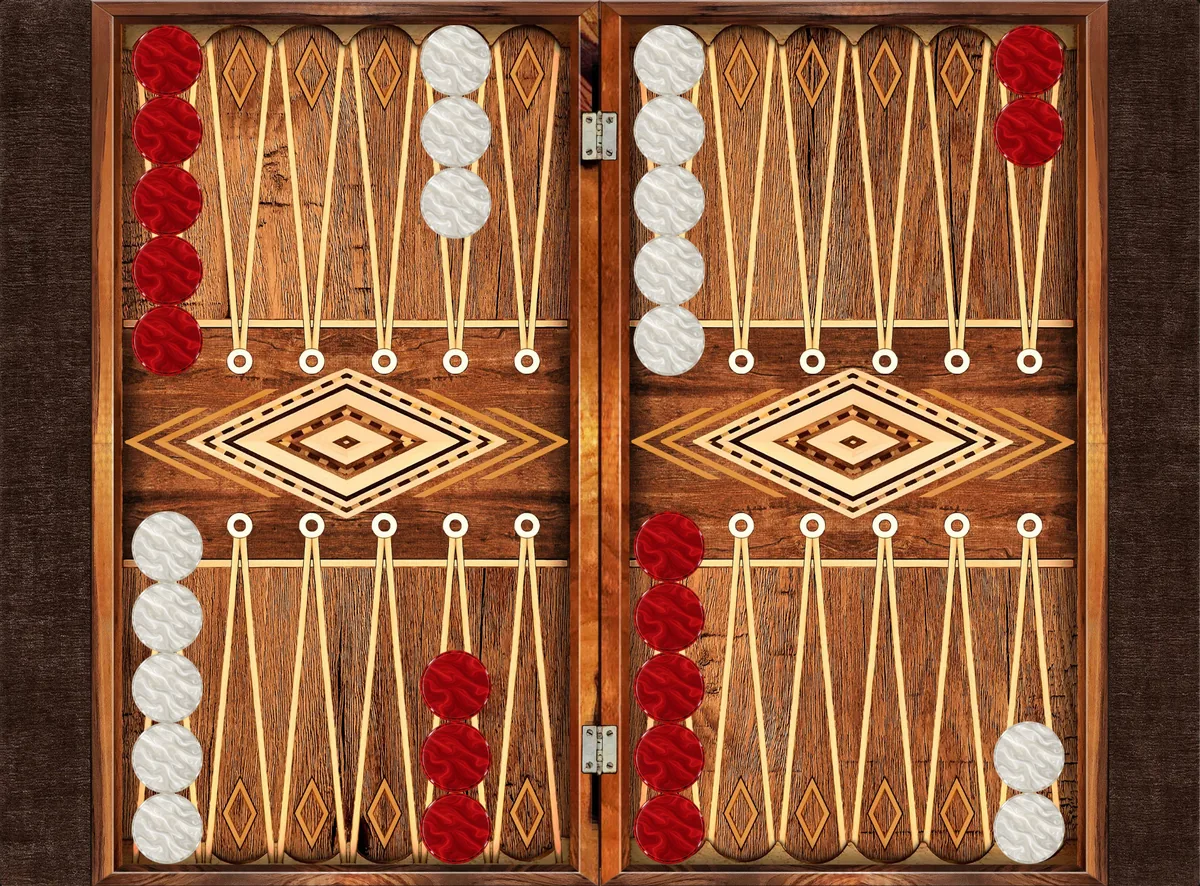
In setup and movement, shesh besh is identical to standard backgammon: the same board, the same 167-pip starting position (2×24+5×13+3×8+5×6=167), the same directions of play.
Shesh besh uses the standard backgammon starting position and movement.
Beyond that, sources describe it in two honest and compatible ways:
Wikipedia treats shesh besh as the regional name for backgammon in Israel and much of the Middle East — the same game, locally named. Modern casual play in Israel is frequently simply standard backgammon under the local name (see the backgammon rules page).
bkgm.com describes a rule set that differs from standard backgammon: the winner of the opening roll re-rolls both dice, there is no doubling cube, and scoring runs 1, 2 or 3 points — with the triple win awarded only if the loser still has a checker on the bar.
Both descriptions are in circulation; which applies is a matter of regional and household variation, and players should agree the details before play.
The shared Persian–Turkish dice vocabulary running through all of these reflects the game's long transmission through the region, traced on the backgammon history page.
Shesh Besh and the GamesGrid Platform
This encyclopedia documents shesh besh as part of GamesGrid's reference coverage of the tables family. The GamesGrid platform plays standard backgammon under international tournament rules; the regional variants on these pages are documented as reference, not offered as playable modes.
Frequently asked questions about shesh besh
What does shesh besh mean?
It is the traditional call for a 6-5 dice roll: shesh is Persian for six (coincidentally also the Hebrew word for six) and besh is Turkish for five. The name of the roll became the name of the game.
Is shesh besh the same as backgammon?
In setup and movement, yes — the starting position and play are identical to standard backgammon. Wikipedia treats it as the regional name for backgammon in Israel and much of the Middle East, while bkgm.com records a rule set with an opening re-roll, no cube and modified scoring; both usages exist regionally.
Does shesh besh use a doubling cube?
In the rule set described on bkgm.com there is no cube, and wins score 1, 2 or 3 points (the triple only if the loser still has a checker on the bar). Where the name simply denotes standard backgammon, standard cube practice applies.
Where is shesh besh played?
Throughout Israel and much of the Middle East. Arabic speakers call the same game tawula or tawle, and the Armenian diaspora uses tavloo/tavlou.
Why is the game named after 6-5 in particular?
6-5 is one of the game's most celebrated throws: from the standard start it runs a back checker from the 24-point to the 13-point in one turn (24−6−5=13), the classic "lover's leap". A memorable roll made a memorable name.
Balashon — Hebrew Language Detective, etymology post on "shesh besh" (balashon.com).
A new backgammon world is opening.
Imagine online backgammon as a living world, where you compete against over 500 unique personalities from 120 countries. Every member has their own character, life story, voice, playing strength and style. They compete in the same leagues and tournaments as you, build careers alongside yours and remember the matches, conversations and history you create together.
Learn who they are. Adapt to how they play. Earn their respect, make friends, create rivalries and become part of their story—because they will become part of yours.