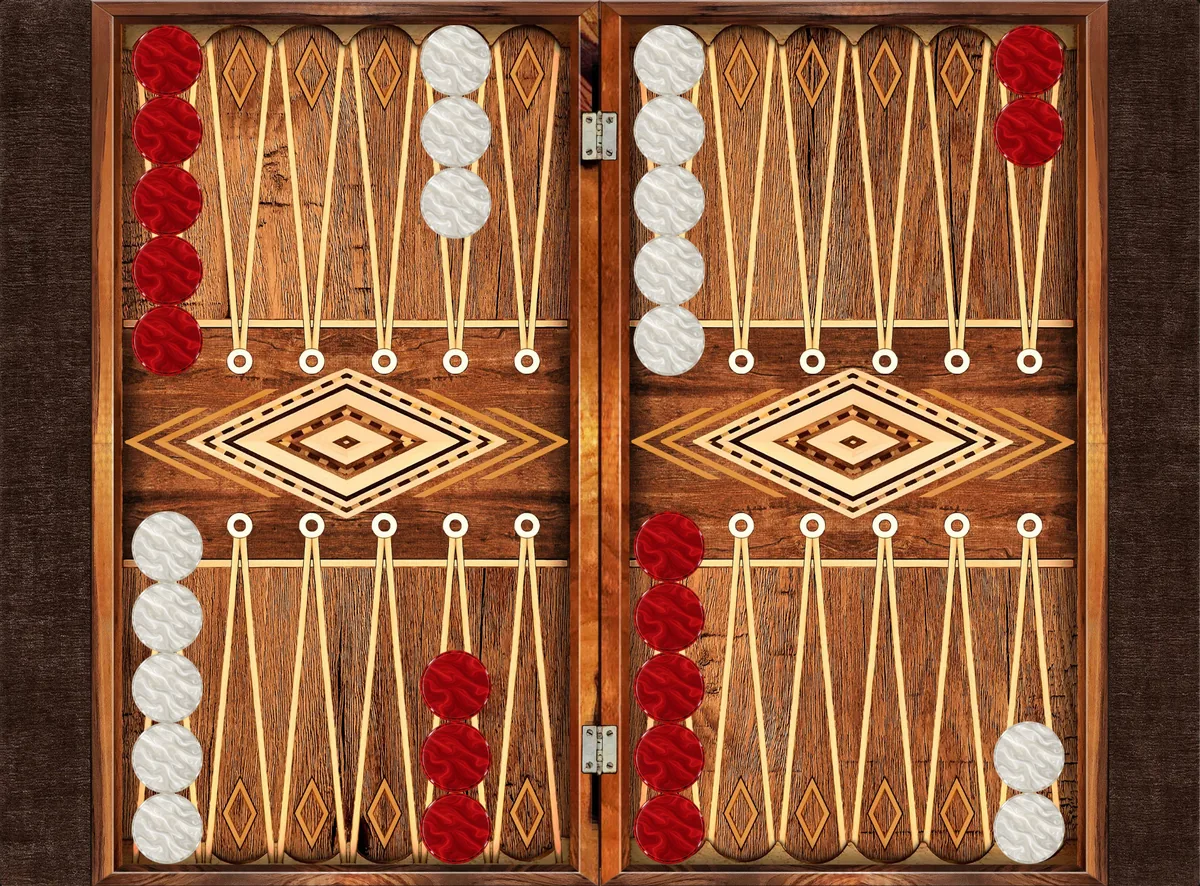
Takhteh — full name Takhteh Nard — is the Persian (Farsi) name for backgammon, and it is one of the oldest and most deeply rooted board-game traditions anywhere in the world. The name means, literally, nard board: takhteh is "board" and nard is the game itself. In Iran the game is most often called simply takhteh in everyday speech, the way English speakers say "backgammon."
GamesGrid offers modern backgammon only.
This page is the encyclopedia entry on takhteh: how the board is set up, the Farsi vocabulary that distinguishes it from English-language backgammon documentation, the handful of rule differences Iranian players observe, and the long history that places Persia at the centre of the game's origin story. For the complete international rules, see the backgammon rules page. For the standard setup that takhteh shares, see the main backgammon setup page. Takhteh is closely related to the Turkish tavla and is part of the same wider family of regional backgammon traditions.
The takhteh board setup
Takhteh uses the same physical board and the same starting position as international backgammon. Each player has 15 checkers on a board of 24 points, distributed across four points.
Standard takhteh starting position — identical to international backgammon. 15 checkers per side on the 24, 13, 8, and 6 points.
Reading each player's points from their own perspective (point 1 in the near corner, point 24 in the far corner):
Point
Stack size
Note
24
2 checkers
Back checkers, on the opponent's 1-point
13
5 checkers
Midpoint
8
3 checkers
Outfield point
6
5 checkers
Six-point
Total: 2+5+3+5=15 ✓
The opponent's setup is the mirror image, and the opening pip count is 167 for both sides — exactly as in international backgammon. This is the setup used for the standard game most Iranians simply call takhteh. (A separate tradition, Long Nardi, uses a different all-on-one-point starting array and forbids hitting; it is covered briefly below and on the backgammon rules page.)
Equipment: takhteh vocabulary in Farsi
Persian backgammon carries its own complete vocabulary, much of it centuries old:
English
Farsi (transliterated)
The game / backgammon
Nard / Takhteh Nard
The board
Takhteh
A checker
Mohreh
A die
Tas
Dice
Tas-ha
To play
Bazi kardan
How takhteh differs from international backgammon
The takhteh setup is identical to international backgammon, but Iranian play observes a few conventions that differ from the modern tournament rules used on most servers:
No doubling cube. Traditional takhteh is played without the doubling cube. The cube is a 20th-century American addition; café and home games in Iran are typically straight single-stake games.
Opening roll re-rolled. In many takhteh traditions, the player who wins the opening-roll contest does not play those two dice — they roll again for a fresh first turn. (In international backgammon, the opening dice are played as rolled.)
No hit-and-run in the home board. A number of takhteh house traditions disallow hitting an opponent's blot in your own home board and then immediately running the checker onward in the same turn.
Doubles. As in international backgammon, rolling doubles is played as four moves of that number rather than added together.
These are the conventions most commonly described for casual and traditional Iranian play; competitive Iranian players who play internationally use the standard backgammon ruleset, including the cube. For the full, unambiguous rules GamesGrid uses, see the backgammon rules page.
Alongside standard takhteh, Iran (and the wider region from the Caucasus to Russia) also plays Long Nardi (nard in its long form). It uses the same board but a completely different starting position: all 15 checkers begin on each player's 24-point, both players move in the same direction around the board, and hitting is not allowed at all — the game is a pure race with blocking. Long Nardi is a genuinely different game from standard takhteh despite sharing the equipment, and it deserves its own treatment; the glossary carries the cross-lingual term map, and the backgammon rules page covers the variant rule sets.
The Persian history of backgammon
Few games can claim a deeper history in one place than nard in Persia. Backgammon-type boards consistent with the modern fifteen-checker lineage appear extremely early in the region: an ebony board with dice and sixty checkers was excavated at the Burnt City (Shahr-e Sukhteh) in south-eastern Iran, dated to roughly 3000 BCE — roughly four centuries older than the comparable set found at Ur in Mesopotamia.
The game took its recognisable nard form during the Sasanian Empire (224–651 CE). Persian tradition attributes the invention of nard to the sage Bozorgmehr (Bozorgmehr-e Bokhtagan), grand vizier to King Khosrow I Anushirvan, framing the board as a model of the cosmos — the 24 points for the hours of the day, the 30 checkers for the days of the month, the two dice for fate. Whatever the legend's literal accuracy, it tells you how central the game has been to Persian culture for fifteen centuries.
That cultural centrality continues today. In Iranian households a takhteh board is rarely far away, and teahouses across the country serve as communal spaces where players of every age meet over the board — the same role the original GamesGrid server played online for the international community from 1996.
Takhteh on GamesGrid
GamesGrid plays the standard international ruleset, which shares its setup exactly with takhteh. Persian-speaking players will find the board, the starting position and the recorded matches immediately familiar. The club's members — over 500 of them, from 120 countries — play the same game whatever name a player calls it by.
Takhteh (full name takhteh nard) is the Persian name for backgammon. The name means "nard board": takhteh is "board" and nard is the game. In everyday Iranian speech the game is usually called simply takhteh.
Is takhteh the same as backgammon?
Yes — standard takhteh is backgammon. It uses the same 24-point board and the same 15-checker starting position. Traditional Iranian play differs only in a few conventions, most notably playing without the doubling cube.
How do you set up a takhteh board?
Exactly as in international backgammon: 2 checkers on your 24-point, 5 on your 13-point, 3 on your 8-point, and 5 on your 6-point, mirrored for your opponent. See the setup section above.
What is the difference between takhteh and Long Nardi?
Standard takhteh shares the international backgammon setup and allows hitting. Long Nardi starts with all 15 checkers on the 24-point, moves both players in the same direction, and forbids hitting entirely — a pure racing-and-blocking game.
Where does backgammon come from?
The game has one of its deepest roots in Persia. A board with dice and checkers dated to around 3000 BCE was found at the Burnt City in south-eastern Iran, and the game took its recognisable nard form under the Sasanian Empire. See the history of backgammon for the full five-thousand-year arc.
See also
Backgammon Setup — the standard international setup that takhteh shares.
Tavla — the Turkish backgammon tradition, a close regional cousin.
Rules of Backgammon — full international rules, including regional variant notes.
Glossary — including the Nard / Nardi / Nardy entry.
Sources
Excavations at Shahr-e Sukhteh (the "Burnt City"), Sistan-Baluchestan, Iran — backgammon-type board dated c. 3000 BCE.
Encyclopaedia Iranica, "Backgammon" — on nard, the Sasanian period, and the Bozorgmehr attribution.
A new backgammon world is opening.
Imagine online backgammon as a living world, where you compete against over 500 unique personalities from 120 countries. Every member has their own character, life story, voice, playing strength and style. They compete in the same leagues and tournaments as you, build careers alongside yours and remember the matches, conversations and history you create together.
Learn who they are. Adapt to how they play. Earn their respect, make friends, create rivalries and become part of their story—because they will become part of yours.