Tavla is the Turkish family of tables games and, by common consent, the national game of Turkey. It is the dominant board game of the Turkish café (kahvehane) culture: sets are kept behind the counter of tea houses across the country, games are played rapidly and loudly, and the rules are transmitted almost entirely orally rather than through rulebooks. The word covers both the equipment — the hinged wooden board itself — and a family of distinct games played on it.
GamesGrid offers modern backgammon only.
The standard, everyday form is simply tavla — called erkek tavlası when it needs distinguishing from kız tavlası, a dice-only children's game — a game essentially identical to Western backgammon with a handful of rule differences described below. It is the form meant when Turks simply say "tavla", and it is by far the dominant café game. Alongside it sit uzun tavla ("long tavla", a no-hitting race in the Moultezim and long-nardy family), gül bara (the ascending-doubles game shared with Bulgaria) and hapis or esir tavla (the pinning game equivalent to Greek Plakoto). A separate historic game called Tawula, recorded in older sources, is a different and older game and should not be confused with modern tavla.
For the general framework of tables games — board layout, dice, bearing off — see the backgammon rules page and the glossary.
Equipment and Turkish Vocabulary
Turkish play has its own settled vocabulary, useful both at the board and when reading Turkish-language material. The single most-searched Turkish query on the subject is "tavla nasıl kurulur" — "how is tavla set up" — which for erkek tavlası is answered by the standard backgammon setup shown in section 3 (see also the backgammon setup page).
Turkish term
English equivalent
tavla tahtası
backgammon board
pul
checker (playing piece)
zar
die / dice
hane
point
kırmak
to hit (a blot)
Dice rolls are traditionally announced aloud in a mixed Persian/Turkish set of number words, a legacy of the game's transmission through Persian-speaking culture. The doubles have fixed names that every café player knows:
Roll
Turkish name
6-6
düşeş
5-5
dübeş
4-4
dörtcihar
3-3
dü se
2-2
dubara
1-1
hepyek
The mixture is visible inside the words themselves: dü ("two") and şeş ("six") are Persian, while beş ("five") is Turkish — so dübeş, double fives, is literally a Persian–Turkish compound. The same bilingual habit gives the region the name shesh besh, from the call for a 6-5 roll.
Erkek Tavlası: The Standard Game
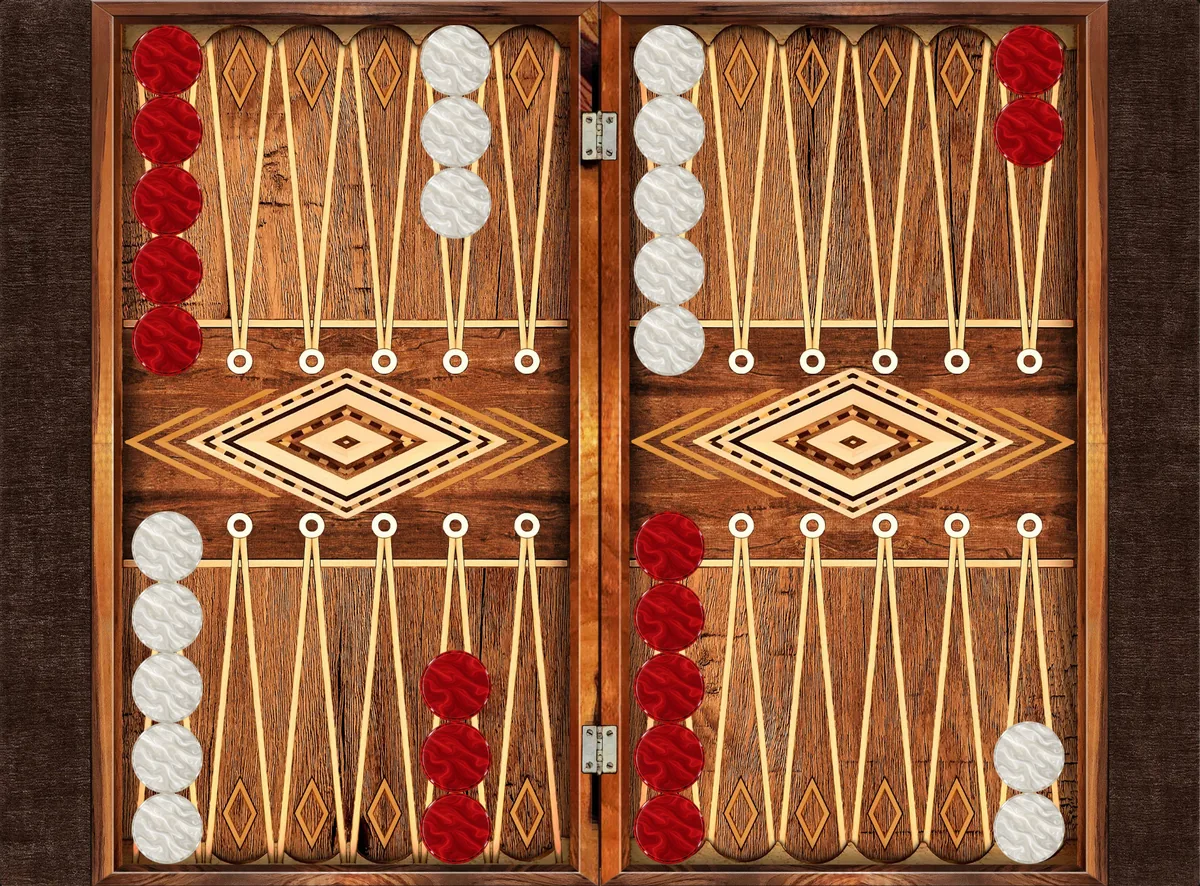
Erkek tavlası uses exactly the same starting position and direction of movement as standard backgammon. Each player begins with two checkers on the 24-point, five on the 13-point, three on the 8-point and five on the 6-point, for a starting pip count of 2×24+5×13+3×8+5×6=167.
Erkek tavlası uses the standard backgammon starting position — the answer to "tavla nasıl kurulur".
Movement, hitting (kırmak), entering from the bar and bearing off all follow standard backgammon practice. The differences are few but characteristic:
Feature
Standard backgammon
Erkek tavlası
Opening roll
Winner plays the two dice as rolled
Winner re-rolls both dice, so doubles are possible on turn one
Hit-and-run in home board
Permitted
Commonly forbidden as a house rule in café play (içeride vur-kaç yasağı): a checker that hits a blot inside the hitting player's own home board may not continue moving that turn; not enforced in federation or club tournaments
Doubling cube
Standard
Not used traditionally
Plain win
1 point
1 point
Gammon
2 points
2 points, called mars, when the loser has borne off nothing
Backgammon (triple win)
3 points
No triple win
Scoring is therefore simply 1 point for a normal win and 2 points for a mars. Games are played in informal series rather than cube-driven matches. Opening theory carries over largely intact from standard backgammon — see the opening strategy page — with adjustments for the hit-and-run ban and the absence of the cube.
Uzun Tavla: The Long Game
Uzun tavla ("long tavla") is the Turkish member of the long-game family that also includes Moultezim and the Russian game long nardy. It is not — despite what some English-language summaries have claimed — the standard Turkish form; that position belongs firmly to erkek tavlası.
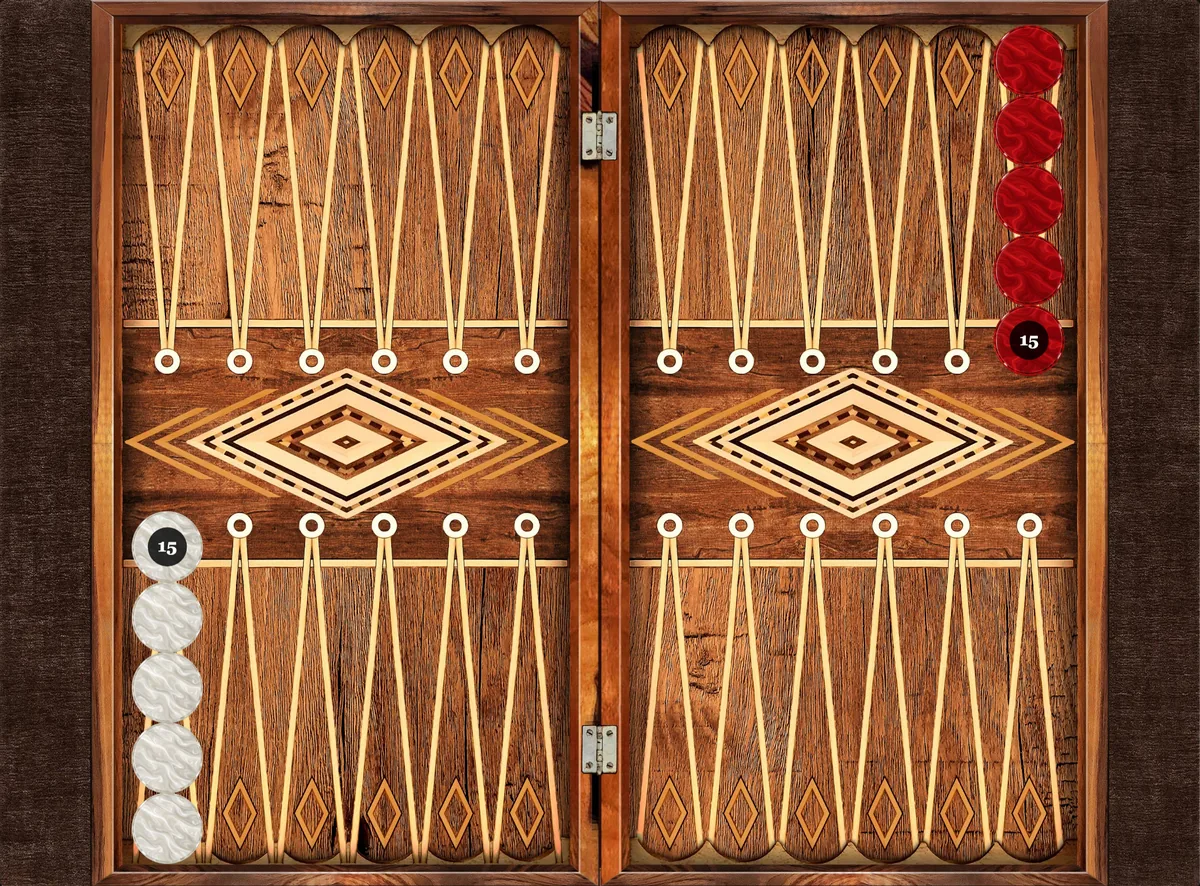
In uzun tavla all fifteen checkers begin stacked in a single corner of the board, and both players move in the same direction around all four quadrants. There is no hitting at any stage: a single checker controls its point, and the game is a pure contest of racing and blocking rather than of blots and the bar. This places uzun tavla in the same structural family as gül bara, Greek Fevga and long nardy, all of which are documented on their own pages.
Uzun tavla starting position: fifteen checkers per side stacked on the first point, the two stacks diagonally opposite. Both players travel the same way round the board — the same start as long nardy and Fevga.
GamesGrid is coming back and you can be part of it.
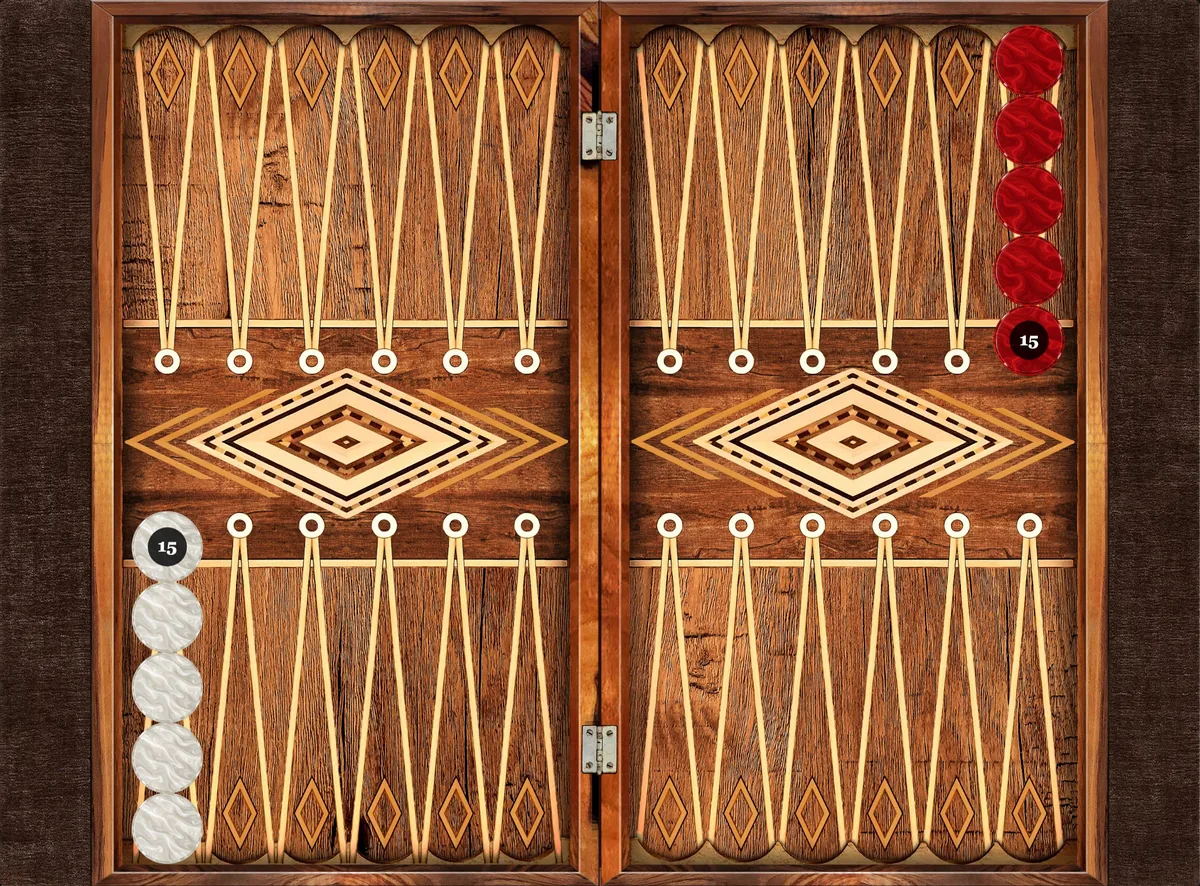
Gül bara (also written gülbahar, and known in English sources as "crazy narde") is played in Turkey and Bulgaria. All fifteen checkers begin on the rightmost point of the far side of the board, with the two players' stacks at diagonally opposite corners; both players move anticlockwise (counterclockwise) in the same direction. There is no hitting, and a single checker controls a point.
Its signature is the ascending-doubles rule: from the fourth roll of the game onwards, a player who rolls a double first plays that double, then plays every higher double in sequence up to 6-6, as far as the position allows. A player who rolls 3-3 after the rule activates thus plays 3-3, 4-4, 5-5 and 6-6 — up to 4×(3+4+5+6)=72 pips in a single turn if every move is legal. This makes gül bara famously volatile: a single mid-game double can transform a losing race.
Scoring follows the tavla pattern — 1 point for a plain win, 2 points when the loser has borne off nothing — and there is no doubling cube.
The gül bara start: fifteen checkers on the far corner, both players moving anticlockwise — no hitting.
Hapis (Esir) Tavla: The Prison Game
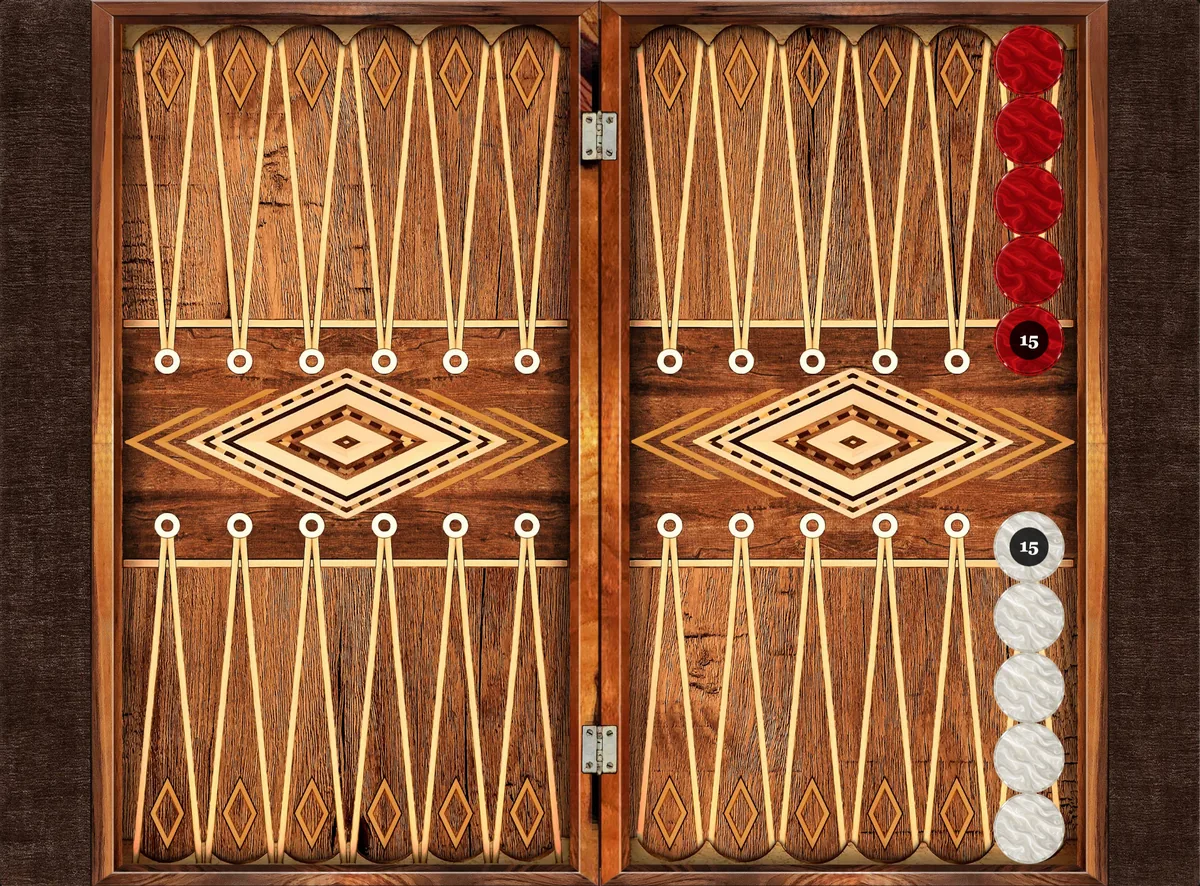
Hapis tavla or esir tavla ("prison" or "captive" tavla) is the Turkish equivalent of Greek Plakoto and Bulgarian Tapa — the pinning branch of the tables family. All fifteen checkers begin on the opponent's one-point, giving each side a starting pip count of 15×24=360. There is no hitting; instead, landing on a lone opposing checker pins it, trapping it beneath your own checker until you choose to move on.
The starting stack's final checker is the vulnerable one: losing your anchor ("mother") checker to a pin loses the game double. If both mother checkers are pinned, the game is a draw. Scoring is otherwise 1 point for a plain win and 2 points for a win when the loser has borne off nothing, with no doubling cube. The Greek treatment of the same game, including its fuller mother-rule formulations, is on the tavli page.
The hapis start: all fifteen on the opponent's ace point — the pinning game begins as a 360-pip escape.
Regional Variation
Oral transmission means that many Turkish households and cafés maintain local house rules across all the variants above.
Tavla Among Its Neighbours
Tavla sits inside a continuous belt of tables traditions. The Persian game takhteh is its closest sibling — the two share the mixed Persian number vocabulary for dice calls — while Greek tavli, the Russian and Caucasian nardi family and the Levantine naming tradition of shesh besh each pair a backgammon-like short game with no-contact long games, exactly as Turkey pairs erkek tavlası and uzun tavla. The shared ancestry of all of these is traced on the backgammon history page.
Tavla on GamesGrid
This encyclopedia page documents the tavla family as part of GamesGrid's reference coverage of the world's tables traditions. The GamesGrid platform plays standard backgammon under international tournament rules — the same rules, board and starting position that erkek tavlası shares. Tavla itself is not a playable mode on GamesGrid.
Frequently asked questions about tavla
What is the difference between tavla and backgammon?
Erkek tavlası uses the identical setup and movement, but the winner of the opening roll re-rolls both dice (so opening doubles are possible), hit-and-run inside your own home board is commonly forbidden as a café house rule, there is traditionally no doubling cube, and there is no triple win — only a plain win (1 point) and a mars (2 points).
How do you set up tavla (tavla nasıl kurulur)?
For erkek tavlası, exactly as in standard backgammon: two checkers on the 24-point, five on the 13-point, three on the 8-point and five on the 6-point per player. Uzun tavla, gül bara and hapis tavla use different, non-standard setups described above.
What is mars in tavla?
A mars is a doubled win, worth 2 points, awarded when the loser has not borne off a single checker. It corresponds to the gammon in Western backgammon; tavla has no equivalent of the triple-value backgammon win.
Does tavla use a doubling cube?
Traditionally, no. None of the Turkish forms — erkek tavlası, uzun tavla, gül bara or hapis tavla — uses the cube; games are worth 1 or 2 points on their own merits.
What is uzun tavla?
Uzun tavla ("long tavla") is the Turkish long game: all fifteen checkers start in one corner, both players move the same way around the board, and there is no hitting. It belongs to the Moultezim/long-nardy family and is a secondary form beside the dominant erkek tavlası.
Crane, "Tavla in Turkey", Backgammon Galore articles (bkgm.com).
A new backgammon world is opening.
Imagine online backgammon as a living world, where you compete against over 500 unique personalities from 120 countries. Every member has their own character, life story, voice, playing strength and style. They compete in the same leagues and tournaments as you, build careers alongside yours and remember the matches, conversations and history you create together.
Learn who they are. Adapt to how they play. Earn their respect, make friends, create rivalries and become part of their story—because they will become part of yours.