Nardi (also narde or nardy) is the tables tradition of Russia, Armenia, Azerbaijan, Georgia and Central Asia. Its principal form is long nardy (Russian: длинные нарды), a no-contact race that is one of the most widely played tables games in the world by population. The name and the game descend from the Persian nard (nardshir) — see the takhteh page for that heritage and the backgammon history page for the wider lineage.
GamesGrid offers modern backgammon only.
In the same regions, "short nardy" simply means standard backgammon under the local name; this page covers the distinctive long game.
Setup and Movement
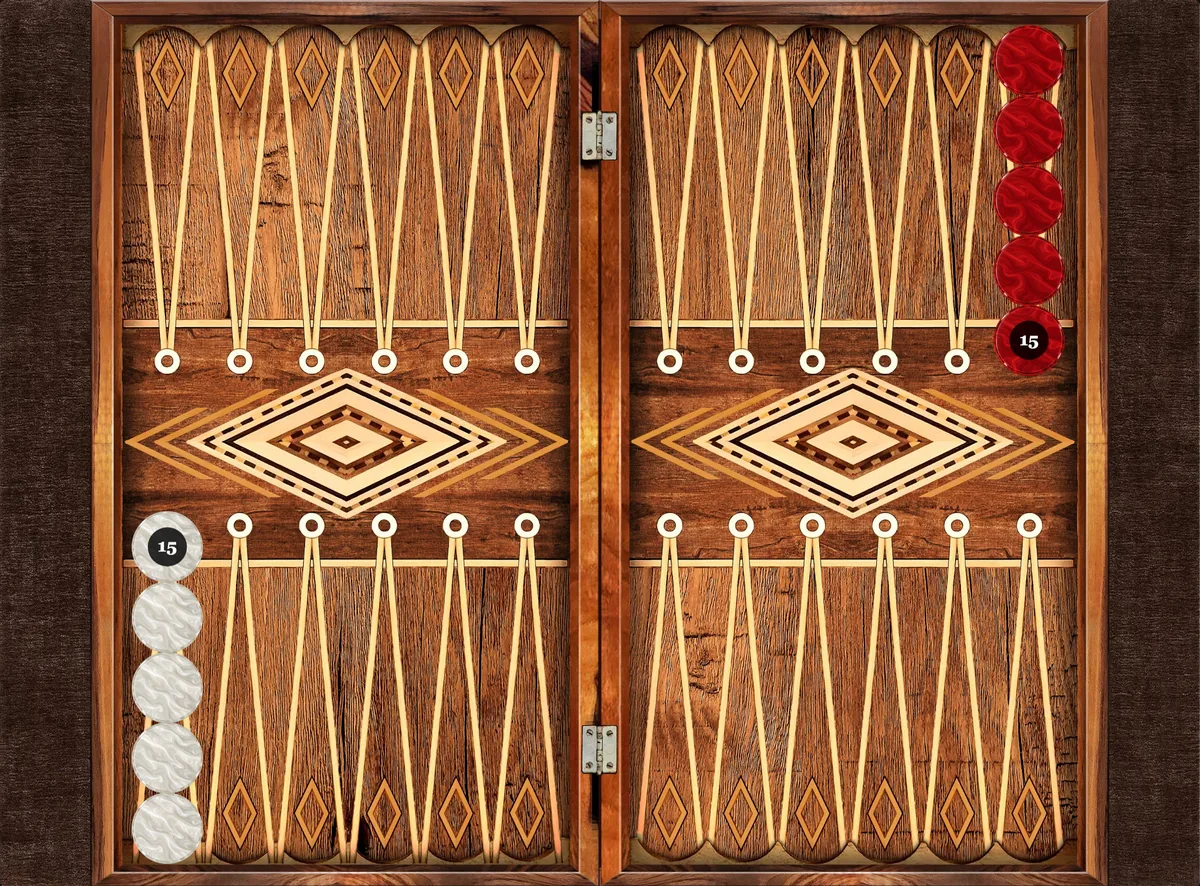
Each player's fifteen checkers all begin stacked on the "head" — the player's own point 24 — with the two heads at diagonally opposite corners of the board. Both players move anticlockwise (counterclockwise), in the same direction, each travelling the full circuit towards their own home quadrant.
The starting pip count is 15×24=360 per player — more than double the standard backgammon start of 167 — so long nardy games are long races by construction.
There is no hitting, ever. A single checker controls a point: an opposing checker may never land on it. With no blots, no bar and no re-entry, the entire game is fought through blocking chains and timing.
The nardi start: all fifteen checkers on the head. Both players race in the same direction — there is no hitting.
The Head Rule
The signature constraint of long nardy is the head rule: only one checker may leave the head per turn.
The exception comes on the first roll of the game. If the opening throw is double 6-6, 4-4 or 3-3, two checkers may leave the head — these are precisely the doubles that could not otherwise be played in full from a fresh position. Formulations of this exception vary between sources: the bkgm.com description gives a looser wording under which the first roll generally permits two checkers off the head, while Russian rule statements restrict the exception to the listed doubles. Agree the formulation before serious play.
Blocking and the Six-Prime Rule
Because one checker owns a point outright, walls are cheap to build — so long nardy imposes an explicit fairness limit. A player may not build six consecutive points (a six-prime) unless at least one opposing checker is ahead of the block. A blockade that would seal in the opponent's entire army is illegal; some opposing checker must always retain, at least in principle, a path forward.
Strategy therefore centres on constructing five-point and broken six-point chains at the right moment of the race, and on timing the release of checkers from the head against the opponent's developing wall.
GamesGrid is coming back and you can be part of it.
Checkers are borne off from the last quadrant of each player's circuit. Bear-off is by exact roll, with the usual higher-point conventions: a number larger than the highest occupied point bears a checker off that highest point, and within the board a die may instead be used to move inside the home quadrant. With no contact possible, the bear-off is a pure race calculation.
Scoring
Result
Name
Value
Plain win
oyn
1 point
Loser bore off nothing
mars
2 points
Enhanced win (informal)
koks
3 points
The koks (3 points) exists in informal play only and is not part of tournament rules. There is traditionally no doubling cube.
Regions and Heritage
Long nardy is the everyday tables game across Russia and the Caucasus — Armenia, Azerbaijan and Georgia in particular — and throughout Central Asia, played in homes, courtyards and clubs. Its ancestry runs through the Persian nard (nardshir) tradition documented on the takhteh page, and it is a close structural relative of Turkish uzun tavla, Greek Fevga (see tavli) and gül bara, all of which share the same-direction, no-hitting design.
Nardi and the GamesGrid Platform
This encyclopedia documents nardi as part of GamesGrid's reference coverage of the tables family. The GamesGrid platform plays standard backgammon under international tournament rules; the regional variants on these pages are documented as reference, not offered as playable modes.
Frequently asked questions about nardi
How is long nardy different from backgammon?
Almost every element of contact play is removed: all fifteen checkers start on one point (the head), both players move the same direction, there is no hitting and no bar, and a single checker controls a point. The starting pip count is 15×24=360 rather than backgammon's 167.
What is the head rule?
Only one checker may leave the head (the starting point) per turn. On the first roll of the game there is an exception for doubles 6-6, 4-4 and 3-3, when two checkers may leave — though sources differ on the exact formulation of this exception.
Can you hit checkers in nardi?
No. There is no hitting at any stage of long nardy. A lone checker fully controls its point, and the game is decided by racing and blocking.
What are oyn, mars and koks?
Oyn is a plain win worth 1 point; mars is worth 2 points when the loser has borne off nothing; koks is an informal 3-point win that does not appear in tournament rules. There is traditionally no doubling cube.
Where is nardi played?
Across Russia, Armenia, Azerbaijan, Georgia and Central Asia. "Short nardy" in these regions means standard backgammon under the local name.
Imagine online backgammon as a living world, where you compete against over 500 unique personalities from 120 countries. Every member has their own character, life story, voice, playing strength and style. They compete in the same leagues and tournaments as you, build careers alongside yours and remember the matches, conversations and history you create together.
Learn who they are. Adapt to how they play. Earn their respect, make friends, create rivalries and become part of their story—because they will become part of yours.