Tavli is the Greek tables tradition: not a single game but a series of three games — Portes, Plakoto and Fevga — played in rotation within one match. It is a fixture of café and plateia (town-square) life in Greece and Cyprus, played quickly, sociably and without written rules, in much the same café setting as Turkish tavla.
GamesGrid offers modern backgammon only.
Three structural features unite all three games:
No doubling cube is used in any of them.
Scoring is identical throughout: 1 point for a plain win, 2 points for a double win when the loser has borne off nothing.
There is no triple win of any kind.
Matches are played to 3, 5 or 7 points, with 5 and 7 the common targets. Because a double win is worth 2 points, a match to five can be over in three games: 2+2+1=5. Players cycle through Portes, Plakoto and Fevga in order, game after game, until one player reaches the target.
Portes
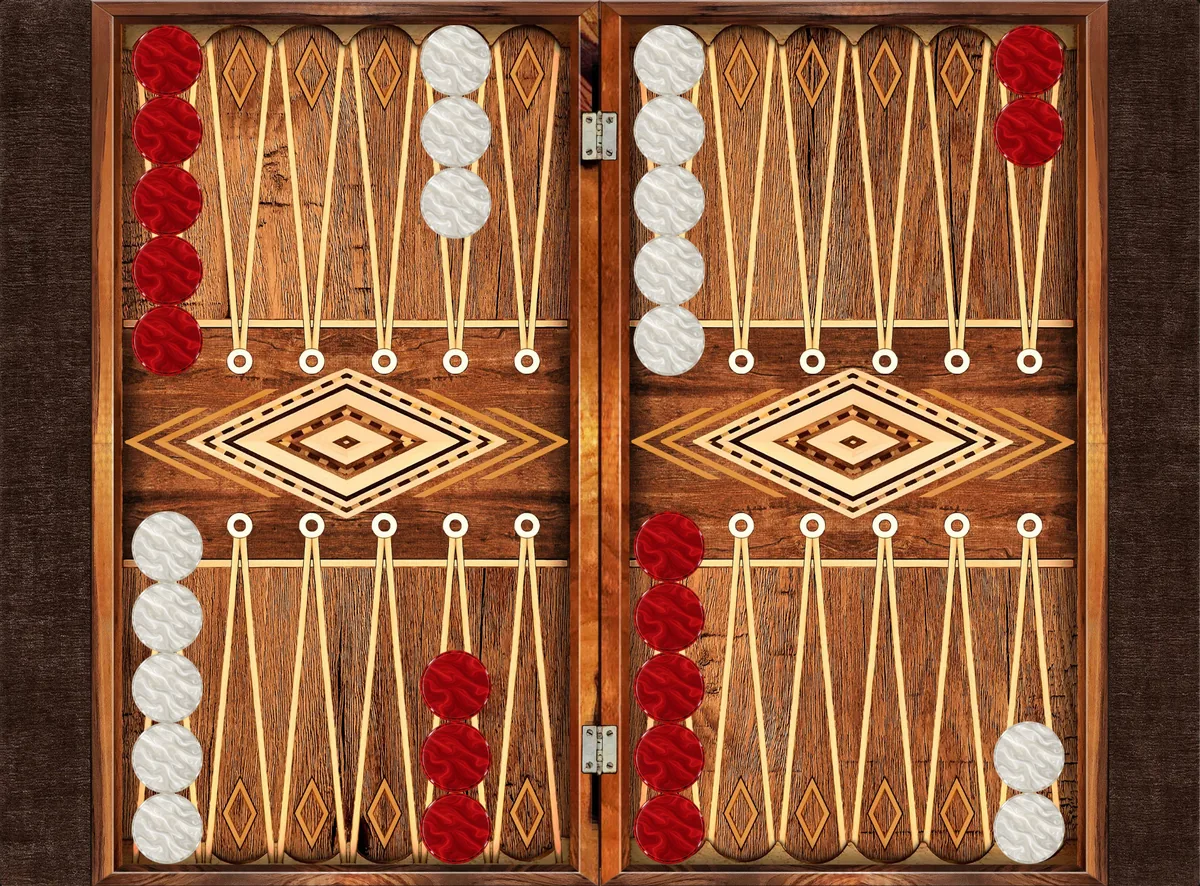
Portes ("doors", after the made points) is the Greek short game and the closest of the three to Western backgammon. The starting position is identical to standard backgammon — the familiar 167-pip arrangement (2×24+5×13+3×8+5×6=167) — and hitting, entering from the bar and bearing off work as on the backgammon rules page.
Portes, the first game of the tavli rotation, uses the standard backgammon starting position.
The differences from standard backgammon:
The winner of the opening roll re-rolls both dice rather than playing the opening throw.
No doubling cube; wins are worth 1 or 2 points as above.
No triple win.
Some descriptions of Portes add the Turkish-style ban on hit-and-run inside one's own home board, while the bkgm.com Portes page omits it; treat this as regional variation and agree the rule before play.
Plakoto
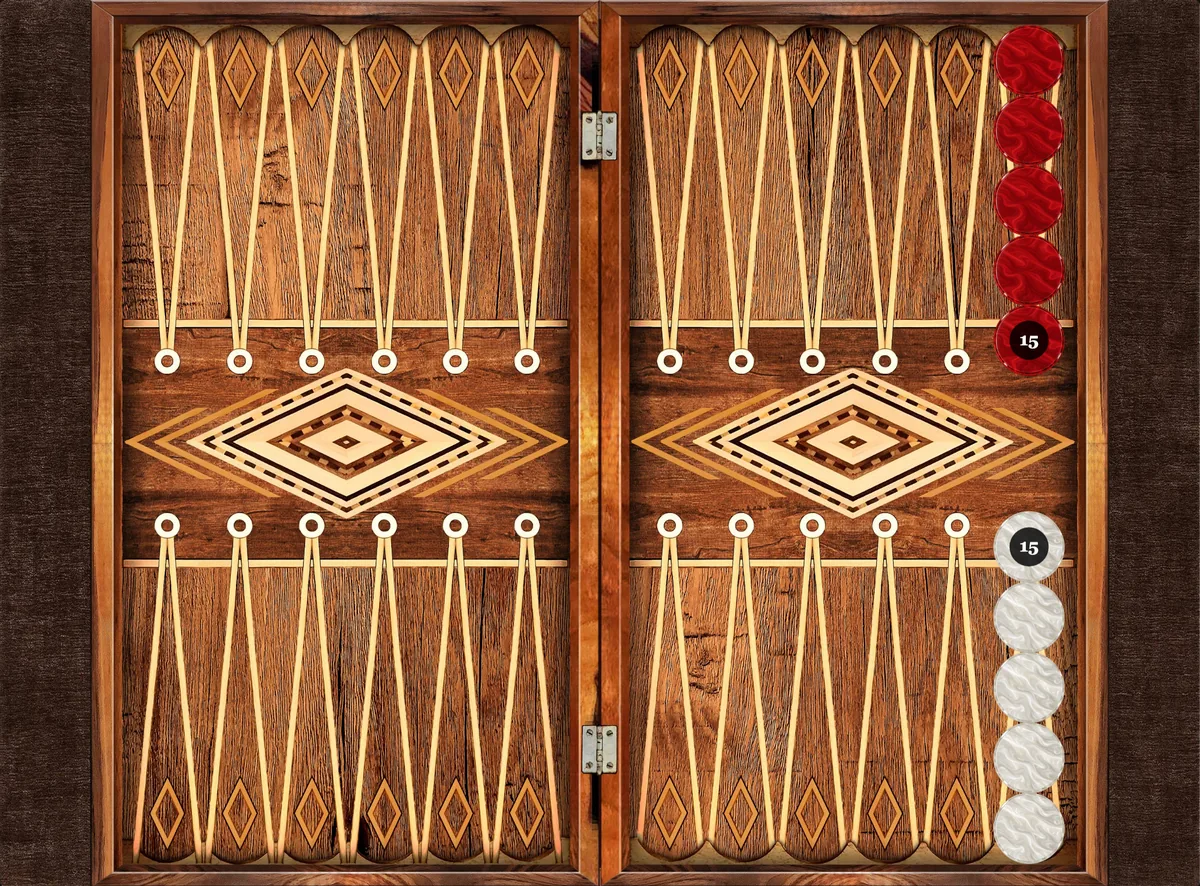
Plakoto is the pinning game. Each player's fifteen checkers all start on the opponent's one-point, and the players move in opposite directions — so each side begins with a pip count of 15×24=360.
There is no hitting. Instead, landing on a lone opposing checker traps (pins) it: the pinned checker cannot move until the pinning checker leaves, and while the pin lasts, the point is controlled by the pinning player.
The dramatic feature is the mother rule. The last checker remaining on your starting point is the mother. If your mother is pinned before it has left the starting point, you immediately lose the game as a double (2 points) — unless your opponent's mother is similarly exposed to the same fate, in which case the game is a tie. Plakoto is the same game as Turkish hapis/esir tavla and Bulgarian Tapa; see the tavla page for the Turkish treatment.
The plakoto start: all fifteen checkers on the mother point — the opponent's ace.
Fevga
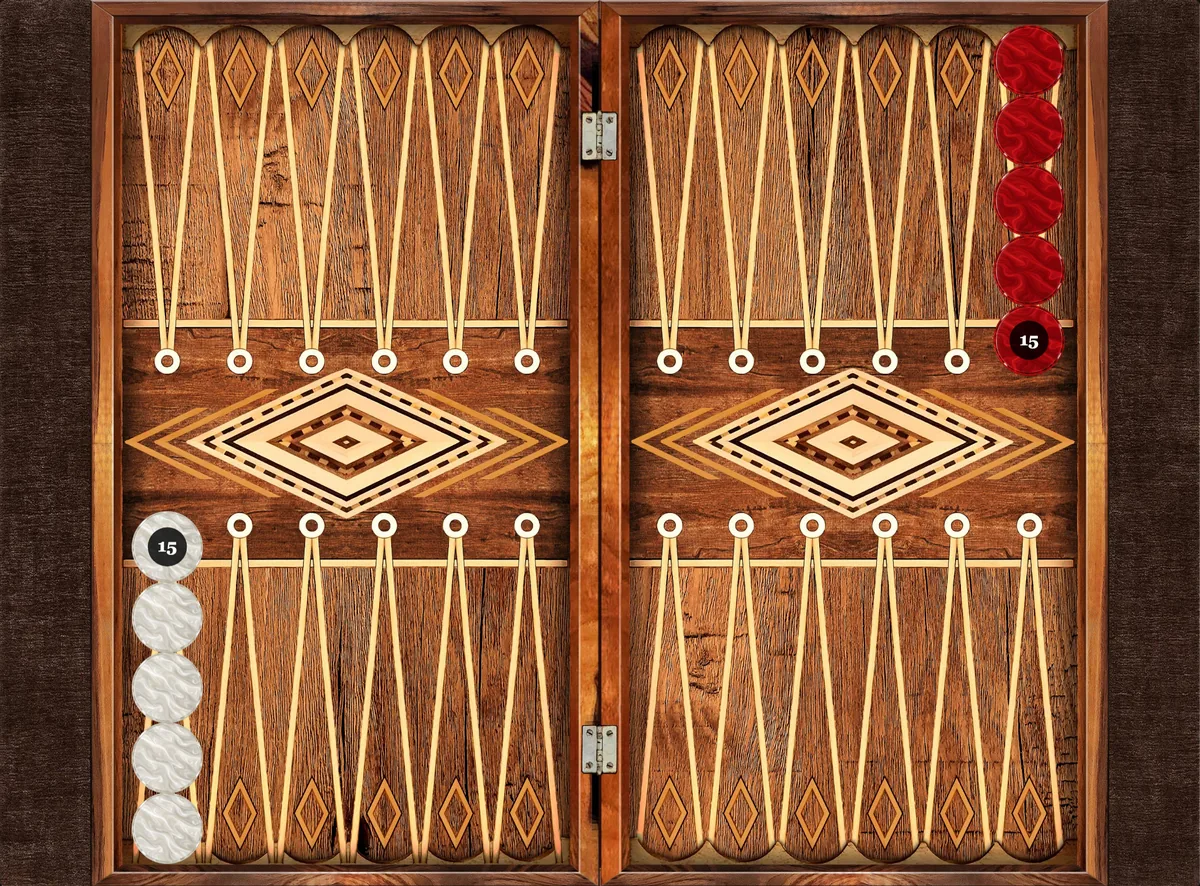
Fevga ("run!") is the Greek long game, a relative of Turkish uzun tavla and Russian long nardy. All fifteen checkers start on the rightmost point of the far side of the board, the two players' stacks occupying diagonally opposite corners, and both players move in the same anticlockwise (counterclockwise) direction.
The distinguishing rules:
No hitting — and a single checker controls a point, so a lone checker is a block, not a blot.
First-checker rule: your first checker must pass the opponent's starting point before any of your other checkers may move.
Anti-blocking rule: you may not maintain a six-point prime that completely fences in an opponent whose checkers are all collected behind it. A total blockade of a fully trapped opponent must be broken.
Because single checkers make points, Fevga strategy revolves around chains of blocking points rather than hitting duels, and the early race to get the first checker round is critical.
The fevga start: diagonal corners, same-direction race, no hitting — a single checker controls a point.
The Three Games Compared
Portes
Plakoto
Fevga
Setup
Standard backgammon
All 15 on opponent's one-point
All 15 on far-right point, opposite corners
Directions
Opposite
Opposite
Same (anticlockwise)
Contact
Hitting, as backgammon
Pinning, no hitting
None; lone checker blocks
Signature rule
Opening-roll re-roll
Mother rule
First checker must pass opponent's start; no total six-prime fence
Scoring
1 / 2 points
1 / 2 points (mother loss =2)
1 / 2 points
Cube
None
None
None
Tavli and the GamesGrid Platform
This encyclopedia documents tavli as part of GamesGrid's reference coverage of the world's tables traditions. The GamesGrid platform plays standard backgammon under international tournament rules; the regional variants on these pages are documented as reference, not offered as playable modes.
Frequently asked questions about tavli
What are the three games of tavli?
Portes (the backgammon-like short game), Plakoto (the pinning game, where lone checkers are trapped rather than hit) and Fevga (the no-contact long game in which both players move the same direction). They are played in rotation within a single match.
Does tavli use a doubling cube?
No. None of the three games uses a cube. Every game is worth 1 point, or 2 points as a double win when the loser has borne off nothing, and there is no triple win.
What is the mother rule in Plakoto?
The last checker on your starting point is the mother. If it is pinned before leaving, you immediately lose 2 points — unless your opponent's mother is similarly exposed, in which case the game is a tie.
How is Fevga different from backgammon?
Everything about contact changes: there is no hitting, one checker alone controls a point, both players move the same direction from diagonally opposite corners, your first checker must pass the opponent's starting point before the rest may move, and you may not keep a six-prime that completely fences in a fully trapped opponent.
How many points do you play tavli to?
Matches run to 3, 5 or 7 points, with 5 and 7 the common choices. Since double wins score 2, a five-point match can finish in as few as three games (2+2+1=5).
Imagine online backgammon as a living world, where you compete against over 500 unique personalities from 120 countries. Every member has their own character, life story, voice, playing strength and style. They compete in the same leagues and tournaments as you, build careers alongside yours and remember the matches, conversations and history you create together.
Learn who they are. Adapt to how they play. Earn their respect, make friends, create rivalries and become part of their story—because they will become part of yours.