Trictrac is the great tables game of pre-Revolutionary France — and, importantly for the modern reader, it is not backgammon under another name. Though played on the same style of board with fifteen men and two dice per side, trictrac is a fundamentally different game: the object is to accumulate points by scoring positions and feats of play, the celebrated jans, rather than to race one's men off the board. Games of trictrac routinely end before any piece has left the board at all.1
GamesGrid offers modern backgammon only.
For over two centuries trictrac was the aristocratic game of France, codified in print, furnished in marquetry, and woven into the national vocabulary. This page covers its rules in outline, its rise and fall, and its simpler successor jacquet — this is also the site's reference page for jacquet. For the game family as a whole, see the history page; for the modern game the French now play, see the backgammon rules page.
What Trictrac Is — and Is Not
Trictrac belongs to the tables family alongside backgammon, tavla, tavli and nardi, but it occupies a branch of its own. The decisive differences from backgammon:
Feature
Backgammon
Trictrac
Object
Bear off all 15 checkers first
Accumulate points by scoring jans
Hitting
Blots are hit and sent to the bar
No actual hitting — the potential to hit scores points
Doubles
Played four times
Played only once
Game end
Always by bear-off (or resignation/cube)
Often before any man leaves the board
Scoring unit
Points per game (cube, gammons)
Points → trous, matches to 12 trous
Trictrac is best understood as a game of position-scoring played on tables equipment: the board is a scoring landscape, and moving one's men is the means of generating scoring situations rather than an end in itself.12
Board and Starting Position
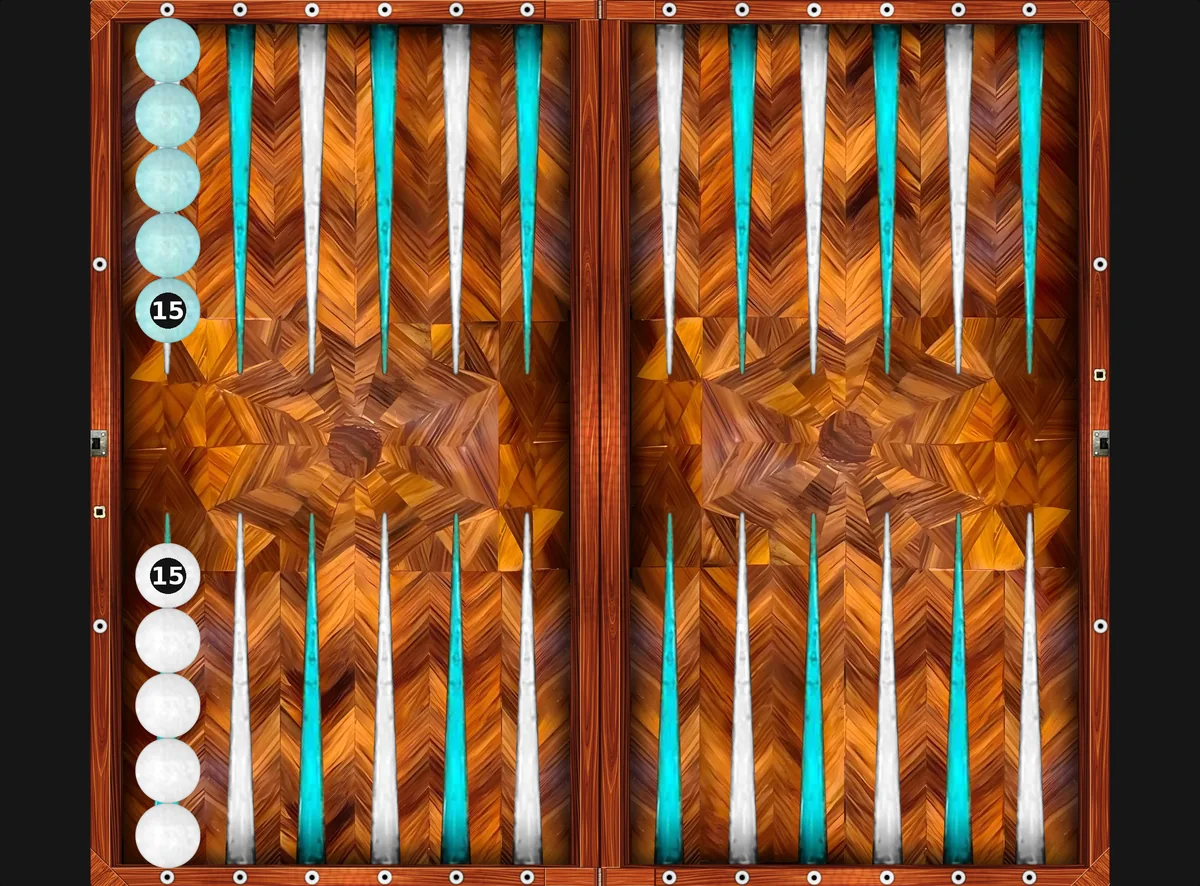
Each player begins with all 15 men stacked on his own first point, known as the talon.3 The board is the familiar 24-point tables board, traditionally fitted with pegs and peg-holes along the rails for marking trous (holes) — the game's larger scoring unit — so that a proper trictrac table is recognisable at a glance by its scoring apparatus.
The starting position: all fifteen men on the talon. The two talons face each other at the same end of the board; each player travels along his own side to the rest corner, then back along the opponent's side. The rows of peg-holes along the rails mark the trous.
How Trictrac Is Played
Both players roll and move men according to the dice, as in other tables games, but with two structural departures:
Doubles are played only once. A roll of 5-5 moves two fives, not four — there is no four-move bonus.1
There is no capture. When your men could hit an enemy blot by the numbers rolled, you do not remove it; instead you score points for the potential hit, an act called battre ("to strike"). The blot stays where it is; the points go on your tally.13 The hit must be genuine — battre à vrai, with the intermediate points open. Claiming a hit that the position does not allow, battre à faux, gives the same points to the opponent instead.32
Play thus becomes a continuous exchange of scoring claims: each roll is examined for the jans and battre opportunities it creates, points are declared and marked, and the men advance — often slowly, and often never as far as bearing off before the match is decided on points.
The Jans, Trous and the Bredouille
The scoring situations of trictrac are collectively the jans — a codified catalogue of positions and dice events, each worth a fixed number of points. Among them:
Jan de mézéas — one of the classic named jans of the codified game.3
Battre le coin — scoring against the opponent's corner point.3
The various battre scores for the potential to hit blots, as described above.
Points convert to the game's larger currency at a fixed rate: 12 points make 1 trou, marked with the pegs on the rail. A match is played to 12 trous, so a full match represents up to
12×12=144
points of accumulated scoring. The most celebrated flourish is the bredouille: a player who scores their 12 points consecutively, without the opponent scoring in between, scores two trous instead of one.132 Managing the bredouille — protecting one's unbroken run, or breaking the opponent's — is a strategic layer with no backgammon equivalent whatsoever.
Two scoring examples
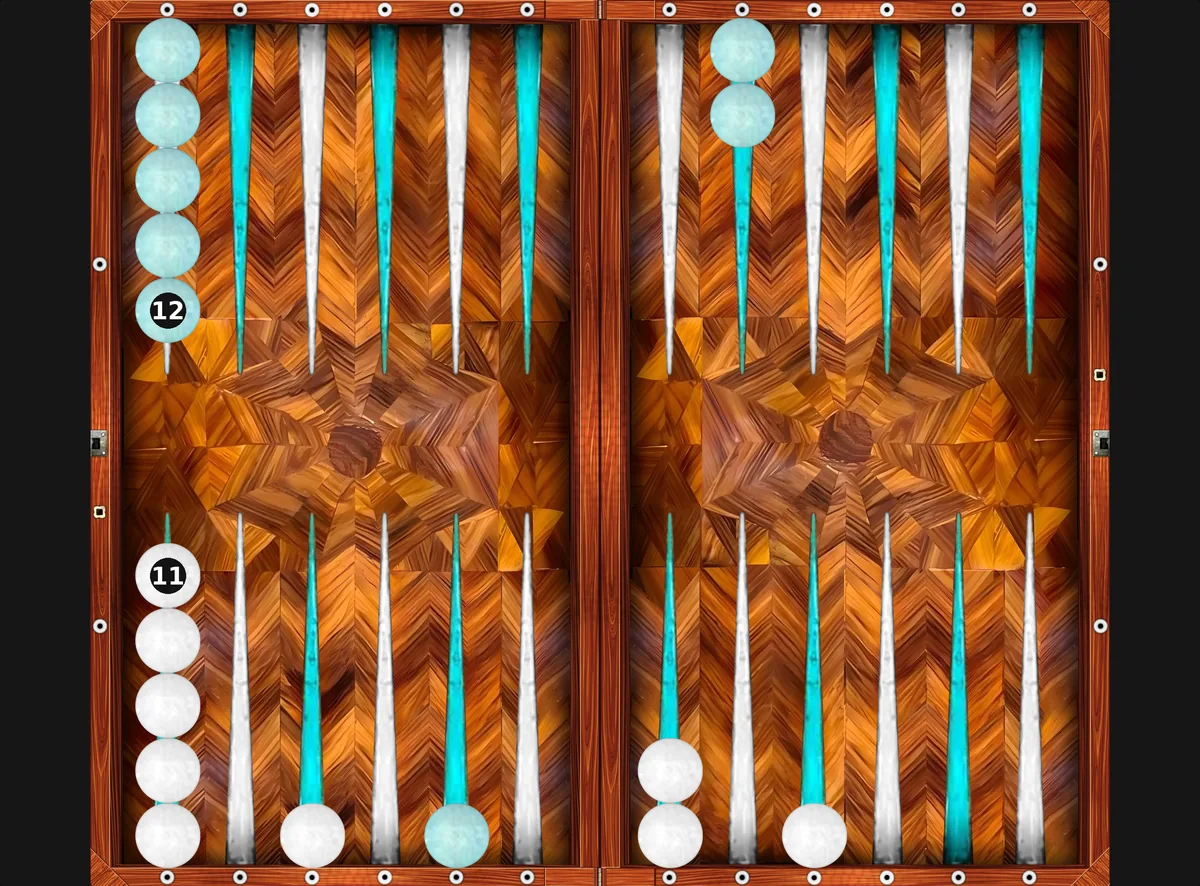
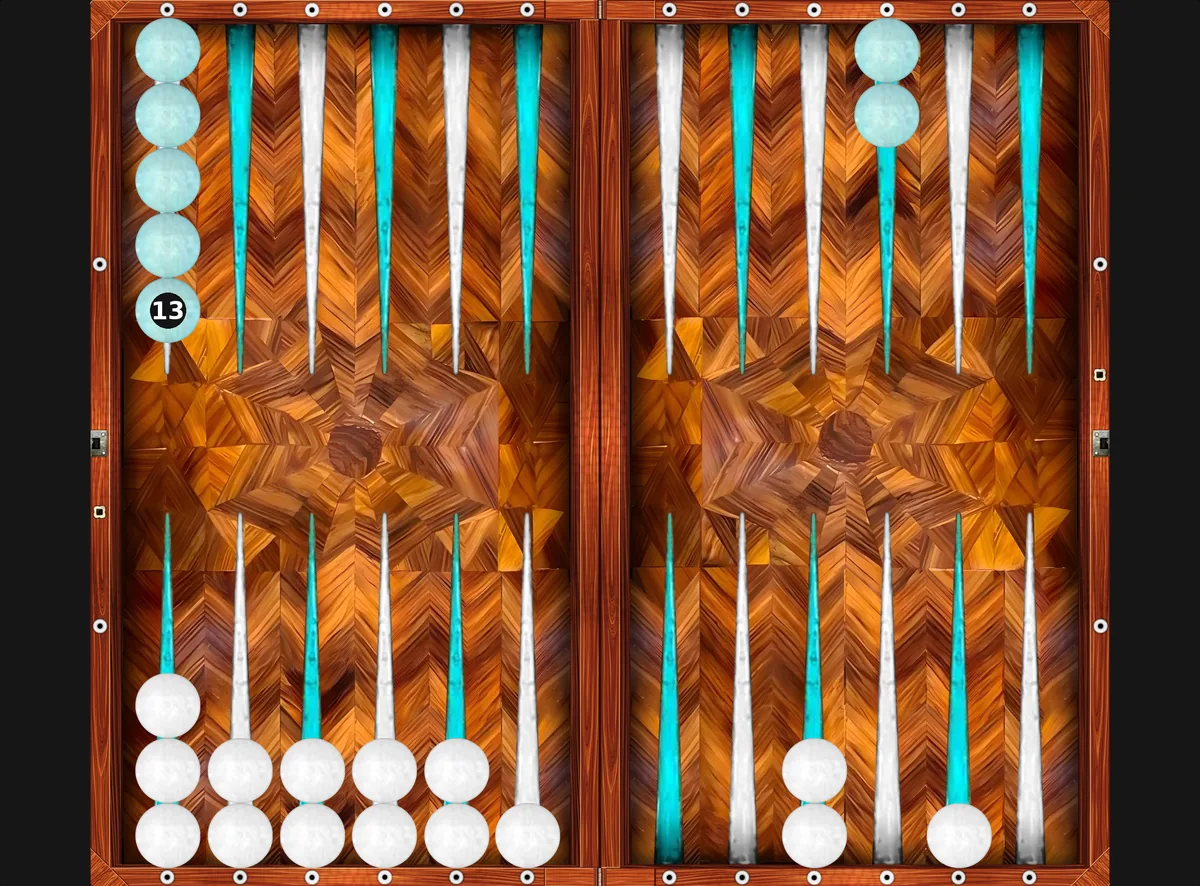
Trictrac is easier to grasp from a position than from the rulebook. In both examples White plays from the bottom-left talon along the bottom of the board; the points are counted from the talon (T) up to the rest corner (11).
Battre à vrai. White rolls 4-2. The turquoise blot on White's 4-point is hit directly by a 4 from the talon and by a 2 from the 2-point: two ways, by singles, in the petit jan — 4 points each, 8 points in all. The blot is not removed; White marks the points and plays the roll.
A hit in the petit jan (the first table, T to 5) scores 4 points by singles and 6 by doubles; a hit in the grand jan (6 to 11) scores 2 by singles and 4 by doubles.1 Each way the blot can be reached counts separately, which is why a single roll can be worth 8 or even 12 points.
Plein (jan de remplissage). White rolls 5-2. Playing the 5 from the talon puts a second man on the 5-point, so all six points of the petit jan now hold two or more men: the plein is made, 4 points by singles (6 by doubles). Every later roll that keeps the plein intact scores again.
Filling a table — at least two men on each of its six points — is the plein. Making it scores 4 points by singles or 6 by doubles, and so does every roll that preserves it, which turns a well-built petit jan into a steady source of points.1
GamesGrid is coming back and you can be part of it.
The word trictrac is first attested in the early sixteenth century — French Wikipedia cites a letter of Machiavelli from 1513 — and the game's rules were codified in Jollivet's treatise of 1634.3 Through the seventeenth and eighteenth centuries trictrac reigned as the aristocratic game of France: the salon game of the ancien régime, with its own literature, tutors and cabinet-made tables.
The Revolution interrupted but did not kill it; trictrac enjoyed a revival under the Restoration (after 1815) before entering a long decline across the nineteenth century. On when it finally died as a living tradition, sources differ, and the honest answer is a range: some place its effective extinction in the late 1800s, others in the first quarter of the twentieth century.13 Either way, by the early twentieth century trictrac survived only in books and antique furniture.
Jacquet: Trictrac's Successor
What replaced trictrac at French tables was jacquet — a much simpler race game that this section covers as the site's jacquet reference.
Jacquet appeared around 1800 (it is attested from 1827, and may have arrived via Spain or Catalonia).4 Its hallmarks:
It is a true race to bear off, not a jan-scoring game.
Both players' men move in the same direction around the board — the movement pattern of the nardi family rather than of backgammon.
The postillon rule: a designated lead checker must complete its journey before the rest of the army may advance, a pacing mechanism unique to jacquet among the French games.4
Jacquet supplanted trictrac domestically across the nineteenth century, offering casual players the tables experience without trictrac's forbidding scoring code. It remained the standard French tables game until roughly the 1960s–70s, when Anglo-American backgammon — with its doubling cube and international tournament scene — displaced jacquet in turn.4
"Tric Trac" in Modern French
A caution against a common error: modern French players call the modern game "backgammon", using the English name. The term "tric trac" survives only as a dated or colloquial label, or as a historical term — sometimes applied to the board itself rather than to any game played on it.3 It is not the everyday French word for backgammon, and encyclopedic writing should not present it as such.
Trictrac and GamesGrid
GamesGrid documents trictrac and jacquet as part of its reference coverage of the historical tables family, alongside the history page and the pages on tavla, tavli and nardi. The GamesGrid play platform centres on standard backgammon.
Frequently asked questions about trictrac
Is trictrac the same game as backgammon?
No. Trictrac is a distinct French tables game whose object is accumulating points by scoring positions and feats — the jans — rather than racing to bear off. Games often end before any piece has left the board.
How does hitting work in trictrac?
There is no actual hitting. When your roll gives you the potential to hit an enemy blot, you score points for that potential — the act called battre — and the blot remains on the board.
What are trous and the bredouille?
Twelve points make one trou, marked with pegs on the board's rail, and matches are played to 12 trous. A player who scores their 12 points consecutively, without the opponent scoring in between, achieves the bredouille and scores two trous instead of one.
What is jacquet and how is it related?
Jacquet is the simpler French race game that appeared around 1800 (attested 1827, possibly via Spain or Catalonia). It features same-direction movement and the postillon lead-checker rule, supplanted trictrac domestically, and lasted until Anglo-American backgammon displaced it in roughly the 1960s–70s.
Do the French call backgammon "tric trac" today?
No. Modern French uses the English name "backgammon". "Tric trac" survives only as a dated, colloquial or historic label, sometimes referring to the board itself.
Imagine online backgammon as a living world, where you compete against over 500 unique personalities from 120 countries. Every member has their own character, life story, voice, playing strength and style. They compete in the same leagues and tournaments as you, build careers alongside yours and remember the matches, conversations and history you create together.
Learn who they are. Adapt to how they play. Earn their respect, make friends, create rivalries and become part of their story—because they will become part of yours.