The size of a backgammon board changes the playing experience more than many buyers expect.
Too small, and the checkers become fiddly, stacks are harder to read and the board can feel cramped. Too large, and reaching across the board becomes less comfortable during a long match.
This guide compares the four most useful backgammon board size classes, the checker sizes they are designed around and the dimensions you can expect when the board is open and closed.
It also explains what manufacturers mean when they describe a set as 15-inch, 18-inch, 21-inch or 23.5-inch.
What does a 21-inch backgammon board mean?
When a backgammon set is described as 21 inches, the measurement normally refers to its longest side.
That dimension stays essentially the same whether the case is open or closed. What changes is the width: open the board and the two halves sit beside each other, roughly doubling the closed width.
A board therefore has three useful measurements:
Length
The longest side of the case and the measurement normally used to describe the board size.
Width
The shorter side when closed. This roughly doubles when the board is opened.
Height
The thickness of the case. An open board is roughly half the height of the closed case.
This is why two sets both advertised as "21-inch" can still feel different. The external length may be the same, while the internal playing field, trays and checker size can vary.
The checker size matters just as much as the board size
A good backgammon board should be designed around the checkers that will be played on it.
Oversized checkers make the field feel crowded. Checkers that are too small leave unnecessary space between the points and make the board feel less precise.
As a practical guide, backgammon boards fall into four main size classes:
Checker diameter
Board class
50 mm (1.97″)
Championship
44 mm (1.73″)
Tournament
37 mm (1.46″)
Home
30 mm (1.18″)
Travel
The dimensions below are representative proportions for each class. Individual manufacturers may vary slightly depending on the construction of the case, trays, hinges and playing surface.
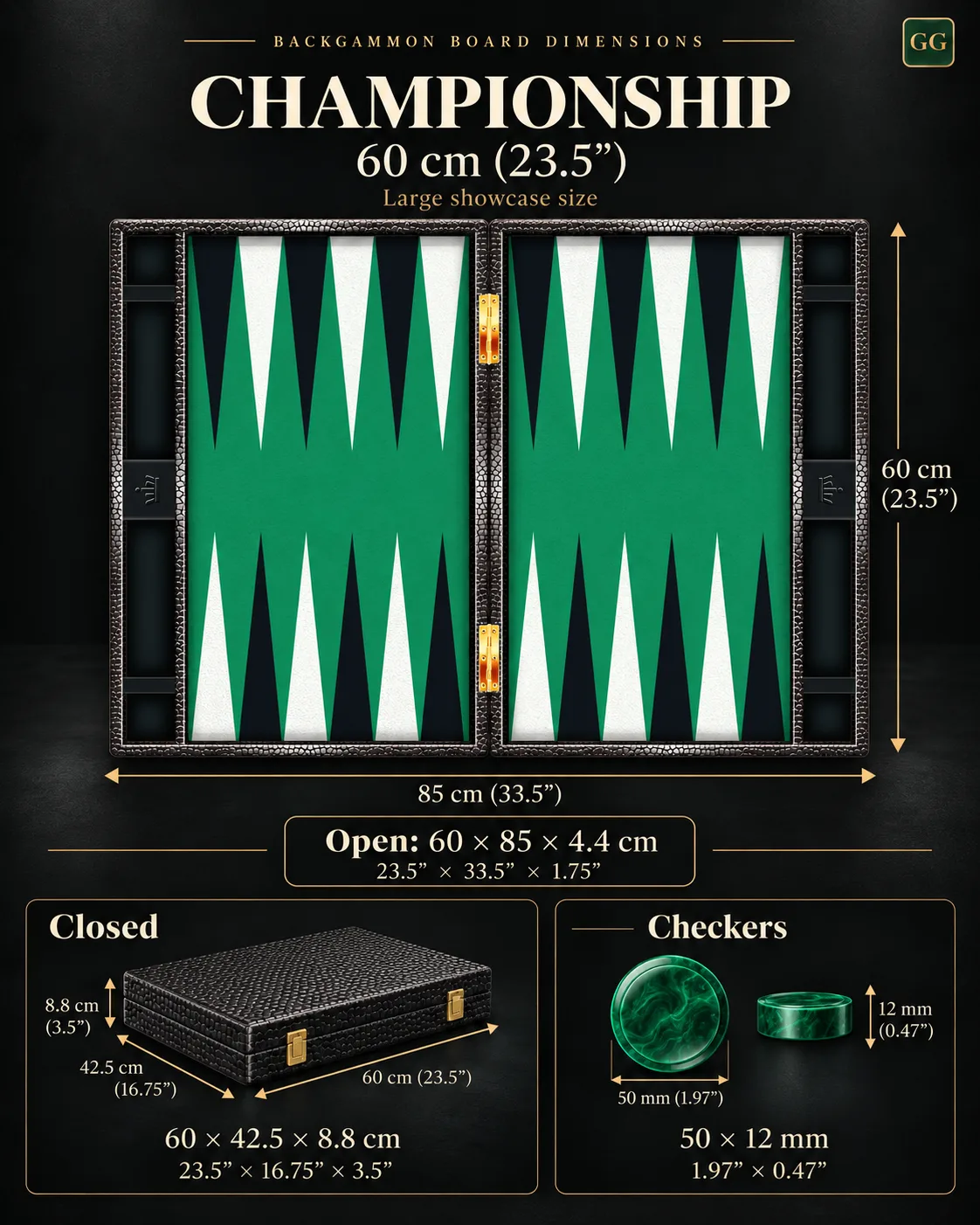
Championship Size: 60 cm (23.5″)
Designed around 50 mm checkers, Championship boards make an immediate impression.
Length
Width
Height
Closed
60 cm (23.5″)
42.5 cm (16.75″)
8.8 cm (3.5″)
Open
60 cm (23.5″)
85 cm (33.5″)
4.4 cm (1.75″)
Checker size: 50 × 12 mm (1.97″ × 0.47″)
At 85 cm wide when open, this is a substantial board. The larger checkers and playing field create excellent visibility and considerable table presence.
The trade-off is reach. Repeatedly moving checkers across a board this wide can become less comfortable during long sessions, which is one reason this size is less common for everyday tournament play.
Championship boards are best suited to spacious playing areas, showcase matches and players who simply enjoy playing on a very large board.
Championship: 60 cm (23.5″). Large showcase size.
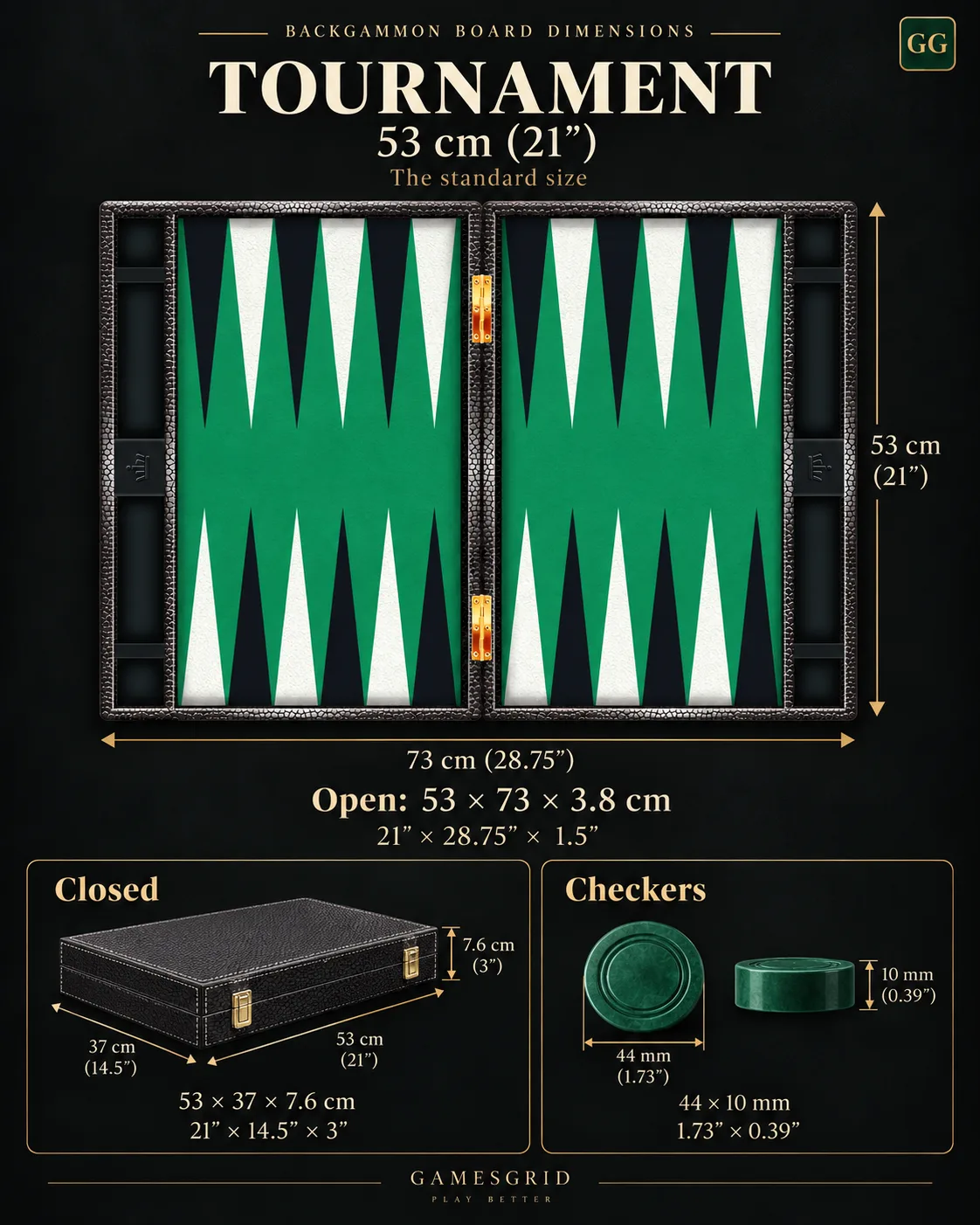
Tournament Size: 53 cm (21″)
Designed around 44 mm checkers, the 21-inch class is the size most closely associated with serious tournament play.
Length
Width
Height
Closed
53 cm (21″)
37 cm (14.5″)
7.6 cm (3″)
Open
53 cm (21″)
73 cm (28.75″)
3.8 cm (1.5″)
Checker size: 44 × 10 mm (1.73″ × 0.39″)
This size offers an effective balance between visibility, checker handling and comfortable reach.
The 44 mm checkers are large enough to handle naturally and make the position easy to read, while the board remains compact enough for long matches and tournament tables.
If you want one full-size backgammon board for serious play, Tournament Size is the natural starting point.
Tournament: 53 cm (21″). The standard size.
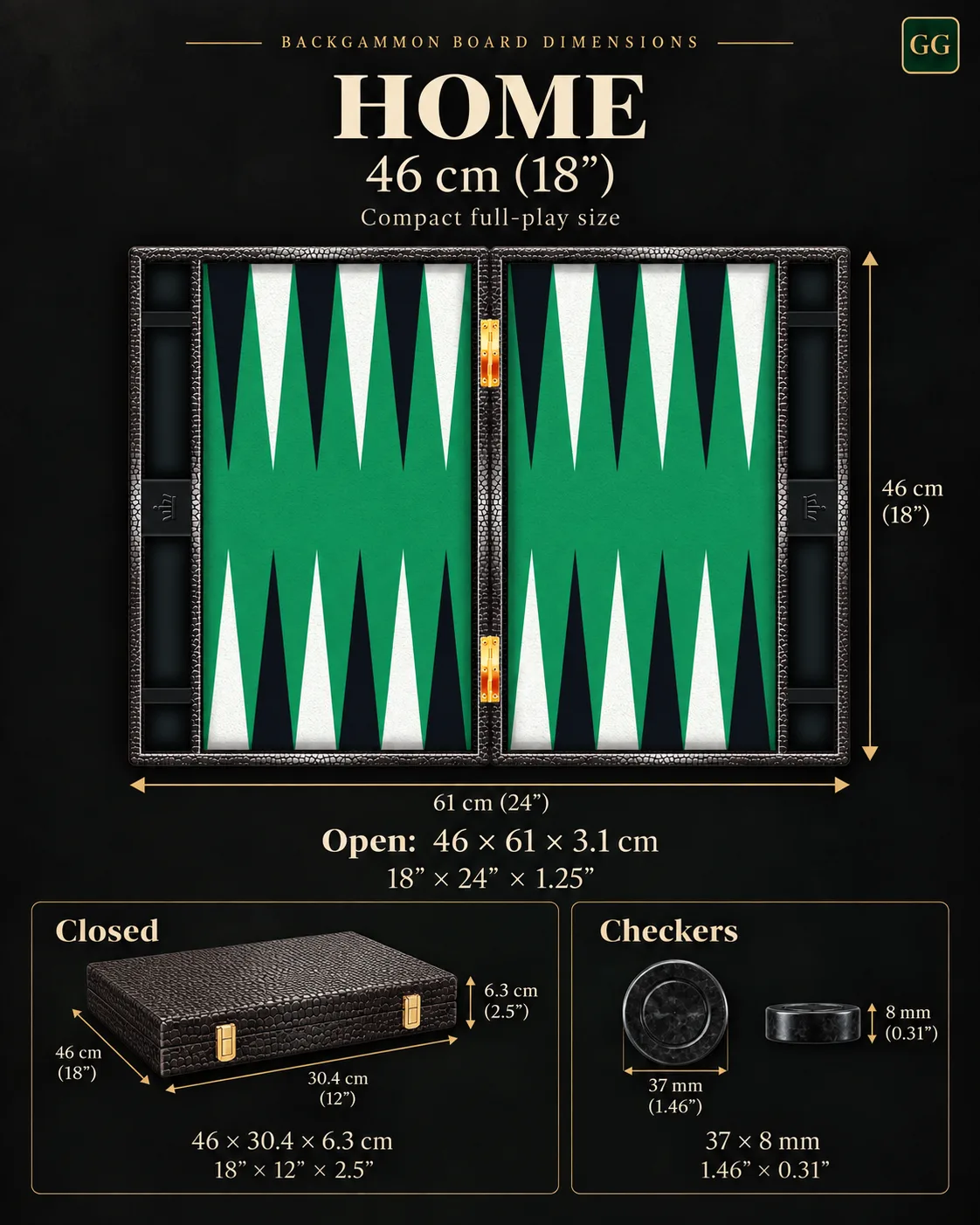
Home Size: 46 cm (18″)
Designed around 37 mm checkers, Home Size gives you much of the feel of a full-size board in a more compact format.
Length
Width
Height
Closed
46 cm (18″)
30.4 cm (12″)
6.3 cm (2.5″)
Open
46 cm (18″)
61 cm (24″)
3.1 cm (1.25″)
Checker size: 37 × 8 mm (1.46″ × 0.31″)
It takes up noticeably less table space than a 21-inch tournament board, while still providing checkers large enough for comfortable regular play.
For a board that will mainly stay at home, sit on a coffee table or be brought to casual club games, 18 inches is an attractive compromise between size and playability.
Home: 46 cm (18″). Compact full-play size.
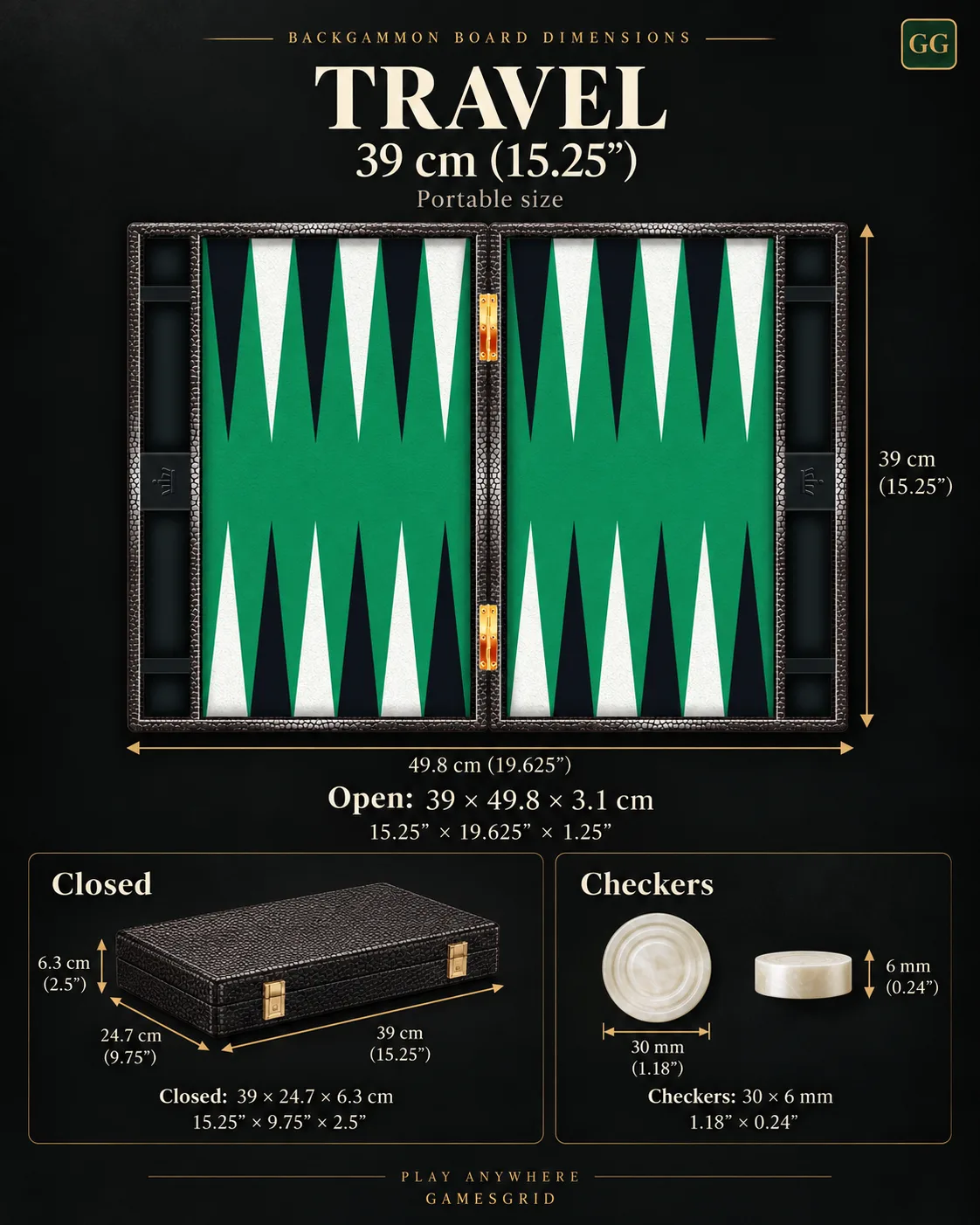
Travel Size: 39 cm (15.25″)
Designed around 30 mm checkers, Travel Size prioritises portability while remaining large enough for proper play.
Length
Width
Height
Closed
39 cm (15.25″)
24.7 cm (9.75″)
6.3 cm (2.5″)
Open
39 cm (15.25″)
49.8 cm (19.625″)
3.1 cm (1.25″)
Checker size: 30 × 6 mm (1.18″ × 0.24″)
This is around the point where portability begins to take priority over playing comfort.
Smaller boards certainly exist, including many sets around 33 cm (13 inches), but the smaller the checker becomes, the more precision is required when moving and stacking pieces.
For holidays, luggage and limited table space, Travel Size works well. For regular long matches, most players will appreciate moving up to Home or Tournament Size.
Travel: 39 cm (15.25″). Portable size.
Which backgammon board size should you choose?
For most players, the choice comes down to how and where the board will be used.
For tournaments and serious regular play:
Choose Tournament Size, around 53 cm (21 inches) with 44 mm checkers.
For regular home play:
Choose Home Size, around 46 cm (18 inches) with 37 mm checkers.
For travel:
Choose Travel Size, around 39 cm (15 inches) with 30 mm checkers.
For maximum presence and playing space:
Choose Championship Size, around 60 cm (23.5 inches) with 50 mm checkers.
If you are buying only one quality backgammon board and portability is not your main concern, the 21-inch Tournament Size is generally the most versatile choice.
Why proportions matter
The number printed on the product page tells you only part of the story.
A well-designed board should have a playing field, points, bar and checker trays that are proportioned around the diameter of its checkers.
That is why checker size is worth checking before buying a board online.
Two boards can both be described as 21-inch sets, yet one may use properly scaled 44 mm checkers while another uses much smaller pieces on a similar-sized case.
The first will usually feel more natural to play.
Do not judge a backgammon board by its outside dimensions alone. Check the checker size as well.
What do the official rules say about board size?
Backgammon tournament rules generally place much more emphasis on the rules of play and the equipment used during competition than on prescribing one exact external board dimension.
As a result, familiar board sizes have developed largely through convention and practical use.
The approximately 21-inch Tournament Size with checkers around 44 mm has become widely associated with serious play because it provides a useful balance between visibility, handling and reach.
So when somebody refers to a "tournament-size backgammon board", they are usually describing a well-established practical format rather than one universally mandated external measurement.
Related
Board setup — where the checkers go once you have the board
Imagine online backgammon as a living world, where you compete against over 500 unique personalities from 120 countries. Every member has their own character, life story, voice, playing strength and style. They compete in the same leagues and tournaments as you, build careers alongside yours and remember the matches, conversations and history you create together.
Learn who they are. Adapt to how they play. Earn their respect, make friends, create rivalries and become part of their story—because they will become part of yours.