Every platform documented in this encyclopedia stands, knowingly or not, on the foundations of FIBS — the First Internet Backgammon Server. Launched in July 1992, FIBS was the first place on the Internet where two people anywhere in the world could sit down to a rated game of backgammon. It invented, improvised or popularised most of what later servers took for granted: online ratings, server-side dice, spectating, chat etiquette, resident bots. Remarkably, it did all of this as a free, non-commercial volunteer project — and it may still be doing so today.
Platform
Active years
Founder/Owner
Model
Status
FIBS (First Internet Backgammon Server)
19 July 1992 – present (2026 status unclear)
Created by Andreas "marvin" Schneider; maintained since 1996 by Patti Beadles
Free, non-commercial, volunteer- and donation-run
Operational status in 2026 unclear (see "Status in 2026")
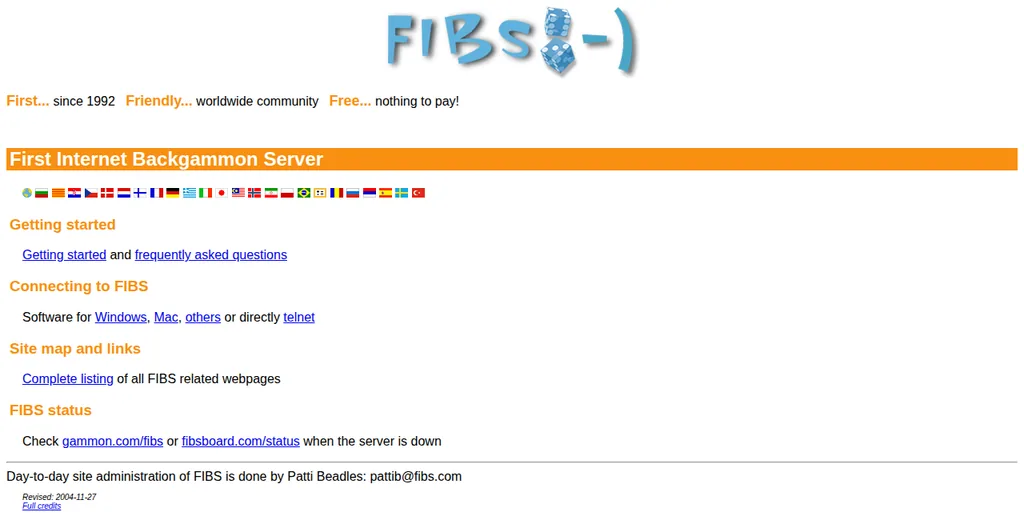
December 2004 — the FIBS homepage, essentially unchanged for decades (Internet Archive).
Launch: 19 July 1992
FIBS went live on 19 July 1992 at 10:56:22 GMT — a timestamp preserved with the reverence early Internet communities gave their founding moments. Its creator was Andreas Schneider, known on the server as "marvin", and the machine originally sat in Aachen, Germany. There had been play-by-email backgammon and local bulletin-board games before, but FIBS was the first dedicated backgammon server on the Internet: a persistent, always-on meeting place rather than an exchange of correspondence.
From Aachen to Chalmers
On 3 December 1993 the server relocated from Aachen to Chalmers in Sweden, where it became reachable by telnet on the now-famous port 4321. Since 1996 FIBS has been maintained by Patti Beadles, whose long stewardship carried the server through the commercial era that its own success helped provoke. Throughout, FIBS remained free and non-commercial, supported by volunteers and donations — a governance model it has never abandoned.
The telnet experience
FIBS in its native form is a telnet service drawing the board in ASCII characters. Players typed commands to roll, move and double, and read the position from a lattice of letters and pipes. It was austere, and it selected for a certain kind of player — but it was also universal: any computer with a telnet client, on any operating system, could reach FIBS.
Graphical relief arrived in 1994 with the first client GUIs, FIBS/W for Windows and MacFIBS for the Macintosh, which spoke the telnet protocol underneath and painted a proper board on top. A long lineage of clients followed: JavaFIBS, FiBzilla, C4FIBS and, on Android, LeptonBackgammon. This open-protocol, third-party-client ecosystem stands in deliberate contrast to the closed proprietary clients of later servers such as NetGammon and the commercial rooms — a fork in design philosophy that shaped the whole online backgammon landscape.
The first backgammon ratings
FIBS was the first server ever to rate backgammon players, using a modified Elo system adapted for match play. The formula became a lingua franca: GamesGrid used a rating of the same family, DailyGammon adopted the FIBS formula outright, and "FIBS rating" remains a recognised unit of backgammon strength decades later. The idea that an online backgammon identity carries a number — and that the number means something — begins here.
Community and moderation
FIBS developed a social architecture that later servers copied wholesale. The shout command addressed everyone, kibitz spoke to the watchers of a match, whisper to fellow spectators only; the gag command let individuals mute abusive users, a decentralised form of moderation. The login banner banned racism and rudeness in plain terms. Volunteers organised tournaments, and in 2002 the community gained an off-server home with the founding of the FIBSBoard forum. It was community management by covenant rather than by paid staff, and for the most part it worked.
GamesGrid is coming back and you can be part of it.
FIBS launched into an extraordinary moment for backgammon. Gerald Tesauro's TD-Gammon — the landmark program that taught itself backgammon by reinforcement learning — was demonstrating that neural networks could reach and exceed world-class play. FIBS became the venue where that revolution met the public: neural-net-derived bots played rated games against humans on equal terms, giving ordinary players their first experience of machine opposition at strength.
A distinctive bot culture grew up around the server. GammonBots, based on the gnubg engine, offered rated games around the clock; MatchDog played strong matches; TourneyBot ran competitions; and RepBot, most curiously, tracked player reputation — an early experiment in community-driven trust infrastructure. The full story of backgammon's neural-network age is told on our bots and AI page.
FIBS and GamesGrid
By the mid-1990s FIBS had proven something commercially important: there was real, sustained demand for online backgammon. The original GamesGrid launched in December 1996 partly on the strength of that demonstration, offering a polished graphical client and paid service where FIBS offered telnet and volunteerism. Many players moved between the two worlds, and the servers' rating systems were cousins. The relationship — and how the same GamesGrid came back — is covered in our history of online backgammon.
Status in 2026: an honest uncertainty
The evidence on whether FIBS is still running is genuinely conflicting. A client project declared FIBS "apparently shut down" in July 2024. Yet the FIBS website itself was loaded live and intact in July 2026, and the UK backgammon federation still lists it among playing resources. It is possible the server has been intermittently reachable, or that the 2024 report reflected a temporary outage; no authoritative statement exists either way. This page therefore states plainly that FIBS's operational status in 2026 is unclear. Given its thirty-plus years of continuous, non-commercial service, we record the uncertainty with respect rather than writing an obituary that may prove premature.
Legacy
FIBS's legacy is simply the field itself. Online ratings, server dice, spectator culture, bot opposition, third-party clients, volunteer moderation: each became standard equipment for MSN Backgammon, GamesGrid, Play65 and every server since. That a free telnet service written in 1992 defined the shape of an entire online game for three decades is one of the quiet triumphs of the early Internet.
Frequently asked questions about FIBS
What was FIBS and when did it launch?
FIBS — the First Internet Backgammon Server — launched on 19 July 1992, created by Andreas "marvin" Schneider. It was the first backgammon server on the Internet and the first to rate players, using a modified Elo system.
Is FIBS still running in 2026?
Its status is unclear. A client project reported it "apparently shut down" in July 2024, yet the fibs.com website was confirmed live in July 2026 and the UK federation still lists it. No authoritative closure statement exists.
Did FIBS cost money?
No. FIBS has always been free and non-commercial, run by volunteers and supported by donations — maintained since 1996 by Patti Beadles.
rec.games.backgammon FAQ (stason.org mirror), on FIBS's launch, relocation and commands.
the-backgammon-guide.com, FIBS page, on the server's history and clients.
LeptonBackgammon GitHub README, containing the July 2024 "apparently shut down" note.
ukbgf.com resources page, which continues to list FIBS.
A new backgammon world is opening.
Imagine online backgammon as a living world, where you compete against over 500 unique personalities from 120 countries. Every member has their own character, life story, voice, playing strength and style. They compete in the same leagues and tournaments as you, build careers alongside yours and remember the matches, conversations and history you create together.
Learn who they are. Adapt to how they play. Earn their respect, make friends, create rivalries and become part of their story—because they will become part of yours.