For nearly a quarter of a century, more people probably played their first online backgammon match through Microsoft's gaming services than through any other single channel. What players variously knew as "Zone backgammon", "MSN Backgammon" or simply "Internet Backgammon" — the game bundled into Windows itself — introduced millions of casual players to live, networked backgammon. This page records the platform's history from its 1996 origins to its staged shutdown between 2006 and 2020.
Platform
Active years
Owner
Model
Status
MSN Backgammon (Internet Gaming Zone / MSN Gaming Zone / MSN Games)
1996–2020 (client-based play)
Microsoft (originally Electric Gravity)
Free play only; no real-money wagering
Closed; MSN Games persists as a casual browser portal
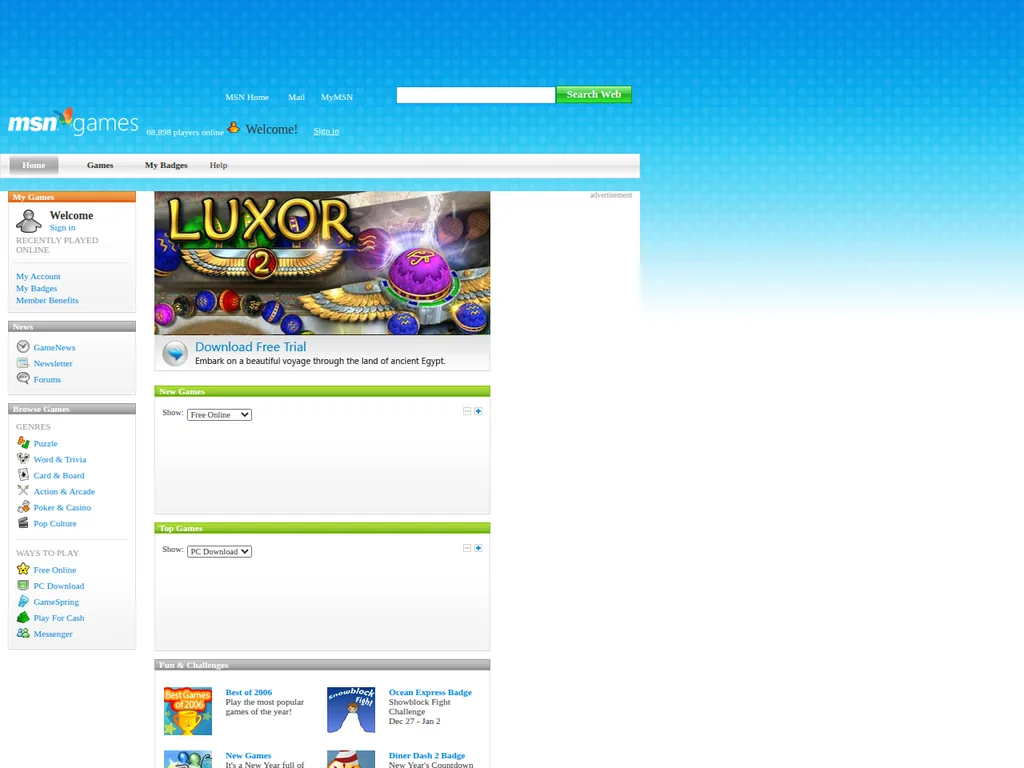
January 2007 — the MSN Games portal, home of Zone backgammon (Internet Archive).
Origins: The Village and Electric Gravity
The service that became the MSN Gaming Zone was born on 7 August 1996 as "The Village", a matchmaking service created by the small studio Electric Gravity, founded by Kevin Binkley, Ted Griggs and Hoon Im. Backgammon was present from the start: it sat among the initial slate of free card and board games alongside Hearts, Spades, Checkers and Bridge. The premise was straightforward — players connected through a browser-launched lobby, found opponents in themed rooms, and played in a lightweight client.
Microsoft acquired Electric Gravity and folded The Village into its online strategy, rebranding the service as the Internet Gaming Zone, later the MSN Gaming Zone, and eventually MSN Games at zone.msn.com. Growth was rapid by the standards of the dial-up era: the service counted some 600,000 users by 1998. Notably, 1996 was also the year the original GamesGrid backgammon server launched (see our history page and the launch manifesto) — the two services represented opposite poles of the early online backgammon world, one a dedicated serious-play server, the other a mass-market casual portal.
Backgammon on the Zone
Within the Zone's card-and-board section, backgammon developed a substantial community of its own. Earlier versions of the service offered selectable rooms, letting players congregate in lobbies by skill level or social preference, with chat and friends features (ZoneFriends) binding the community together. Play was rated on an internal rating scale, and community discussions from the period commonly reference ratings around 1850 as the mark of the site's stronger players.
The Zone also made occasional gestures towards the serious game. It hosted specialty backgammon tournaments featuring world-class players and authors Kit Woolsey and Bill Robertie — a rare bridge between the expert community that had gathered on servers such as FIBS and GamesGrid and the Zone's enormous casual base.
Throughout its life, Zone backgammon was entirely free. Microsoft never attached real-money play to the game — a point worth noting given that much of the online backgammon industry of the 2000s, chronicled elsewhere in this encyclopaedia, went the other way. The present-day GamesGrid, which is unaffiliated with Microsoft and with all platforms described here, follows the same free-of-real-money principle.
Internet Backgammon in Windows (2000)
The platform's greatest reach came not through the website but through the operating system. Beginning with Windows ME and continuing with Windows XP, Microsoft shipped a bundled game called "Internet Backgammon", which matched players automatically via the zone.msn.com service (the service behind the bundled games debuted in 2000). There were no rooms to choose and no visible opponent identity beyond a skill band: the player clicked the icon, and the system paired them with a stranger somewhere in the world.
This design decision — automatic, anonymous matchmaking rather than a social lobby — made Internet Backgammon one of the most-played backgammon products in history almost by accident. Every copy of Windows ME and XP put live online backgammon two clicks from the desktop, years before "casual games" became an industry term. For countless players, the bundled game was their first, and often only, experience of networked backgammon.
GamesGrid is coming back and you can be part of it.
The Zone's backgammon community is also remembered for a less happy reason: a timing flaw known as the "stall bug". The bug was a defect in how the client attributed clock time during cube decisions — the time an opponent spent considering a double was counted against the wrong player. Exploiters learnt that by manipulating this flaw they could run an opponent's clock down and steal wins on time without outplaying anyone.
The scale of the exploitation is a matter of community testimony rather than official record. In January 2007, posts on the newsgroup rec.games.backgammon alleged that roughly half of the players rated above 1850 on the service were using the stall to maintain their ratings. That figure is a community allegation and was never confirmed by Microsoft, but the volume and consistency of complaints in contemporary threads indicate the bug materially damaged trust in the rating list during the service's later years. The episode remains a case study in how a single unpatched timing flaw can corrode a competitive community.
Shutdown in Phases
MSN Backgammon did not die on a single day. Its retirement stretched across thirteen years.
Date
Event
7 August 1996
The Village launches (Electric Gravity); backgammon among the initial games
1998
Service reaches 600,000 users under Microsoft
2000
zone.msn.com service behind the Windows-bundled games debuts
19 June 2006
CD-ROM matchmaking, chat lobbies, ZoneFriends and Member Plus retired
2 July 2019
Microsoft announces the end of the Internet Games
31 July 2019
Windows XP and ME versions of Internet Backgammon go offline
22 January 2020
Windows 7 versions go offline
The first major amputation came on 19 June 2006, when Microsoft retired CD-ROM game matchmaking, the chat lobbies, ZoneFriends and the paid Member Plus programme — effectively ending the Zone as a social destination. The bundled Internet Games, backgammon included, survived this cull and carried on quietly for another thirteen years.
The end came in a 2 July 2019 announcement: Microsoft would shut down the Internet Games. The Windows XP and Windows ME versions went dark on 31 July 2019, and the Windows 7 versions followed on 22 January 2020. Microsoft's stated reasoning was that it had "made the decision to invest in more recent technologies". No archive, migration path or farewell tournament was offered.
MSN Games itself persists today as a casual browser-games portal, and it still offers backgammon — but as third-party browser titles (Backgammon by Masque, and Arkadium's version) unconnected to the old rated, client-based community.
Legacy: The Zoner Diaspora
When a platform of this size closes, its players scatter, and the scattering itself becomes part of backgammon history. Displaced Zone players — "Zoners", as they called themselves — seeded several later communities. The most direct inheritor is SafeHarbor Games, a free community-run site founded in the Zone tradition, which to this day runs a "Zoner's Reunion" event for veterans of the old service. Others drifted to dedicated backgammon servers, including GridGammon and the free servers descended from FIBS, or to the play-money rooms of the commercial sites of the 2000s.
MSN Backgammon's historical significance is scale. It never produced champions the way the dedicated servers did, and its rating list was ultimately compromised by the stall bug, but no other platform put live backgammon in front of so many people. Newcomers wanting to learn the game those millions played can start with our rules and learning pages.
Frequently asked questions about MSN Backgammon
When did MSN Backgammon shut down?
In stages. The social lobby features closed on 19 June 2006; the Windows XP/ME bundled Internet Backgammon went offline on 31 July 2019; and the Windows 7 versions followed on 22 January 2020, after a 2 July 2019 announcement.
Was MSN Backgammon ever a real-money game?
No. Play on the Zone was always free, with no wagering of any kind. (The 2026 GamesGrid, though unaffiliated with Microsoft, operates on the same free-of-real-money model.)
What was the "stall bug"?
A timing flaw that counted an opponent's cube-decision time against the wrong player, allowing exploiters to win on time. A January 2007 rec.games.backgammon thread alleged that around half of players rated above 1850 used it — a community allegation Microsoft never confirmed.
Where did MSN Backgammon players go after the shutdown?
Many "Zoners" migrated to community sites, most visibly SafeHarbor Games, which still hosts a "Zoner's Reunion" event; others joined dedicated backgammon servers.
Wikipedia, "MSN Games" — history of The Village, Electric Gravity, the Internet Gaming Zone and the shutdown timeline.
deluxebackgammon.co.uk, "The demise of Microsoft Internet Backgammon".
BleepingComputer, 2019 — report on Microsoft's 2 July 2019 announcement ending the Internet Games.
rec.games.backgammon thread, 2007 — contemporary discussion of the stall bug and allegations regarding its use among highly rated players.
A new backgammon world is opening.
Imagine online backgammon as a living world, where you compete against over 500 unique personalities from 120 countries. Every member has their own character, life story, voice, playing strength and style. They compete in the same leagues and tournaments as you, build careers alongside yours and remember the matches, conversations and history you create together.
Learn who they are. Adapt to how they play. Earn their respect, make friends, create rivalries and become part of their story—because they will become part of yours.