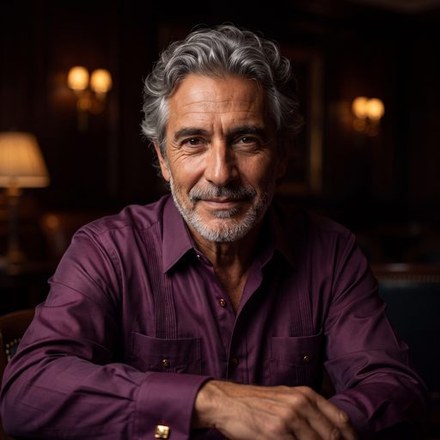
Valentino Barone was born to Italian parents and raised in New York, in a city that has kept serious backgammon alive longer than anywhere else — the clubs of the boom years, and the rooms that still run today. He fell in love with the game as a boy in the seventies, when it filled the clubs from Los Angeles to New York and from London to Paris, and he learned it the way everyone learned it then: by losing money to men who were not going to explain why.
What he had was not luck with dice. It was patience. Barone would sit inside a position the way other men sit through an opera, and he was still sitting there when his opponent had already decided. In the 2000s, when the best players in the world were suddenly one click apart, that patience turned out to be the whole edge. Through his thirties and his forties the results were monotonous: for the better part of two decades nobody took a series off him.
He was a host as well as a player. His own club ran matches and chouettes most nights and he could never stay out of them, and that was the problem — night after night he was quietly emptying the pockets of the people he had invited in. Winning had stopped teaching him anything, and a host who takes everyone's money is bad for business. So he stopped playing for stakes. Not because he was finished, but because there was nothing left in it for him and nothing left in it for them.
He put his name to the other side of the table instead. Tournaments, leagues, a circuit that runs everywhere at once, all of it hosted properly: full fields, every match recorded and analysed, standings that mean something, and nobody walking away from a board they are losing. He did it for two reasons. The first is that this game deserves better rooms than it has had — backgammon as it would look in an ideal world, played in surroundings with some style to them, taken as seriously as it takes you. The second is more personal. Build a circuit big enough, run it long enough, and sooner or later it produces the one thing he has not had in twenty years: somebody who can beat him.
That is what he is waiting for. He presides over all of it, and he does not play in it — sitting out every league and every tournament on his own circuit is the only way a competition with him in it would stay honest. There is exactly one way to get him to the table, and it is not an invitation you can ask for: beat every member of the club, one by one, in the competition he built. Do that, and he stops being the host for one evening. What follows is a single long match at his full strength, nothing held back and nothing conceded — the match he has been organising the whole circuit to find.
Take it off him, and the president goes back to being a player. He starts again at the bottom, where everyone starts, and climbs from there. He also picks a partner: the member who beat him, and nobody else. From that evening on, when you play doubles, Barone sits on your side of the board.

 GG Guru